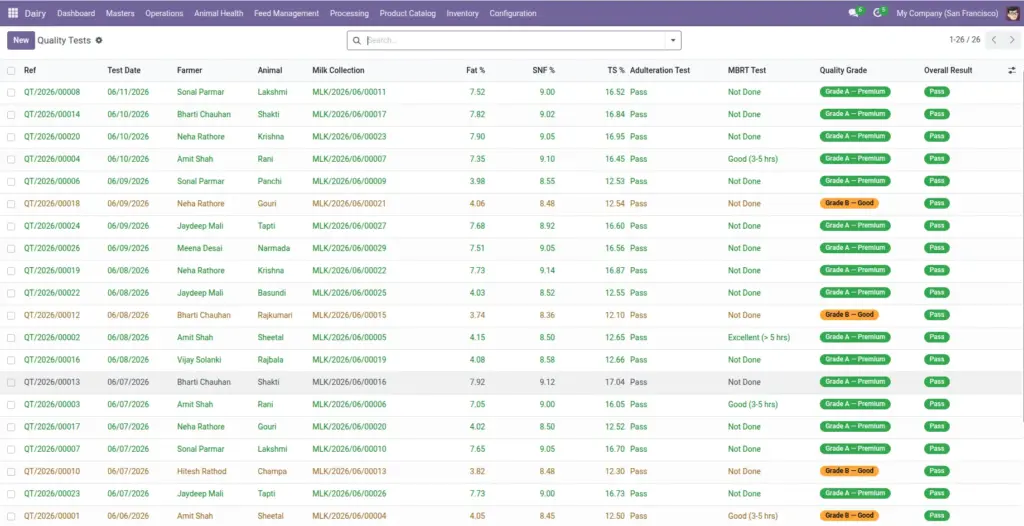
Test milk samples in the lab, detect adulteration, and get automatic quality grades from A (premium) to Rejected.
Overview
Quality Tests record lab analysis of milk samples – fat, SNF, protein, pH, adulteration checks, and bacterial counts. The system automatically assigns a grade (A, B, C, or Rejected) based on the readings.
Quality tests can be created from a milk collection entry or standalone. Passing a test marks the collection as Done; failing rejects the milk.
How It Works
- Go to Dairy → Operations → Quality Tests. Each test links to a farmer, optional animal, and optional milk collection entry.
- Grading rules: Grade A for high fat/SNF (e.g. cow fat ≥ 3.5% and SNF ≥ 8.5%), Grade B and C for lower values, Rejected for adulteration or antibiotic failures.
Step-by-Step Guide
- From a milk collection entry, click Create Quality Test – or create a new test from Quality Tests menu.
- Enter Test Date, Farmer, and lab readings: Fat %, SNF %, pH, temperature.
- Record adulteration test results (water, starch, sugar, urea, detergent, antibiotics).
- Enter microbiology results if available (MBRT, bacteria count).
- Click Pass to approve (collection marked Done) or Fail to reject the milk.
- Review the auto-assigned Quality Grade.
Fields Table
| Field Name | Description | Example |
|---|---|---|
Test Reference |
Auto-generated test number. |
QT/00089 |
Milk Collection |
Linked collection entry (if created from collection). |
MC/00128 |
Farmer |
Farmer whose milk is being tested. |
Ramesh Patel |
Fat % |
Fat content of the sample. |
4.2 |
SNF % |
Solid Not Fat percentage. |
8.6 |
pH Value |
Acidity level. Normal: 6.6–6.8. |
6.7 |
Adulteration Test |
Overall adulteration result: Not Done, Pass, or Fail. |
Pass |
Antibiotics Test |
Detects antibiotic residues. Fail = rejected. |
Pass |
MBRT Test |
Bacterial load indicator (Methylene Blue Reduction). |
Excellent (> 5 hrs) |
Quality Grade |
Auto grade: A (Premium), B (Good), C (Average), Rejected. |
Grade A |
Overall Result |
Pass, Fail, or Pending. |
Pass |
Rejection Reason |
Why milk was rejected (if failed). |
Adulteration Detected |
Field Explanations
Below is a detailed explanation of each field listed in the table above.
Test Reference
Auto-generated test number. For example: QT/00089.
Milk Collection
Linked collection entry (if created from collection). For example: MC/00128.
Farmer
Farmer whose milk is being tested. For example: Ramesh Patel.
Fat %
Fat content of the sample. For example: 4.2.
SNF %
Solid Not Fat percentage. For example: 8.6.
pH Value
Acidity level. Normal: 6.6–6.8. For example: 6.7.
Adulteration Test
Overall adulteration result: Not Done, Pass, or Fail. For example: Pass.
Antibiotics Test
Detects antibiotic residues. Fail = rejected. For example: Pass.
MBRT Test
Bacterial load indicator (Methylene Blue Reduction). For example: Excellent (> 5 hrs).
Quality Grade
Auto grade: A (Premium), B (Good), C (Average), Rejected. For example: Grade A.
Overall Result
Pass, Fail, or Pending. For example: Pass.
Rejection Reason
Why milk was rejected (if failed). For example: Adulteration Detected.
Tips
- Test before marking collection as Done: Use “Send for Quality Check” on collections when lab testing is mandatory at your centre.
- Failed adulteration = automatic rejection: Any adulteration or antibiotic test failure automatically sets grade to Rejected.
Common Mistakes
- Skipping adulteration tests – Without adulteration results, grading relies only on fat/SNF which may not catch watered milk.
- Not recording rejection reason – Always document why milk failed for farmer disputes.
Image