Summarize This Article With AI
Running AI risk assessments for high-risk AI systems is no longer something teams can postpone until late-stage review. If an AI system can affect safety, rights, access to essential services, employment, healthcare, education, or other high-impact decisions, risk assessment has to be part of the AI lifecycle from the start. Strong risk management is not just a legal exercise. It is a practical way of managing AI risks before they turn into system failures, compliance failures, or reputational damage.
This guide explains how to identify high risk AI systems, assess the right potential risks, document evidence, define human oversight, and build a repeatable risk assessment framework that supports both delivery speed and trustworthy deployment.
If you want help building a practical governance workflow
What counts as a high-risk AI system?
A system should be treated as high-risk when failure could materially affect health, safety, fundamental rights, or access to important opportunities and services. The EU AI Act uses a risk-based structure and identifies categories of high risk AI systems that require stronger governance and ongoing risk management.
In practice, you should treat an AI system as high-risk when it can:
- influence employment or hiring outcomes
- affect healthcare, education, credit, insurance, or eligibility decisions
- operate in safety-sensitive environments
- automate or recommend actions with significant customer or citizen impact
- handle sensitive data or run across critical workflows
This matters beyond legal labels. Many AI systems may not fall neatly into one regulation but still create serious AI risk, legal risks, and operational risks. A strong structured approach helps teams decide where to place particular emphasis and where stronger controls are required.
Why AI risk assessments matter
High-risk AI systems rarely fail in only one way. A technically strong model can still create serious problems because of weak controls, poor data governance, missing human oversight, or inadequate monitoring.
A structured risk assessment helps teams:
- identify likely harms before launch
- define where human review is required
- document assumptions and limits
- select controls before incidents happen
- support procurement, audits, and regulatory compliance
- create an evidence trail for approvals and reassessments
Good risk management practices help teams manage risk earlier, reduce blind spots in AI deployment, and strengthen confidence when deploying AI systems.
This is particularly important as organizations expand their use of AI technologies, including generative AI, machine learning systems, and other forms of artificial intelligence and begin deploying AI agents in business workflows.
The core risk categories to assess
A useful risk assessment framework should review several concrete categories of risk instead of collapsing everything into one abstract score.
Safety and reliability risk
Could the system behave incorrectly in a way that causes unsafe outcomes, missed interventions, or faulty recommendations?
Privacy and data risk
Could the system expose, infer, retain, or misuse sensitive data in ways that create data breaches, data leakage, or poor data integrity?
Bias and fairness risk
Could outputs produce systematically different outcomes for specific demographic groups or for different demographic groups that should be treated fairly?
Security and misuse risk
Can the system be manipulated through prompt injection, weak permissions, insecure integrations, adversarial attacks, or other security threats?
Transparency and explainability risk
Can teams explain what the system is for, what it should not do, and what evidence supports important outputs?
Operational risk
Are ownership, monitoring, incident response, rollback, and escalation clear enough to support production use?
Third-party and vendor risk
How much of the system depends on external models, APIs, or tools, and what happens if they change behavior, terms, retention practices, or availability?
These are the kinds of technical risks, operational risks, and associated risks that enterprise teams must assess when building trustworthy AI systems and supporting long-term AI governance.
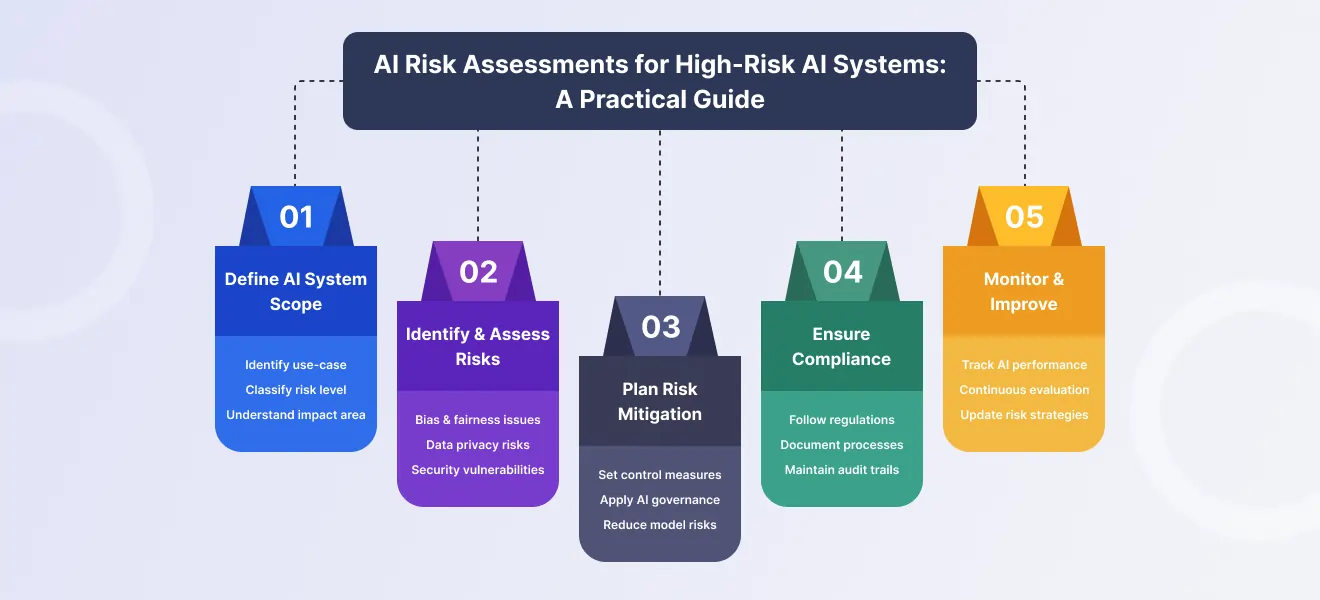
A practical AI risk assessment framework
A strong AI risk assessment process should be simple enough to repeat and detailed enough to act on. This is where a practical AI risk management framework helps.
Step 1: Define the system scope
Document:
- intended use
- prohibited use
- affected users or groups
- key inputs and outputs
- whether the system is assistive, semi-autonomous, or autonomous
This first step sets the context for the entire risk assessment process.
Step 2: Map dependencies
List:
- data sources
- external vendors and APIs
- models used
- tools or actions available to the system
- downstream systems that consume outputs
This helps teams understand the wider AI system’s performance dependencies, where failures may originate, and when a more detailed comparison of AI agents vs chatbots vs automations is needed for a given use case.
Step 3: Identify harms and failure modes
Ask:
- what could go wrong?
- who could be affected?
- how severe would the harm be?
- how likely is it?
- how easy would it be to detect?
This step helps surface potential risks, unacceptable risks, and the broader AI risk landscape before deployment.
Step 4: Score likelihood and impact
Use a practical matrix, such as:
- Impact: low / medium / high
- Likelihood: low / medium / high
- Detectability: easy / moderate / hard
This helps prioritize mitigations based on the organization’s risk tolerance.
Step 5: Define controls
Controls might include:
- approval gates
- role-based access control
- output review
- audit logging
- fallback behavior
- continuous monitoring
- retraining or retesting triggers
- incident response playbooks
This is where teams define risk mitigation strategies, practical mitigation strategies, and the operational controls needed to mitigate risks.
Step 6: Assign owners
Each material risk should have named ownership across:
- business
- engineering
- security/data
- governance/compliance
This supports stronger risk management efforts and clearer accountability across teams, including security teams, security professionals, data owners, and business stakeholders.
Step 7: Record evidence and approval
Capture findings, controls, residual risk, and approval decisions in one place. This supports internal governance, regulatory compliance, and evidence-based AI governance.
Step 8: Reassess after change
Re-run the assessment after:
- model changes
- new data sources
- expanded tool access
- deployment into a new context
- incidents or near misses
This is why risk management for AI systems has to be continuous rather than static.
What evidence should be documented?
Risk assessments only become useful when they are documented well enough to survive review.
A strong evidence pack should include:
- system name and owner
- intended use and prohibited use
- affected workflow and user groups
- risk categories and severity summary
- data sources and access boundaries
- model or provider details
- testing and validation results
- human oversight plan
- monitoring and incident-response plan
- approval records
- review date and reassessment triggers
This kind of documentation supports internal governance, customer due diligence, security questionnaires, and compliance review. It also strengthens operational effectiveness by ensuring decisions are visible and reviewable later.
Human oversight and operational controls
High-risk AI systems should not rely on model quality alone. Human oversight and operational controls are part of the system design.
Human oversight
Define:
- when a person must review the output
- when a person can override the system
- what actions must never be automated without approval
- what happens when confidence is low or a result is disputed
Strong human oversight is central to responsible AI, especially where AI models affect high-impact decisions.
Logging and audit trails
At minimum, log:
- who triggered the system
- which model or version ran
- what data sources were used
- what output was produced
- what actions were taken
- who approved any high-impact action
Monitoring
Monitor:
- quality and error trends
- overrides and complaints
- performance or input drift
- AI security incidents
- latency and operational failures
- incident volume
This supports continuous monitoring, stronger AI security, and faster response to emerging threats.
Security, data, and model risks to watch closely
Many teams focus only on output quality, but strong AI risk management should also consider:
- data integrity problems from weak pipelines
- security vulnerabilities in tools, prompts, or integrations
- adversarial attacks against models and workflows
- misuse of AI tools by internal or external users
- unsafe use of training data
- model drift caused by new data
- hidden weaknesses in AI models, especially large external ones
For machine learning systems, these issues can affect both reliability and compliance. For generative AI systems, they often introduce additional AI security and misuse concerns.
Common mistakes in AI risk assessments
Treating assessment as a one-time document
A static document cannot protect a changing system. Good risk management must continue after launch.
Focusing only on model accuracy
A model can score well offline and still create serious AI risk because of weak permissions, unclear ownership, or poor incident handling.
No clear ownership
If no one owns the risk register, controls decay and reassessments do not happen.
Relying only on vendor assurances
Vendor documentation helps, but it does not replace your own context-specific review of how the system is used.
No reassessment triggers
You need explicit triggers for re-review after model changes, new tools, new data sources, or incidents.
These are common weaknesses in risk management frameworks when teams move too quickly from prototype to production.
AI risk assessment checklist
Use this checklist before launch and after material changes:
- System purpose and prohibited use documented
- High-risk classification decision recorded
- Affected users and stakeholder groups identified
- Data sources reviewed and approved
- Safety, privacy, fairness, security, and operational risks assessed
- Human oversight rules defined
- Logging and audit-trail requirements implemented
- Monitoring thresholds documented
- Incident response path assigned
- Evidence pack completed
- Residual risk accepted by the right owner
- Reassessment triggers defined
This checklist helps organizations prepare for safer AI deployment, align with EU AI Act readiness requirements, and build more consistent governance.
Work with WebbyCrown Solutions
WebbyCrown Solutions helps teams turn AI risk management into an operating process, not just a checklist.
We help with:
- AI system inventory and classification
- risk assessment workshops
- evidence pack design
- approval workflow design
- monitoring and incident-response planning
- integration of governance into delivery
For implementation support, explore
FAQs
What is a high-risk AI system?
A high-risk AI system is one where failure can materially affect safety, rights, access, or important decisions. Under the EU AI Act, certain use cases are explicitly classified as high-risk.
How often should AI risk assessments be updated?
They should be reviewed before launch and whenever there is a material change, such as a model update, a new data source, expanded tool access, or a significant incident.
What evidence should be kept?
Keep a documented record of intended use, data sources, risk scoring, controls, testing, approvals, monitoring plans, and incident workflows.
Do providers and deployers assess risk differently?
Yes. Depending on the context, providers and deployers can have different obligations for high-risk AI systems.
Is the NIST AI RMF mandatory?
No. The AI RMF is voluntary, but it is widely useful as a practical structure for identifying, assessing, and managing AI risks.
What is the difference between AI governance and AI risk management?
AI governance is the broader operating model—policies, approvals, ownership, and controls. AI risk management is the discipline of identifying, assessing, mitigating, and monitoring specific risks within that model.