Summarize This Article With AI
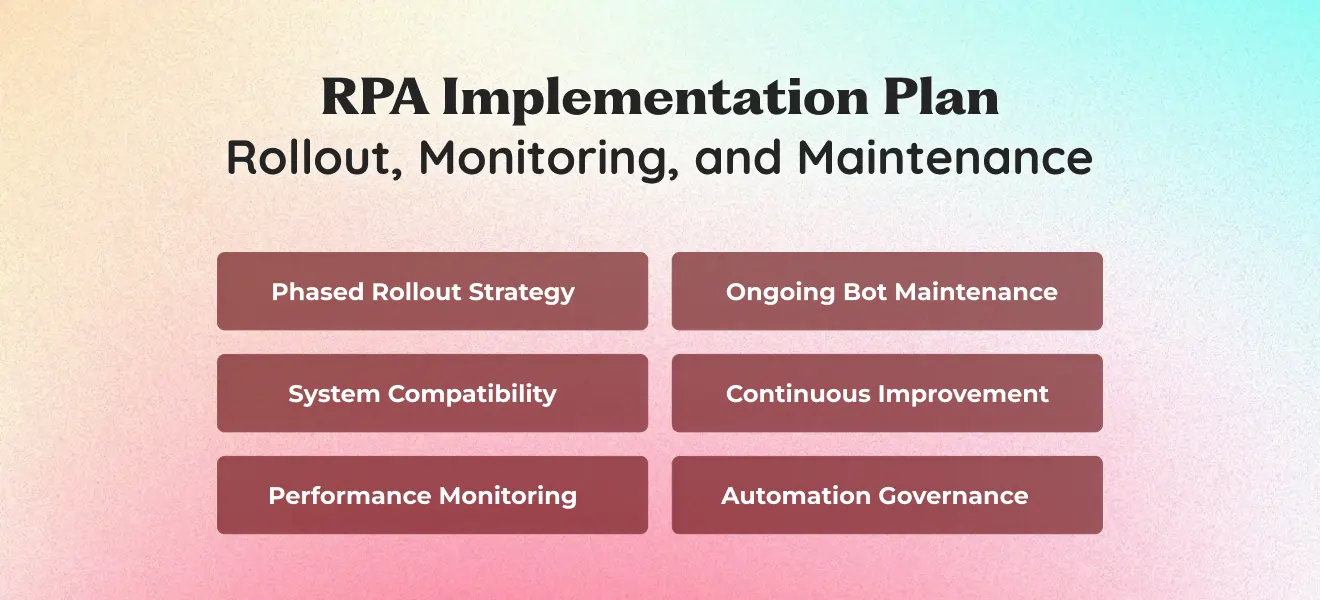
A strong RPA implementation plan does more than explain how to launch bots. It defines how robotic process automation will be rolled out, how performance will be tracked through ongoing monitoring, and how support will be handled after go-live. In real business environments, rpa implementation succeeds only when the organization treats rollout, production visibility, and long-term support as one connected operating model rather than three separate activities.
That is especially important because the rpa journey does not end when a bot first runs in production. A business may choose the right rpa solution, build solid automation for repetitive tasks, and still struggle later if there is no ownership for alerts, exceptions, change requests, or production issues. A good plan connects the business case, rollout, support, and process optimization so automation can deliver cost savings, reduced manual effort, and better outcomes across key business functions.
What an RPA Implementation Plan Should Include
An effective RPA implementation plan starts with clear business goals. Before implementing RPA, the team should understand which business processes are being automated, why they matter, what success looks like, and how the results will be measured. Those goals should cover efficiency, quality, compliance, cycle time, and the broader business needs behind the initiative.
A complete rpa implementation process should also define scope. That means identifying which applications, systems, and handoffs are involved, where exceptions occur, how much human review is required, and whether the target workflow is built on stable interfaces or older legacy systems. Without a defined scope, an rpa project often expands too quickly and becomes harder to support.
A practical plan should include:
- business goals and scope
- rollout phases and timeline
- ownership model
- testing and approval criteria
- success metrics and KPI review
- monitoring dashboards and alerts
- maintenance and support model
- rpa governance, security, and access control
- post-launch optimization plan
This early structure makes successful rpa implementation more realistic because it links the automation build with the people, controls, and processes required to keep it healthy over time.
Discovery Phase and Process Selection
The discovery phase is one of the most important critical stages in the full rpa implementation lifecycle. This is where teams assess whether the target workflow is suitable for process automation and whether the automation will create measurable value after deployment.
The best candidates are usually rule based processes, rules based tasks, and repetitive workflows with stable inputs, clear decisions, and predictable outcomes. These often include administrative tasks, structured data handling, handoffs between applications, and routine updates that create human error when done manually. Teams should also review data quality, exception patterns, and the amount of data extraction required before deciding whether to automate.
During discovery, business stakeholders, IT teams, business analysts, and rpa developers should review:
- process volume
- exception frequency
- application stability
- compliance requirements
- expected operational impact
- likely upfront investment
- expected ROI and long-term maintainability
This stage is also where organizations should avoid automating broken workflows. A poor process becomes a poor automation faster. That is why careful planning and process selection matter so much for rpa success.
Implementation Phases for RPA Rollout
A successful rollout usually works best in phases instead of one large launch. This is one of the most reliable best practices for deploying rpa, because it reduces risk, improves user readiness, and gives teams time to solve issues before the automation reaches a wider audience.
The first phase is validation. At this point, the team confirms process logic, exception paths, application access, and bot feasibility. The second phase is development and testing, where the automation is built, reviewed, and validated against real scenarios. The third phase is pilot rollout, where the bot is released to a smaller environment or limited production group. The fourth phase is broader deployment, where the automation moves into normal operations with support, governance, and monitoring already in place.
A phased rollout plan should include:
- pilot scope
- user acceptance testing
- exception handling readiness
- rollback steps
- production support ownership
- communication plan
- training and change management
This structure improves rpa adoption because users are not forced into a sudden change without context. It also helps teams handle unexpected behavior before the automation reaches more users or more processes.
If you need help planning the technical rollout, bot design, and go-live structure, explore RPA Development Services.
Design Phase, Tools, and Platform Decisions
The design phase turns business requirements into an automation blueprint. This is where teams decide which rpa tools, workflow logic, exception rules, and integration methods will support the rollout. They also define the target rpa platform, review rpa software capabilities, and confirm whether the selected stack fits current scale and future growth.
Choosing the right rpa vendor matters because the platform affects security, governance, integration depth, scalability, and total support effort. Some organizations evaluate every leading rpa platform on cost, ease of use, governance features, support, and compatibility with existing applications. Others choose an rpa vendor based on business constraints, compliance requirements, or the availability of internal talent.
A good platform decision should consider:
- ease of integration with existing systems
- handling of credentials and access control
- reporting and bot activity visibility
- support for scaling and orchestration
- vendor training and enablement
- alignment with long-term automation goals
This phase is not only about software selection. It is also about defining process design, setting standards for rpa developers, and making sure the automation can be supported after launch.
RPA Rollout Strategy and Go-Live Readiness
A rollout strategy should balance speed with stability. Some organizations want fast delivery because they have urgent business pressure or cost targets to meet, but pushing automation live before the workflow is ready can create more disruption than value.
Go-live readiness should be checked before the bot is activated in production. That includes:
- validated workflow logic
- secure credential handling
- tested failure paths
- confirmed access to target applications
- dashboard and alert setup
- business-side support contacts
- training for impacted teams
- clear escalation paths
Even when the automation runs in the background, clear communication matters. Users should know what the bot does, when it runs, what happens during exceptions, and how issues are reported. This is especially important when organizations are adopting RPA for the first time and need to build trust across teams.
RPA Monitoring
RPA monitoring should begin on day one of production use. Once the automation is live, teams need visibility into whether rpa bots are running correctly, whether queues are moving as expected, and whether failure patterns are increasing. Without monitoring, a bot can silently degrade while the business assumes the process is still working.
Monitoring should track both technical and operational performance. Useful measures often include:
- bot uptime
- queue health
- task completion rate
- exception rate
- retry frequency
- SLA adherence
- average handling time
- downtime events
- bot activity across key workflows
Dashboards and automated alerts reduce the delay between failure and response. If one of the software robots stops running, the team should know quickly. If error rates spike, that should be visible before it affects service quality or downstream operations.
Monitoring should also support business reporting. It is not enough to know that the automation ran. The business needs to understand whether the bot still supports the original goals, whether it is reducing operational costs, and whether it is still aligned with current process expectations.
Bot Performance Monitoring and Reporting
Reporting creates accountability after deployment. A bot may look technically stable but still fail to deliver business value if upstream workflows change or if exceptions rise over time. This is why rpa implementation should include regular reporting, not only live dashboards.
A good reporting rhythm may include:
- daily operational monitoring
- weekly exception review
- monthly KPI review
- quarterly optimization review
Useful KPIs include cycle time reduction, error reduction, cost savings, bot utilization, throughput, downtime, and employee productivity. Your uploaded notes also stress that tracking KPIs helps answer deployment questions, validate expectations, and identify optimization opportunities.
This reporting model supports successful rpa implementation because it shows whether the automation is still producing measurable value instead of simply running on schedule.
RPA Maintenance and Support
RPA maintenance should be treated as an ongoing operating function, not a post-launch afterthought. Applications change, website layouts move, business rules evolve, fields shift, and integrations break. Even a strong automation will eventually need updates as processes and systems change.
That is why maintenance and support should be defined before deployment. Teams need to know:
- who owns updates to existing bots
- how incidents are logged
- how fixes are prioritized
- how regression testing is handled
- when change requests require approval
- how support is managed outside core business hours if needed
A strong support model protects rpa bots from gradual decline and helps the organization maintain performance as more automation is added. It also supports scaling rpa because the team has a repeatable model for keeping automations stable as the digital workforce expands.
If you are planning long-term support, process review, and an automation opportunity assessment for new or evolving workflows, it helps to align maintenance decisions with future automation priorities.
Incident Management, Change Management, and Governance
Once bots are live, teams need a clear way to respond to failures and changes. Incident management should define how issues are identified, logged, escalated, and resolved. Common problems include login failures, interface changes, validation errors, timeouts, queue bottlenecks, and application updates that break the bot.
Change management is equally important. A process owner may update a business rule, rename a field, change a report format, or alter how a task moves between teams. If the RPA team is not informed and the change is not tested, the automation may fail unexpectedly. Your uploaded notes also emphasize that change management is essential for workforce acceptance and smooth transitions during rpa adoption.
A mature governance model should include:
- defined bot ownership
- credential and access policies
- audit trails
- release approvals
- disaster recovery planning
- support documentation
- production issue review
- controls for security vulnerabilities and sensitive data
Strong rpa governance helps prevent uncontrolled bot sprawl and makes it easier to scale automation responsibly across departments, similar to how AI agents in business with safe use cases and governance controls rely on clear guardrails and oversight. Your uploaded notes also highlight governance frameworks, stakeholder involvement, and regular metric reviews as core elements of sustainable RPA programs.
KPIs to Track After RPA Deployment
After rollout, teams should track KPIs that reflect both technical health and business value. Monitoring only uptime is not enough. The business also needs to know whether automation is improving performance in meaningful ways across key business processes.
Useful KPIs often include:
- cycle time reduction
- error reduction
- task completion rate
- exception rate
- rework reduction
- downtime
- bot utilization
- SLA performance
- business value delivered
- employee productivity
- customer experience impact
In some environments, these improvements can also influence customer satisfaction, especially when the automation supports service operations, back-office response times, or data accuracy. KPI reviews help teams decide whether a bot should be improved, expanded, or retired, or whether complementary tools like enterprise AI chatbots for customer support could further enhance service outcomes.
When RPA Is the Right Fit
RPA is usually the right fit when the process is rules-driven, repetitive, and dependent on stable user interface actions across existing applications. It works especially well when teams want to automate repetitive work, reduce human error, support a growing digital workforce, and improve outcomes in structured workflows.
That makes RPA a strong fit for many transactional and operational use cases, especially when the goal is to automate routine steps across current applications without major system replacement or full rebuilds through React JS development services. This is often valuable in environments with legacy systems, high-volume administrative tasks, and clear business rules.
However, not every automation need belongs to pure RPA. When the workflow depends on unstructured data, adaptive decision-making, or more complex tasks, the organization may need intelligent automation, cognitive automation, or a broader mix of AI and machine learning capabilities or even enterprise AI agent development services to orchestrate more advanced end-to-end workflows. Your uploaded notes also note that AI can extend RPA for unstructured data and more complex workflows, which is where the boundary between standard RPA and broader automation becomes important.
For a broader comparison of where each approach works best, review this RPA vs AI agents decision guide.
People, Adoption, and Long-Term Scale
Technology alone does not guarantee rpa success. Teams also need adoption, training, and shared ownership. Employees should understand how automation will change the workflow, where human workers remain essential, and how bots and people will work together. Good change planning reduces fear around human jobs and helps users see automation as support rather than disruption.
That is why stakeholder alignment matters across the full rpa journey. Business teams, IT, compliance, process owners, and operations leaders should be involved early. Your uploaded notes also emphasize stakeholder engagement, executive buy-in, workforce training, and transparency about role changes as essential parts of successful rpa implementation.
When organizations do this well, RPA becomes more than a one-off project. It becomes a scalable automation capability that can support more processes, enable sustained growth, and expand a governed set of digital workers across the business.
Common Mistakes in RPA Rollout, Monitoring, and Maintenance
Many RPA programs struggle not because process automation is the wrong choice, but because the operating plan ends at deployment. One of the most common mistakes is assuming that a successful go-live means the work is finished. In reality, production support is where long-term value is protected.
Other common mistakes include:
- unclear goals
- weak pilot planning
- poor process selection
- no monitoring ownership
- no maintenance model
- no change approval path
- weak governance
- no KPI review after rollout
- trying to scale before the first automation is stable
These gaps often lead to bot sprawl, degraded performance, and lower trust. A better plan treats rollout, monitoring, and maintenance as connected responsibilities from the start.
Conclusion
A strong RPA implementation plan connects rollout, monitoring, and maintenance into one practical operating model. The real value of robotic process automation does not come only from building bots. It comes from rolling them out safely, tracking performance consistently, updating them as workflows and systems change, and governing them with clear ownership and support controls.
When these pieces are in place, rpa implementation becomes easier to support, easier to scale, and more likely to deliver long-term value. That is what turns an early rpa project into a reliable automation capability across the broader business.
FAQs
What should an RPA implementation plan include?
An RPA implementation plan should include scope, business goals, rollout phases, testing, ownership, monitoring, maintenance, governance, and post-launch support.
How do you roll out RPA successfully?
Successful rollout usually starts with a pilot, then moves into phased deployment with testing, exception handling, user training, and clear go-live controls.
What should teams monitor after RPA deployment?
Teams should monitor bot uptime, queue health, exception rates, task completion, SLA performance, downtime, and business KPIs after deployment.
How often do RPA bots need maintenance?
RPA bots need maintenance whenever workflows, interfaces, business rules, or connected applications change, and they should also be reviewed on a scheduled basis.
What is the difference between RPA monitoring and RPA maintenance?
RPA monitoring focuses on visibility into live performance, while maintenance focuses on fixes, updates, change handling, and long-term support.
Why do RPA implementations fail after rollout?
They often fail because the operating plan stops at go-live and does not include monitoring ownership, maintenance, governance, or structured change control.
What KPIs matter most in RPA support and maintenance?
Useful KPIs include uptime, exception rate, failure rate, task completion, downtime, cycle time reduction, cost savings, and business value delivered.