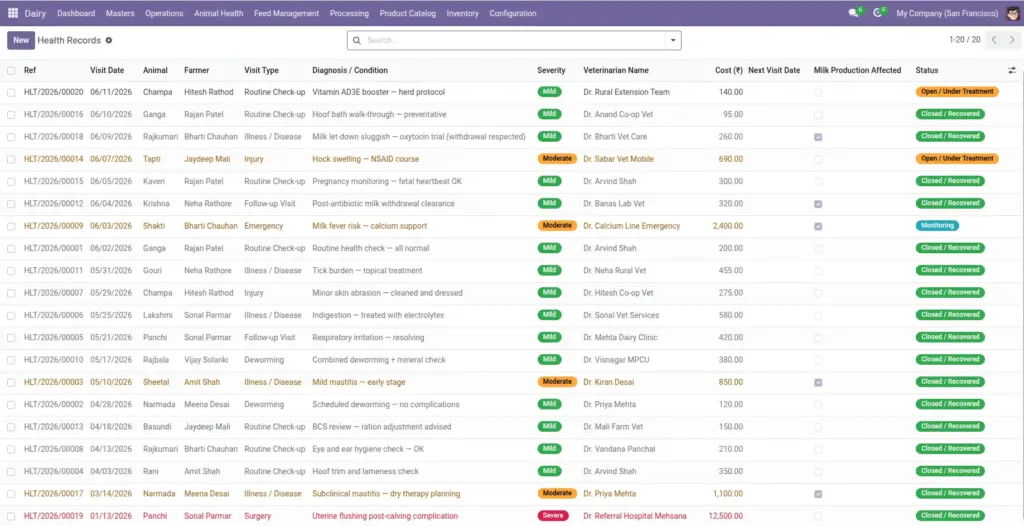
Track vet visits, diagnoses, medicines given, treatment costs, and milk withdrawal periods for every sick animal.
Overview
Health Records document every vet visit – routine check-ups, illnesses, injuries, surgeries, and deworming. Each record includes symptoms, diagnosis, severity, vital signs, medicines prescribed, and follow-up dates.
Importantly, the system tracks milk discard periods – days when milk from a treated animal must not be collected or used due to medicine withdrawal.
How It Works
- Go to Dairy → Animal Health → Health Records. Records link to a specific animal and auto-fill the farmer. You can add multiple medicine lines per visit from your Medicines Master.
- Status flows: Open/Under Treatment → Monitoring → Closed/Recovered.
Step-by-Step Guide
- Go to Dairy → Animal Health → Health Records and click Create.
- Select the Animal and set Visit Date and Visit Type.
- Describe Symptoms, enter Diagnosis, and set Severity.
- Record vital signs: temperature, heart rate, weight.
- Add medicine lines: select from Medicines Master, enter dose, frequency, and withdrawal period.
- Set Milk Discard Days if milk must not be used during treatment.
- Click Close when the animal has recovered.
Fields Table
| Field Name | Description | Example |
|---|---|---|
Reference |
Auto-generated health record number. |
HR/00034 |
Animal |
The animal being treated. Required. |
Gauri |
Visit Date |
Date of vet visit or examination. |
08/06/2026 |
Visit Type |
Routine, Illness, Injury, Surgery, Emergency, Follow-up, Deworming. |
Illness / Disease |
Diagnosis |
Condition identified by the vet. |
Mastitis |
Severity |
Mild, Moderate, Severe, or Critical. |
Moderate |
Body Temperature (°F) |
Normal for cattle: 101–102.5°F. |
103.2 |
Treatment Given |
Summary of treatment provided. |
Antibiotic course 5 days |
Medicines / Treatments |
Line items with medicine, dose, route, withdrawal days. |
Enrofloxacin, IM, 5 days |
Milk Discard Days |
Days milk must not be collected after treatment. |
7 |
Milk Safe After |
Auto-calculated date when milk can resume. |
15/06/2026 |
Status |
Open, Monitoring, or Closed/Recovered. |
Open / Under Treatment |
Field Explanations
Below is a detailed explanation of each field listed in the table above.
Reference
Auto-generated health record number. For example: HR/00034.
Animal
The animal being treated. Required. For example: Gauri.
Visit Date
Date of vet visit or examination. For example: 08/06/2026.
Visit Type
Routine, Illness, Injury, Surgery, Emergency, Follow-up, Deworming. For example: Illness / Disease.
Diagnosis
Condition identified by the vet. For example: Mastitis.
Severity
Mild, Moderate, Severe, or Critical. For example: Moderate.
Body Temperature (°F)
Normal for cattle: 101–102.5°F. For example: 103.2.
Treatment Given
Summary of treatment provided. For example: Antibiotic course 5 days.
Medicines / Treatments
Line items with medicine, dose, route, withdrawal days. For example: Enrofloxacin, IM, 5 days.
Milk Discard Days
Days milk must not be collected after treatment. For example: 7.
Milk Safe After
Auto-calculated date when milk can resume. For example: 15/06/2026.
Status
Open, Monitoring, or Closed/Recovered. For example: Open / Under Treatment.
Tips
- Always set withdrawal days on medicines: The system calculates “Milk Safe After” date so collection staff know when to resume milk from that animal.
- Do not collect milk during withdrawal: Milk from animals under antibiotic treatment must be discarded for food safety.
Common Mistakes
- Forgetting milk discard period – Collecting milk during withdrawal can contaminate your entire batch.
- Not updating animal status – Set animal status to Sick when creating a health record for visibility.
Image