Summarize This Article With AI
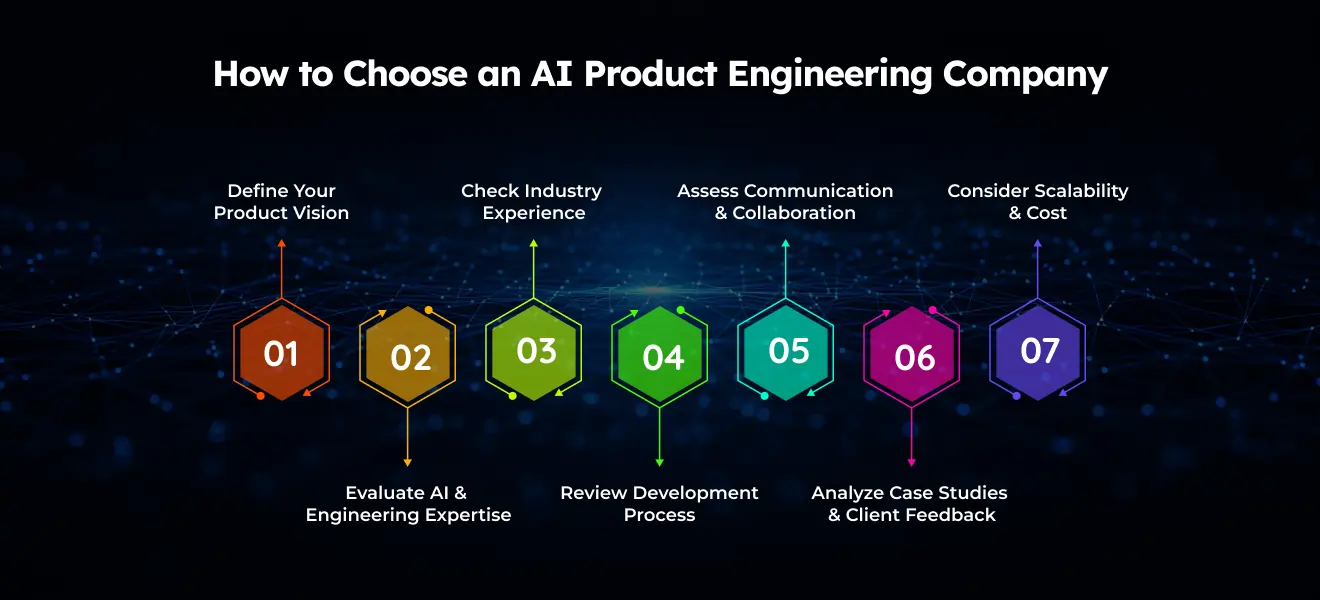
Choosing the right AI partner is one of the biggest factors in whether an idea becomes a working product or stays stuck as a demo. How to choose an AI product engineering company is not only a question about code quality or model choice. It is a question about business fit, product engineering discipline, data engineering maturity, security, deployment readiness, and long-term support. A strong AI development company should help you move from business problem to production system with clear communication, reliable delivery, and measurable outcomes.
That matters because modern AI development is not limited to one type of system. A company may need generative AI for internal assistants, predictive analytics for forecasting, computer vision for inspection, or natural language processing for search, extraction, and support automation. The best partner is the one that can match the right AI capabilities to the right business need, design scalable solutions, and support the full lifecycle of AI implementation across real workflows.
A lot of vendors can build attractive prototypes. Far fewer can design AI systems that survive in live systems, integrate with business operations, protect sensitive data, and continue improving after launch. That is why this guide focuses on what actually matters when comparing an AI product engineering company, not just what sounds impressive in a pitch.
What an AI Product Engineering Company Actually Does
An AI product engineering company does more than train a model or build a proof of concept. It combines software development, data work, model development, integration, deployment, monitoring, and product thinking to create usable AI solutions.
A capable team usually works across these areas:
- problem discovery and product scoping
- data engineering and data pipeline design
- machine learning and AI models selection
- application architecture and workflow design
- front-end and back-end software development
- cloud infrastructure, deployment, and monitoring
- optimization, retraining, and continuous improvement
That is the difference between an agency that only experiments with AI tools and a real product engineering partner. Product engineering means the company understands how to turn artificial intelligence into a usable system that supports decision making, automation, or customer experience in production.
Why Choosing the Right AI Development Company Matters
A weak vendor choice creates expensive problems later. Many companies choose a partner based on cost, presentation quality, or broad claims about innovation. Then they discover the vendor cannot handle project complexity, data readiness, security reviews, or production deployment.
A strong AI development company can help you:
- reduce execution risk
- improve operational efficiency
- shorten time to value
- connect models to real workflows
- avoid wasted spend on low-value AI projects
- support better long-term AI adoption
A weak partner often does the opposite. It may overpromise on model accuracy, ignore data preparation, underestimate integration work, and disappear after launch. That usually raises operational costs instead of lowering them.
If your goal is to leverage AI in a practical way, the company you choose should be able to explain not only what it will build, but how it will deliver business value, how it will protect your data, and how it will support the system after it goes live, ideally through end-to-end machine learning development and consulting services.
How to Evaluate an AI Product Engineering Company
The best way to evaluate a vendor is to treat the decision like both a technical decision and a business decision.
1. Start with business understanding
A good partner should begin with the business problem, not with the model. It should ask what decision needs to improve, what workflow needs to change, and what success looks like.
Look for a company that can explain:
- the business objective
- the user workflow
- the expected outcome
- the main risks
- the likely delivery path
If the conversation starts and ends with model buzzwords, that is usually a bad sign; many teams benefit from guides on how to hire an AI developer in 2026 to better evaluate individual skills behind those claims.
2. Verify technical depth across the right AI domains
Not every project needs the same technical stack. A capable company should show real depth in the domains relevant to your use case, such as:
- machine learning
- deep learning
- natural language processing
- computer vision
- predictive analytics
- recommendation systems
- generative AI
- search and retrieval systems
For example, an ecommerce use case may involve customer analytics, recommendation logic, and conversion prediction. A manufacturing use case may need object detection, anomaly detection, or predictive maintenance. A support use case may need NLP, prompting vs RAG vs fine-tuning choices, and retrieval pipelines. The partner should explain which machine learning algorithms, architectures, or AI models fit the problem and why.
3. Assess data engineering maturity
Many buyers underestimate how important data engineering is. In practice, data work often determines project success more than model choice.
A strong partner should know how to:
- assess historical data
- clean and structure data
- handle missing or inconsistent records
- build reusable data pipelines
- support training, evaluation, and monitoring
- work with both structured and unstructured inputs
If a vendor talks only about modeling and ignores data pipelines, feature preparation, and data quality, that is a major red flag. Strong AI delivery depends on strong data foundations.
4. Check product engineering and integration capability
An AI model only creates value if it fits into a usable product or business system. That means the company should be able to handle:
- APIs and backend services
- web or mobile interfaces
- workflow integration
- internal tools
- dashboards and review systems
- CRM, ERP, or other business software integration
This is where product engineering matters. The partner should be able to build the system around the model, not just the model itself.
5. Look for deployment and MLOps readiness
Many AI prototypes fail because the partner cannot support production deployment. Ask how they handle:
- model versioning
- testing
- rollback
- monitoring
- drift detection
- retraining
- logging
- alerting
If the company cannot explain how it will maintain live systems, optimize model behavior, and support ongoing releases, it is not ready for serious production work.
6. Review security, compliance, and privacy standards
This is essential. A capable AI company should be ready to discuss:
- data security
- data privacy
- access controls
- encryption
- auditability
- retention policies
- environment isolation
- relevant compliance needs
Ask directly whether they follow industry standard security practices and how they handle regulations such as GDPR, HIPAA, SOC 2, ISO 27001, or other industry-specific obligations, using structured EU AI Act readiness checklists or similar frameworks where applicable. This matters even more in healthcare, finance, legal, enterprise SaaS, and other specific industries with tighter controls.
For organizations evaluating vendor risk, governance standards, and rollout controls, AI governance consulting for enterprise AI delivery can help connect partner selection with real operational guardrails.
7. Check team composition
Effective AI work is multidisciplinary. Strong projects usually need a mix of:
- ML engineers
- data scientists
- data engineers
- backend engineers
- product managers
- designers
- DevOps or MLOps engineers
- QA specialists
A vendor that relies on one or two generalists for everything may struggle once the project grows.
8. Evaluate communication and delivery process
A good partner should have:
- clear communication
- realistic timelines
- milestone-based delivery
- discovery or paid planning phases
- strong project management
- transparency on risks and assumptions
The right company should help you make informed choices, not just sell certainty.
9. Require proof of real-world delivery
Ask for:
- relevant case studies
- examples of real world applications
- production outcomes
- references
- domain experience
- evidence beyond concept demos
A company that has shipped AI in environments similar to yours will usually make better decisions faster.
10. Confirm long-term support
Do not overlook support after launch. A serious partner should provide ongoing support for:
- bug fixes
- monitoring
- retraining
- performance tuning
- cost optimization
- model updates
- workflow changes
Long term support matters because model quality, data patterns, and user behavior change over time.
What Good Delivery Looks Like
A strong vendor does not jump straight into model building. Good delivery usually starts with discovery, moves into scoped validation, then into implementation, integration, monitoring, and iterative improvement. That means the company is thinking in terms of product lifecycle, not just technical output.
In practice, good delivery looks like:
- a clear discovery phase
- realistic assumptions about data quality
- phased validation before full rollout
- strong documentation and communication
- deployment planning from day one
- monitoring and support after launch
For a broader view of how strong delivery should progress from concept to release and iteration, review the AI product engineering lifecycle.
Questions to Ask Before You Hire
Here are the most useful questions to ask any AI product engineering company:
- How do you validate the business problem before you start building?
- How do you evaluate data readiness and pipeline quality?
- Who owns data engineering, model development, and MLOps?
- What is your deployment process for live production systems?
- How do you handle model drift and ongoing monitoring?
- What does post-launch support include?
- How do you manage privacy, compliance, and security reviews?
- Can you show similar AI projects delivered in production?
- How do you estimate timeline, budget, and risk?
- What are the most likely failure points in this project?
The answers will usually tell you more than a polished deck ever will.
Red Flags to Avoid
There are some warning signs that should make you pause.
Vague accuracy claims
Be cautious if a vendor makes sweeping accuracy promises before reviewing your data. A partner that says it can guarantee 99% accuracy without understanding the data, workflow, or edge cases is usually selling confidence, not delivery quality.
Cost-first positioning with weak capability
Choosing based only on price often leads to poor outcomes. Low-cost delivery may exclude the exact work that makes AI successful, such as data engineering, monitoring, model retraining, or secure deployment.
No real production evidence
Many vendors can show concept demos. Far fewer can show production case studies with measurable outcomes.
Weak answers on security and privacy
If the company cannot explain how it handles data privacy, compliance, and auditability, that is a serious issue.
No post-launch ownership
If support stops at handoff, your internal team may inherit more complexity than expected.
Generic “AI” positioning
If the company cannot explain whether your use case fits machine learning, generative AI, rules, analytics, or hybrid systems, it probably lacks real solution depth.
How to Compare Vendors Side by Side
A useful comparison framework includes many of the same tradeoffs you would consider in an AI agent vs chatbot vs automation decision guide, such as:
- business understanding
- technical fit
- domain fit
- data engineering maturity
- deployment readiness
- security and compliance strength
- communication quality
- support model
- references
- pricing and commercial fit
The best development company is rarely the one with the biggest service menu. It is the one that fits your business problem, constraints, data reality, and growth path.
Best-Fit Scenarios by Use Case
Different companies are stronger in different types of AI work.
Startup MVP
Look for speed, clear scoping, and the ability to make smart tradeoffs without overengineering.
Growth-stage SaaS
Look for scalability, model monitoring, cloud deployment, and product-led integration.
Enterprise modernization
Look for governance, security, cloud architecture, system integration, and long-term delivery discipline.
Customer-facing AI products
Look for strong UX, reliability, guardrails, and production monitoring, especially if you expect to run enterprise-grade AI chatbots across multiple channels.
Operations and analytics use cases
Look for strength in predictive analytics, forecasting, optimization, and business workflow integration, ideally grounded in proven AI agent use cases, risks, and governance controls.
Specialized AI use cases
If your project involves computer vision, object detection, image recognition, image processing, facial recognition, recommendation systems, or domain-specific models, verify that the partner has shipped those types of applications before, including production-ready enterprise AI agents and automation services where relevant. The same applies to complex domains such as autonomous vehicles, robotics, or industrial intelligence.
What Post-Launch AI Support Should Include
After launch, a strong partner should help you:
- monitor model and system performance
- track drift and workflow issues
- retrain or refresh models
- manage costs across cloud computing environments
- improve throughput and response times
- adapt the system as the business grows
- maintain optimal performance
This is where many AI vendors fall short. They deliver the build, but they do not help the system evolve. In practice, strong AI delivery requires continuous improvement.
What a Good AI Product Engineering Partner Looks Like
A good partner:
- understands the business problem first
- has real delivery depth in AI development
- treats data engineering as core work
- knows how to build production-ready systems
- follows strong security and privacy practices
- communicates clearly
- supports deployment and monitoring
- offers ongoing support after launch
A weak partner:
- leads with buzzwords
- skips discovery
- underestimates data work
- avoids detailed security questions
- cannot show relevant delivery experience
- stops at the prototype
Conclusion
If you want to know how to choose an AI product engineering company, start by looking beyond demos and beyond cost. The right partner should combine machine learning, product engineering, deployment discipline, security, and business understanding. It should be able to build AI powered systems that fit real workflows, support decision making, and continue improving after launch.
The strongest choice is not the company with the most dramatic claims. It is the one with the clearest thinking, the strongest delivery discipline, and the best fit for your business problem.To evaluate, design, and scale production-ready AI products with the right delivery model, explore AI Product Engineering Services.
FAQs
What does an AI product engineering company do?
An AI product engineering company helps businesses move from discovery and data readiness to model development, software integration, deployment, and long-term optimization of AI systems.
How do you choose an AI product engineering company?
Choose one by evaluating business understanding, technical depth, data engineering, security, deployment maturity, communication quality, and long-term support.
What should you ask an AI development company before hiring?
Ask about discovery, data readiness, model monitoring, privacy, deployment, team composition, references, and post-launch support.
What red flags should you avoid in an AI vendor?
Red flags include vague performance claims, weak security answers, no data engineering depth, no production proof, and no post-launch support.
Does an AI partner need MLOps and deployment experience?
Yes. Without deployment, monitoring, and support experience, many AI projects fail to reach stable production use.
What should post-launch AI support include?
It should include monitoring, drift detection, retraining, optimization, issue resolution, and ongoing business alignment.
How do you compare AI product engineering companies?
Compare them by business fit, technical fit, data engineering maturity, deployment readiness, security, communication, references, and support model.