Summarize This Article With AI
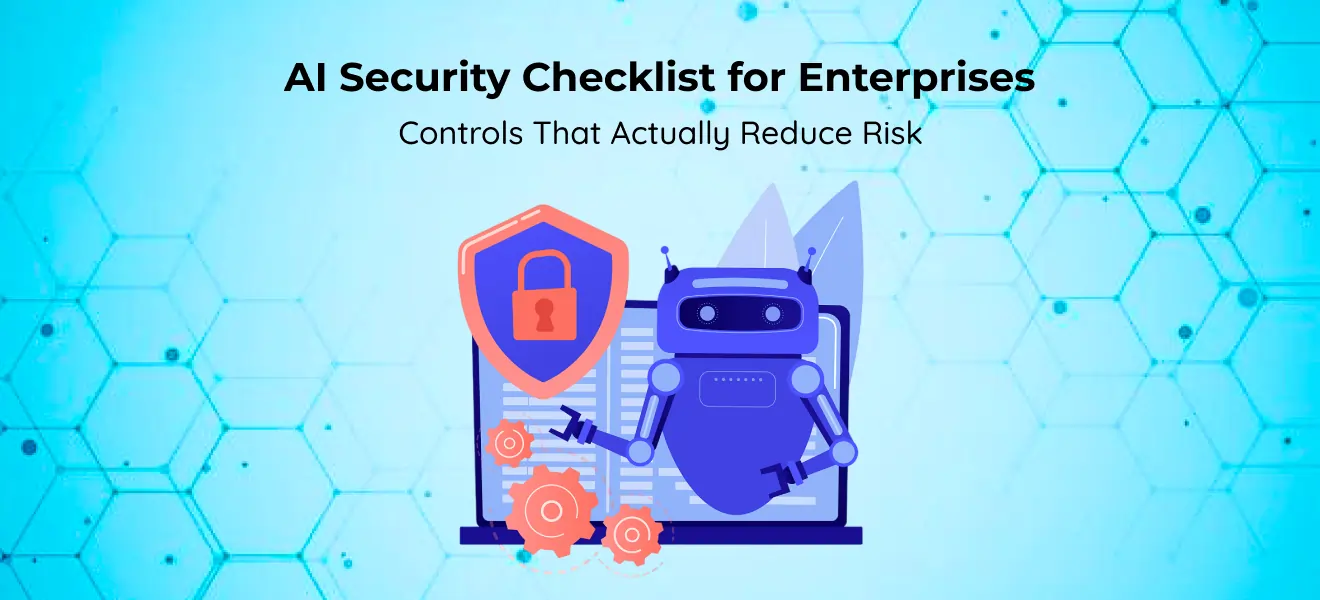
An AI security checklist for enterprises should focus on the controls that reduce real operational risk, not just policy language. As organizations expand AI usage across copilots, generative AI workflows, internal AI systems, AI models, and connected AI tools, the biggest failures usually come from weak governance, poor data access controls, insecure handling of prompts and outputs, and limited visibility after deployment. A practical checklist helps security teams protect sensitive data, strengthen security posture, and reduce the chances of compliance failures, data breaches, or unsafe AI behavior in production.
This matters because enterprise AI risk is broader than model accuracy. Once teams start integrating AI into business operations, the risk surface includes training data, inference data, data pipelines, third-party tools, agent actions, user interactions, logs, outputs, and downstream automations. That is why strong AI security is not one control. It is a layered system of governance, access controls, monitoring, review, and incident response that works across the full AI lifecycle.
Why Enterprises Need an AI Security Checklist
Many enterprises already have cloud security, identity management, and software review processes. The problem is that AI-specific risks do not always fit neatly inside those older controls. A new AI tool can gain new permissions, connect to new systems, ingest critical data, or start handling regulated data without triggering the same review discipline applied to traditional software. That creates gaps in data protection, compliance enforcement, and operational oversight.
An enterprise checklist creates consistency. It gives security, legal, privacy, engineering, and compliance teams a shared review model for AI projects. It also helps the business answer basic but important questions: Which AI systems exist? Who owns them? What sensitive information do they touch? Which models or third-party tools can access enterprise data? What monitoring tools are in place? What evidence supports audit readiness? Those are the questions that actually reduce risk.
1. Establish Governance and Ownership First
The first control is governance. Every enterprise should maintain clear governance structures for AI, not informal ownership. That means defining who approves AI use, who owns each system, who reviews risks, and who is responsible for policy enforcement after launch. A cross-functional governance model should include security, legal, compliance, privacy, IT, and business stakeholders so AI decisions are not made in a silo, and many teams formalize these expectations using an AI governance policy template with practical controls. Your uploaded guidance also recommends an AI governance committee with cross-functional representation and clear accountability.
A strong governance checklist should require:
- a named owner for every production AI system
- documented use cases and business purpose
- a risk review before deployment
- a record of connected systems, users, and datasets
- defined escalation paths for security incidents
- regular re-review as AI usage expands
If you need help turning checklist controls into approvals, ownership models, and operational workflows, explore AI Governance Consulting Services.
2. Inventory All AI Systems, Models, Tools, and Integrations
You cannot secure what you cannot see. Enterprises should maintain a live inventory of all AI systems, AI models, generative AI tools, third-party services, agent frameworks, API integrations, and data connections. This includes internal tools, vendor products, shadow usage, pilots, and embedded features inside existing platforms. Inventory is one of the most practical controls because it exposes where AI usage is growing and which systems may create new security risks or compliance gaps.
The inventory should capture:
- system name and business owner
- model or provider used
- connected datasets and data access
- whether the system can access sensitive data
- deployment status
- user groups
- approval status
- logging and monitoring coverage
- regulatory or contractual constraints
This is especially important when teams adopt new AI tools quickly. Many security failures happen because tools are integrated before the enterprise understands what data they can reach or how they behave in practice.
3. Classify Data and Restrict Sensitive Data Exposure
Enterprises should assume that AI can inadvertently expose sensitive data unless strong controls are already in place. A proper checklist must include data classification, so the organization knows which information is public, internal, confidential, restricted, or regulated. It should also define what data can and cannot be processed by specific AI tools or models. Your uploaded source specifically recommends automated sensitive-data detection, masking before data reaches providers, and extra protections for confidential or restricted material.
This section of the checklist should cover:
- sensitive data protection for PII, PHI, financial data, trade secrets, and intellectual property
- policies to prevent sensitive data leakage
- controls to prevent users from sending restricted files into external AI tools
- end-to-end encryption for sensitive workflows
- review rules for regulated data
- protections to protect sensitive information in prompts, uploads, outputs, and logs
If an AI system touches customer records, employee records, product designs, contracts, or internal research, data classification and masking are not optional. They are foundational.
4. Enforce Access Controls, RBAC, and Strong Authentication
Least privilege matters even more in AI because AI systems often touch many systems at once. Enterprises should implement strong access controls for models, prompts, logs, datasets, tools, and administrative functions. That includes role based access control, multi factor authentication, SSO, environment separation, and explicit approval for privileged model operations. Your uploaded notes also recommend Zero Trust principles, RBAC, and identity-based controls such as SSO and MFA to secure AI platforms.
A good enterprise checklist should verify:
- who has AI system access
- which users can modify prompts, models, or routing logic
- which tools or plugins can be called
- whether developers, analysts, and admins have separate privileges
- how encryption keys and secrets are managed
- whether user authentication and audit logs are enforced consistently
Weak access control is one of the fastest ways to turn a useful AI deployment into a security incident.
5. Protect Training Data, Data Pipelines, and Model Integrity
Enterprise AI security is not only about runtime behavior. It also includes protecting the inputs used to build and update systems. Training data can be poisoned, corrupted, mislabeled, or modified in ways that silently weaken model reliability. Model artifacts can also be stolen, reverse engineered, or manipulated if storage and access policies are weak. Your uploaded notes explicitly warn about data poisoning, model theft, and the need for immutable training-data provenance plus real-time monitoring of data pipelines.
This checklist area should include:
- provenance records for training and validation data
- validation steps for data integrity and quality
- restrictions on who can change datasets or model artifacts
- encryption and secure storage for models and related data
- monitoring for unusual updates or access patterns
- review of any external or vendor-provided training inputs
If your enterprise is fine-tuning or extending machine learning models, protecting model integrity should be treated like protecting source code or production secrets, especially for high-impact applications such as an enterprise knowledge assistant built on secure RAG architecture.
6. Secure Prompts, Outputs, and Application-Layer Workflows
One of the biggest differences between enterprise AI and older application security is the application layer around prompts, retrieved context, tools, and generated content. Prompts, uploaded files, retrieved content, and tool responses should be treated as untrusted input. Enterprises should add controls that reduce prompt injection, insecure output handling, and accidental disclosure through AI outputs. Your uploaded notes specifically call for AI-specific incident response around prompt injection and behavioral monitoring for hallucinations and bias.
This part of the checklist should require:
- prompt and input filtering where appropriate
- output validation before actions are triggered
- human review for high-risk outputs
- restrictions on tool use and downstream actions
- logging for prompt-driven changes, tool calls, and output exceptions
- extra review for systems that can read from or write to sensitive applications
This matters even more for AI agents and workflow automation. Teams building action-taking systems often need AI agent development with audit logs and access controls so permissions, tool scope, evidence trails, and approval logic are designed into the application layer from day one; mature programs also define safe AI agent use cases, risks, and governance controls across different business functions.
7. Implement Continuous Monitoring and Threat Detection
Enterprise AI is not secure just because it passed an initial review. Systems change over time. Permissions expand. Integrations change. New users appear. Models drift. That is why continuous monitoring is one of the controls that actually reduces risk. Your uploaded notes recommend real-time monitoring of AI systems, automated alerts for unusual access patterns or sensitive-data exposure, and comprehensive visibility into AI usage across the organization.
A strong monitoring program should include:
- centralized logs for model activity, prompts, outputs, and API events
- monitoring tools for unusual access, abuse patterns, and failed policy checks
- proactive monitoring of sensitive output behavior
- alerting for high-risk actions or permission changes
- visibility for security teams into which teams are using which AI tools
- monitoring across inference endpoints, data pipelines, and connected systems
This is how enterprises move from reactive cleanup to real threat detection.
8. Build Policies, Evidence, and Audit Readiness
Policies only reduce risk if they are connected to actual controls and evidence. Enterprises should document how AI tools may be used, what approval steps are required, which data can be processed, and which controls must be enforced for regulated or high-risk use cases. They should also maintain evidence that those policies are applied consistently. Your uploaded notes emphasize that AI compliance is not uniform, that controls must be tailored to the system, and that logs and audit trails are required for compliance and forensics.
This checklist section should verify:
- written AI usage and security policies
- mapping to compliance frameworks and compliance requirements, including upcoming regulations such as the EU AI Act readiness checklist for product teams
- evidence of consistent enforcement
- logs for approvals, exceptions, access, and usage
- records that support audit readiness
- review processes for emerging compliance gaps or compliance failures
For teams designing policy workflows, evidence standards, and exception handling, use the AI policy management playbook.
9. Review Vendor, Model, and Supply Chain Risk
Enterprises often focus on internal controls and ignore external dependencies. But many AI failures happen through providers, plugins, data connectors, or model ecosystems that sit outside direct enterprise control. A practical AI checklist should include vendor and supply chain review for:
- model providers
- API vendors
- hosting platforms
- plugin ecosystems
- connectors to third-party tools
- external data sources
This is where enterprises should ask:
- What data leaves our environment?
- What provider logging occurs?
- What retention policy applies?
- What contract terms govern data use?
- What happens if the provider changes capabilities or permissions?
Third-party risk is especially important when generative AI tools are adopted quickly by individual teams without full legal and security review.
10. Prepare AI-Specific Incident Response
Standard incident response plans are not enough. Enterprises need playbooks for AI-specific risks, including prompt injection, model manipulation, sensitive output leakage, poisoning events, unsafe agent actions, and model abuse. Your uploaded notes directly recommend AI-specific incident response plans, tabletop exercises, and regular simulations of AI security incidents.
This section of the checklist should include:
- defined AI incident types
- response owners across security, privacy, legal, and engineering
- playbooks for prompt injection, data theft, output abuse, and unauthorized access
- escalation paths for severe events
- tabletop exercises and adversarial testing
- procedures for rollback, shutdown, or access restriction
This is one of the clearest differences between a paper policy and actual enterprise readiness.
Common Gaps That Leave Enterprises Exposed
Most enterprise AI failures do not come from missing one advanced security measure. They come from basic gaps that compound over time. Common examples include:
- no inventory of AI tools and models
- weak ownership and governance structures
- poor visibility into AI usage
- loose data access controls
- no classification for sensitive or regulated data
- missing review of agent permissions or lacking the right AI developer hiring strategy and skills checklist to build secure systems
- no continuous monitoring
- incomplete logs and weak evidence collection
- no AI-specific incident response plan
- assuming model accuracy equals security
These are the areas that create real exposure, including data breaches, compliance failures, and avoidable security incidents.
Checklist Implementation: What to Do First
If your enterprise is early in AI governance, start in this order:
- Create an inventory of all AI systems, models, tools, and integrations.
- Assign owners and establish cross-functional governance.
- Classify data and define what AI can and cannot process.
- Enforce RBAC, MFA, and least-privilege access controls.
- Add monitoring, logging, and alerting for high-risk events.
- Build AI-specific incident response playbooks.
- Review vendors, third-party tools, and compliance evidence.
- Reassess regularly as AI adoption expands.
That order reduces risk faster than starting with scattered policy updates or tool-level fixes alone.
Conclusion
An AI security checklist for enterprises should help the organization reduce real risk across the full AI lifecycle, from governance and data access to outputs, agents, monitoring, and incident response. The most effective controls are usually not the flashiest ones. They are the disciplined ones: ownership, inventory, classification, least privilege, logging, review, and continuous monitoring.
When enterprises apply those controls consistently, they are better able to maintain compliance, reduce security incidents, protect sensitive information, and keep AI adoption aligned with business goals instead of exposing the organization to unmanaged risk.
FAQs
What should an enterprise AI security checklist include?
It should include governance, ownership, AI inventory, data classification, access controls, prompt and output safeguards, monitoring, incident response, and compliance evidence.
Which AI controls reduce risk fastest?
Usually inventory, ownership, sensitive-data filtering, RBAC, MFA, centralized logging, and AI-specific incident response.
How is AI security different from normal application security?
It includes traditional security concerns, but also AI-specific risks such as prompt injection, model manipulation, unsafe outputs, data poisoning, and agent misuse.
Why is prompt injection a major enterprise risk?
Because it can change system behavior through untrusted input and influence downstream actions, which makes it a major risk in LLM and agent-based applications.
What controls should enterprises apply to AI outputs?
Output validation, human review for high-risk scenarios, policy checks, logging, and restrictions on downstream actions.
How do you govern AI agents across the organization?
Use centralized inventory, ownership, least-privilege access, observability, logging, approval boundaries, and AI-specific incident handling.
How often should enterprise AI systems be reviewed?
Continuously through monitoring, and formally whenever permissions, tools, data connections, or deployment conditions change.