Summarize This Article With AI
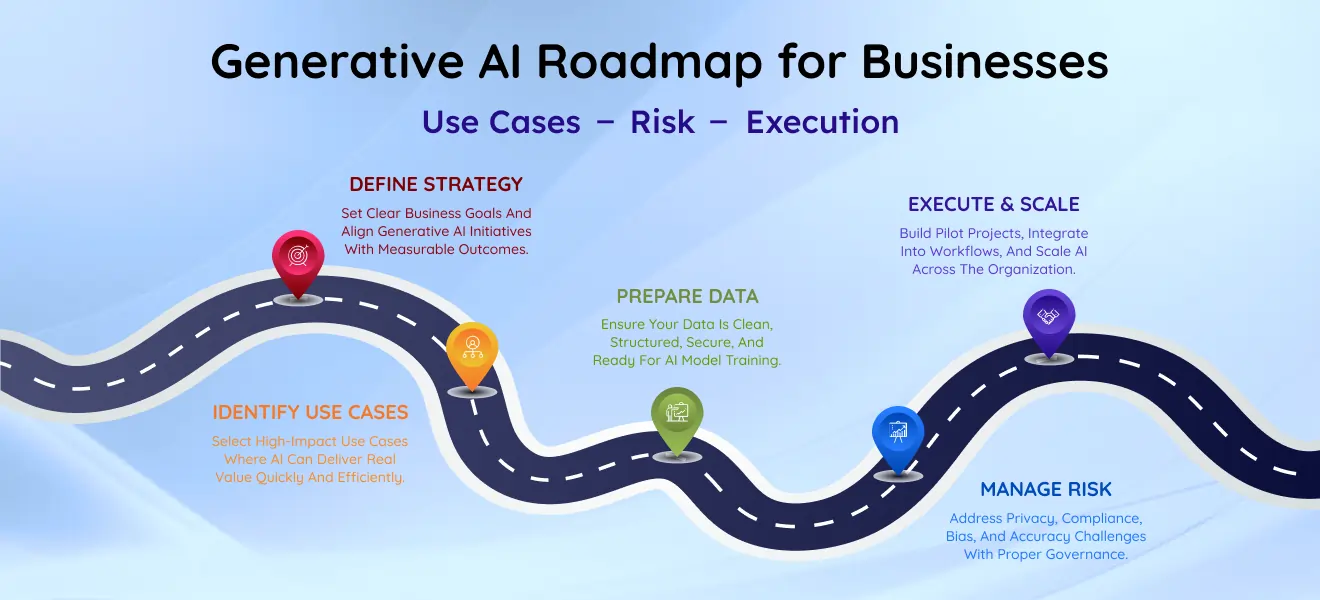
A generative ai roadmap for businesses gives organizations a structured way to move from experimentation to implementation. Instead of launching disconnected pilots, businesses need a practical ai roadmap that aligns generative ai with business strategy, measurable business outcomes, and long-term ai adoption goals. A strong roadmap helps business leaders assess readiness, prioritize the right use cases, define ai governance, choose the right ai models, and plan ai deployment in a way that creates real business value rather than short-lived excitement.
If your team needs help shaping priorities, readiness, and implementation phases from the start, explore Generative AI Consulting Services.
Generative AI is no longer just a trend limited to marketing experiments or chatbot demos. Businesses are using gen ai to improve content generation, automate support workflows, enhance internal knowledge access, speed up software delivery, assist with data analysis, and create more personalized customer experiences. At the same time, the technology brings real planning challenges around privacy, model risk, cost control, data security, and organizational change. That is why the most effective roadmap is not only about selecting new ai tools. It is about connecting artificial intelligence to the right operating model, the right business priorities, and the right controls from the beginning.
Why Businesses Need a Generative AI Roadmap
Many organizations begin with scattered ai initiatives. One team experiments with large language models, another tests drafting tools, and a third explores ai agents for workflow support. Without a shared roadmap, those efforts often remain disconnected, which makes it harder to prove ROI, govern risk, or scale what works. A business roadmap helps leaders avoid this problem by giving teams a common framework for prioritization, ownership, security, and measurement.
A good generative ai roadmap helps businesses answer practical questions early. Which use cases are worth piloting first? Which areas of the business have the right data and process maturity? Which ai capabilities should stay experimental, and which are ready for production workflows? What risks need to be governed before expansion? These are strategic questions, not just technical ones.
This roadmap mindset matters because generative ai can create real competitive advantage when used well, but it can also waste budget if businesses pursue too many ideas at once or try to scale before they are ready.
AI Readiness Assessment
Before a company commits to implementation, it needs an AI readiness assessment. This is where businesses examine their current ai maturity, internal skills, technology stack, workflow readiness, and governance posture. A strong readiness assessment should review more than infrastructure. It should also evaluate the quality of internal content, the availability of usable data, the maturity of approval processes, and whether the organization has enough ownership to support live ai applications after launch.
Data readiness is especially important. Businesses often want fast wins from generative ai solutions, but the quality of outputs depends heavily on data quality, access controls, and the maturity of data governance. If internal documents are outdated, fragmented, or inaccessible, even powerful pre trained models and advanced models will struggle to create reliable results.
This stage should also examine:
- whether internal teams can support data ingestion and data processing
- whether workflows involve mostly structured inputs or large amounts of unstructured data
- whether the business has enough technical support for integration, monitoring, and policy enforcement
- whether internal teams understand the limits of model behavior, prompt engineering, and responsible deployment
Without that foundation, businesses often move into pilots too early and then struggle when they try to scale.
How to Prioritize Generative AI Use Cases
Not every generative ai application belongs on the roadmap at the same time. Businesses need a prioritization model that balances value, feasibility, risk, time-to-impact, and data readiness. The best early use cases are usually the ones that solve clear real world problems, fit current business needs, and can be measured without a huge implementation burden.
High-potential candidates often include:
- knowledge assistants for internal teams
- support copilots for service operations
- drafting tools for emails, documentation, and social media posts
- workflow support for repetitive internal requests
- coding or QA assistance
- reporting and summarization tools
- customer-facing virtual assistants
These kinds of ai solutions often create fast wins because they support everyday workflows and have clear ownership. Businesses should evaluate each use case against business value, effort, required approvals, expected ROI, and whether humans can review outputs before high-impact decisions are made.
This prioritization step matters because businesses do not need every possible generative ai capability on day one. They need the right use cases first.
Governance, Risk, and Responsible AI
A serious roadmap must include ai governance from the beginning. Businesses cannot treat privacy, policy, and risk as later-stage add-ons. When generative ai is connected to internal workflows, customer content, or decision support, leaders need clear rules for who can use it, what data can be accessed, how outputs are reviewed, and how risk is managed.
That means planning for:
- risk assessment and risk management
- privacy and regulatory compliance
- human review for sensitive outputs
- approval paths for production release
- auditability and logging
- safeguards for hallucinations, unsafe outputs, or data leakage
This is especially important because businesses are not only deploying drafting tools anymore. They are increasingly exploring ai agents, process automation, and customer-facing ai systems. As those systems gain more influence over workflows, weak governance can directly affect business risk, customer trust, and operational stability.
For teams defining policy, review workflows, and guardrails, AI governance consulting for rollout controls can help turn roadmap decisions into practical operating controls.
Data, Models, and Architecture Decisions
A good roadmap should explain how the business will use internal data and which kinds of generative ai models fit the use cases being prioritized. In some cases, the right answer is a general-purpose model built on large language models. In others, businesses may need retrieval-based systems, specialized workflows, or carefully scoped AI services that are easier to govern.
This section of the roadmap should define:
- what internal data will be used
- how data will be cleaned, governed, and refreshed
- whether general pre trained models are sufficient
- when the business should consider retrieval instead of fine-tuning
- how the solution connects to business workflows and existing ai products
- how teams will manage integration, monitoring, and support
It is also useful to explain where broader machine learning, machine learning ml, and deep learning fit. Not every business challenge needs GenAI. Some needs are still better handled by traditional data science, predictive ML, or structured automation. A clear roadmap distinguishes these paths instead of forcing every problem into one technology category.
For example, a company may use machine learning or other ai technologies for forecasting and structured predictions, while using generative ai for drafting, summarization, search, or assisted workflow execution. In niche cases, businesses may also consider specialized areas like image generation, synthetic data, or research workflows, though these should be included only when they clearly support business priorities.
From Strategy to Build
A roadmap creates direction, but businesses also need a clear path from strategy into delivery. That means turning prioritized use cases into solution architecture, operating controls, workflow design, and implementation plans that can actually be executed by product, engineering, and operations teams. This is where roadmap work becomes much more than a strategy document.
For a broader view of how planning connects to delivery, review the AI product engineering lifecycle.
Where GenAI Fits in Business Operations
For most organizations, the strongest roadmap is not about replacing everything with AI. It is about improving the right workflows. Businesses are finding value where generative ai helps with:
- support and service operations
- internal search and knowledge access
- drafting and content generation
- coding assistance
- onboarding and training
- workflow summarization
- repetitive coordination work
In more advanced cases, businesses may explore industry-specific use cases such as fraud detection, policy support, research assistance, claims processing, or regulated documentation review.
That said, businesses should not chase every new technology trend. The roadmap should focus on the ai use cases that are realistic, measurable, and aligned with current strategy. That is how GenAI begins to drive innovation in a controlled way rather than becoming a source of scattered experimentation.
Phased Implementation Roadmap
A successful generative ai roadmap usually moves in phases instead of trying to scale everything immediately. This phased approach helps businesses manage risk, prove value early, and build confidence across stakeholders.
A practical roadmap often follows these phases:
1. Assess
Review ai maturity, business readiness, governance posture, internal data conditions, and current workflow pain points.
2. Prioritize
Choose the most valuable use cases based on effort, risk, strategic value, and likely time-to-impact.
3. Pilot
Launch limited, measurable pilots with defined approvals, user groups, and success metrics.
4. Implement
Move proven pilots into broader workflow integration with architecture, controls, and support ownership.
5. Govern
Strengthen policies, model oversight, review processes, compliance controls, and escalation paths.
6. Scale
Expand what works across departments, additional workflows, and higher-value ai initiatives.
ROI, KPIs, and Business Outcomes
A roadmap is incomplete without a measurement plan. Businesses need to define how they will track success before implementation begins. The most useful roadmap KPIs often include:
- time saved
- reduced manual effort on repetitive tasks
- faster turnaround
- improved accuracy or quality
- better internal adoption
- improved service outcomes
- lower cost-to-serve
- broader cost efficiency
- clearer evidence of business outcomes
The right KPIs depend on the use case. For example, a support assistant may focus on response quality and agent productivity. A drafting assistant may focus on speed and review time. An internal knowledge assistant may focus on time saved and workflow efficiency. The goal is to tie generative ai to measurable business value instead of vague innovation claims.
People, Skills, and Change Management
Technology alone does not create ai success. Businesses also need people, training, and clear communication. Teams must understand how GenAI will support their work, where human review remains necessary, and how new tools fit into daily operations. This is especially important when the roadmap introduces new workflows or changes long-standing responsibilities.
That is why change management should be part of the roadmap itself. Organizations should invest in AI literacy, tailored training, and clear guidance on what GenAI should and should not be used for. Businesses that handle this well are more likely to achieve long term success because adoption becomes part of the operating model rather than a side effect of a technical rollout.
When to Work With a Consulting Partner
Many organizations benefit from outside support when they need to move faster, reduce risk, or align internal stakeholders around one roadmap. A consulting-led approach can help with:
- readiness assessment
- use case prioritization
- governance design
- model and architecture decisions
- pilot planning
- rollout support
- operating model design
This can be especially valuable when internal teams are still building foundational knowledge, comparing ai models, or deciding how generative ai should fit into the broader business strategy.
Common Mistakes Businesses Make
Common roadmap mistakes include:
- starting with tools before business goals
- skipping readiness work
- selecting too many use cases at once
- ignoring governance until later
- using poor-quality internal data
- trying to scale ai before the first pilots prove value
- assuming model capabilities automatically solve business problems
- underestimating change management and ownership
Another major mistake is confusing impressive demos with a scalable operating model. A roadmap should not be a list of interesting tools. It should be a practical plan that connects generative ai solutions to real business priorities, support structures, and measurable outcomes.
Conclusion
A strong generative ai roadmap for businesses helps organizations move from experimentation to structured adoption with more clarity, less risk, and better results. The most effective roadmaps connect readiness assessment, use case prioritization, ai governance, model and architecture choices, phased implementation, and ROI into one planning framework. When businesses take that approach, generative ai becomes easier to deploy, easier to govern, and more likely to create measurable business value across real workflows.
FAQs
What is a generative AI roadmap for businesses?
A generative AI roadmap for businesses is a structured plan that defines how an organization will assess readiness, prioritize use cases, manage governance, implement solutions, and measure ROI.
How do businesses start a generative AI roadmap?
Most businesses start by assessing readiness, identifying high-value use cases, defining governance requirements, and creating a phased plan for pilots and implementation.
What should a generative AI readiness assessment include?
A readiness assessment should include data quality, access controls, workflow maturity, infrastructure, internal skills, governance expectations, and security requirements.
How do you prioritize generative AI use cases?
Businesses should prioritize use cases based on business value, feasibility, data availability, risk, implementation effort, and expected time-to-impact.
Why is AI governance important in a generative AI roadmap?
AI governance helps manage privacy, compliance, model risk, approval paths, and responsible AI use so adoption can scale more safely.
What KPIs should businesses track for generative AI?
Useful KPIs may include time saved, cost reduction, quality improvement, workflow efficiency, adoption rate, response speed, and measurable business ROI.
When should a business use generative AI consulting services?
A business should consider consulting support when it needs help with readiness assessment, prioritization, governance, architecture planning, pilot design, or enterprise rollout.