Summarize This Article With AI
To help your products appear in ChatGPT Shopping, first confirm how your store can provide reliable product information. Eligible Shopify stores can make products available through Shopify Catalog without a separate ChatGPT feed setup. Other merchants may pursue OpenAI’s approved-partner product-feed route and keep public product pages accessible to supported search crawlers. In every case, maintain accurate titles, variants, images, prices, availability, and policies. None of these steps guarantees that a product will be recommended or displayed.
Key takeaways
- Shopify sellers: Check Shopify Catalog and ChatGPT eligibility before buying an integration or trying to upload a separate feed; eligible products are available through Shopify’s existing channel.
- Other merchants: OpenAI documents a direct product-feed path, but onboarding is currently limited to approved partners. Do not confuse a published feed specification with automatic access.
- Catalog accuracy wins over tricks: Use stable item identifiers, complete variants, current prices and stock, trustworthy descriptions, and accessible product images and landing pages.
- Discovery is not checkout: A product can be recommended without a merchant being enabled for checkout inside ChatGPT. Shopify’s documented flow takes buyers to the merchant’s own online checkout.
- Measure carefully: Check catalog completeness and referral traffic, record problems, and improve the source data. Visibility and attribution are not guaranteed or fully observable.
A merchant can have a fast, attractive online store yet still provide ambiguous information to an AI-powered product-discovery system. A shopper may ask for “a lightweight carry-on backpack with a laptop compartment under $100,” while a merchant’s listing only says “Urban Pack.” A better product record explains dimensions, capacity, materials, compatibility, the correct price and the exact variant available. This guide focuses on merchant readiness and product discovery in ChatGPT, not on creating a search engine for your own site or allowing an agent to make purchases.
1. Understand How Products Reach ChatGPT Shopping
ChatGPT can present products when a conversation signals shopping intent. Its shopping experience may use structured merchant data, public product information and other available sources. OpenAI says results are selected for relevance to the shopper’s request rather than being paid shopping ads; ads, where present, are separate. Results can still be incomplete, and product information can change between discovery and checkout. See OpenAI’s explanation of shopping results.
There is no single universal “submit my store” button for every ecommerce platform. The practical route depends on how a merchant’s catalog becomes available to OpenAI.
| Route | Who it applies to | What to do first | Important limit |
|---|---|---|---|
| Shopify Catalog integration | Shopify stores meeting the relevant eligibility requirements | Review Agentic Storefronts eligibility, catalog status and product data in Shopify Admin | Availability for discovery does not guarantee that any particular item is shown |
| Direct product feed through OpenAI's commerce integration | Merchants approved for product-feed onboarding | Apply for access; follow OpenAI's current supported schema and feed-delivery instructions | Documentation is public, but onboarding is currently for approved partners |
| Public product-page discovery | Stores with accessible, accurate public product pages | Check crawl access, page content, links, product data and site reliability | Crawling alone does not ensure inclusion in ChatGPT Shopping or a product carousel |
This distinction matters for budgets and implementation plans. A merchant using Shopify should not assume it must purchase a special ChatGPT-discovery plugin. A WooCommerce or custom-commerce merchant should not assume that publishing a CSV file instantly registers its entire catalog with OpenAI. In both cases, distinguish eligibility, data availability, result selection and purchase completion.
Discovery, shopping research, and checkout are different
Product discovery helps shoppers compare relevant items and click through for details. Shopping research may assemble more involved comparisons using merchant product data and public sources. Checkout is a separate transaction flow, with its own eligibility, security and platform requirements. The broader mechanics of agents and transaction permissions are covered in WebbyCrown’s guide to agentic commerce; the immediate task here is to publish accurate, eligible product information.
A good rollout should begin with discoverability and data correctness, not with a promise of an embedded checkout button. OpenAI’s product discovery announcement explains why the Agentic Commerce Protocol (ACP) has expanded to support structured product discovery.
2. For Shopify Stores: Check Eligibility and Product Data First
According to Shopify’s guidance for selling on ChatGPT, the ChatGPT channel is available by default to eligible stores through Shopify Catalog. OpenAI also states that individual eligible Shopify merchants do not need to perform a separate direct-feed setup for this catalog integration. This does not mean every Shopify store, product or region is automatically eligible.
Step 1: Check the actual eligibility requirements
Shopify currently documents these requirements for its ChatGPT selling channel: the store must sell to customers in the United States, although the merchant may be located elsewhere; products must qualify for Shopify Catalog; the merchant must accept applicable Agentic Storefronts terms; and the store’s terms, privacy, and return/refund policies must be completed. Shopify also notes that B2B-only products are not supported through this agentic-storefront route and that prohibited products cannot appear through ChatGPT product discovery.
If your store sells internationally, check the current requirements in Shopify Admin rather than assuming your entire global catalog is available through every AI shopping surface. Platform eligibility and market coverage can change, so the platform’s live documentation should take precedence over an old screenshot or generic SEO checklist.
Step 2: Review Shopify Catalog and the Agentic section
In Shopify Admin, review Sales channels > Agentic and the Shopify Catalog status available to your store. Confirm whether the store and relevant products are eligible and inspect the catalog data mapping if that option is shown. If the account is marked ineligible, follow the reason and remediation shown by Shopify rather than installing unverified apps.
Shopify’s catalog-discovery guidance explains that eligible product data may be available to supported AI channels through Shopify Catalog. It also notes that opting out of Shopify Catalog access for a specific channel may not hide products discoverable through other public-web sources.
Step 3: Improve the product records that shoppers will compare
Review a representative sample of top sellers, recently changed items and high-return products. Titles should identify the actual item, not just a campaign name. Descriptions should state the facts that affect fit: dimensions, materials, compatible devices, size information, intended use, included components, safety qualifications when relevant and significant restrictions. Product images should show the item being sold, including variant-specific differences when meaningful.
For example, “Travel backpack” provides limited decision value. “28 L travel backpack, fits a 15-inch laptop, 45 x 30 x 18 cm, water-resistant fabric” gives shoppers verifiable criteria. Use that longer description only if those specifications are true; do not invent features to match conversational searches.
Shopify advises merchants to include relevant legal disclosures early in descriptions. Never hide a material limitation behind promotional copy, especially for products with health, age, compatibility or safety considerations.
Step 4: Reconcile price, inventory and variants
A size-M item that is sold out should not inherit the price and stock of size-L. If a separate ERP controls inventory, define which system owns stock and when updates reach Shopify. Map stable variant IDs or SKUs across systems, reconcile mismatches, and verify the price shoppers see on the product detail page and at checkout.
The same hygiene applies to any Shopify–ERP integration. If your team is deciding how to maintain reliable catalog and stock synchronization, WebbyCrown’s Odoo–Shopify integration cost and implementation guide explores the underlying integration choices; it is not a prerequisite for being discovered through Shopify Catalog.
Step 5: Keep checkout and merchant policies trustworthy
Shopify’s documented ChatGPT flow sends customers to the store’s own checkout, including an in-app browser or a separate tab according to the user experience. Confirm your online store checkout works for the products and market you make discoverable: taxes, shipping, currencies, returns, payment methods, and mobile usability. Do not assume a ChatGPT listing means checkout takes place inside ChatGPT or that an additional direct-checkout activation is available in Shopify Admin.
3. For Other Merchants: Understand the Direct Product-Feed Route
OpenAI’s Agentic Commerce getting-started guide describes a direct feed integration but states that onboarding is currently available to approved partners. If you operate WooCommerce, Adobe Commerce, a headless storefront or a custom platform, start by checking the current access process. A public specification is not permission to send files to a production ingestion endpoint.
For approved merchants, feeds are a structured way to communicate current product identities, descriptions, prices, availability, images and seller context. OpenAI’s current stable product-file schema specifies nine basic fields for discovery:
| Required field | Meaning | Common data-quality mistake |
|---|---|---|
| item_id | Stable unique identity for the sellable item or variant | Reusing IDs or changing them when price changes |
| title | Clear name of the actual item being offered | Omitting the variant or using only promotional language |
| description | Factual item description | Unsupported claims and empty attribute information |
| url | Public product-detail URL | Broken link, inaccessible page or wrong selected variant |
| brand | Actual product brand | Placeholder or seller name used as brand without basis |
| seller_name | Merchant offering the item | Confusing seller and brand on marketplace listings |
| image_url | Public main image for that exact item | Missing image, blocked file or image of another variant |
| availability | Current status in a supported value | Publishing stale in-stock data or leaving status empty |
| price | Regular price plus a currency code | Wrong currency, wrong price or unsupported money format |
The documented availability values include in_stock, out_of_stock, pre_order, backorder and unknown. The stable schema expects money as an amount and currency, such as 79.99 USD. For variants, the specification also describes separate item rows with distinct stable IDs, a shared parent group and selected option details. The merchant must check the current stable schema, not a draft or legacy example, before writing a production exporter.
What a reliable feed pipeline needs
OpenAI’s feed-upload guide describes supported uploads over SFTP and recommends full catalog snapshots at least daily. It documents supported file types and operational requirements. Apply those instructions only once an approved integration has been configured; do not publish credentials or feed URLs on your public website.
An engineering pipeline should export sellable items from the authoritative commerce data store, normalize field formats, validate every record, flag missing or contradictory values, produce an approved file format, deliver through the configured secure channel and retain error and update logs. Add a reconciliation process so new items, deletions, changed prices and stock updates are not silently missed. For high-velocity inventory, discuss update frequency and channel constraints with the integration provider rather than assuming a daily snapshot is always sufficiently fresh.
Practical distinction: Feed access, product discovery, ChatGPT Ads and any checkout integration have different requirements. A feed does not automatically enroll a merchant in paid ads or an in-chat purchase flow. Likewise, an ordinary product page with Google Product structured data is not the same thing as an approved OpenAI feed.
4. Make Product Pages Easy to Read and Trust
Even when a merchant uses a feed or Shopify Catalog, the product detail page is where a buyer may confirm facts and complete a purchase. For merchants without direct feed access, publicly accessible pages can also provide useful product information. OpenAI says its shopping experiences may consider first- and third-party structured metadata and publicly available retail sources; it does not publish a guarantee that any individual indexed page becomes a shopping result.
Check crawler access without confusing bots
OpenAI documents OAI-SearchBot as a crawler used for ChatGPT search features, separately from GPTBot, which relates to potential model-training data. A site can make different robots.txt choices for the two. OpenAI recommends permitting OAI-SearchBot and its published IP ranges for site owners seeking inclusion in ChatGPT search. Check your robots.txt, CDN/WAF rules, server response codes and public product-page access against the official crawler guide.
This is a ChatGPT Search accessibility check, not a shortcut that guarantees product-feed ingestion, product ranking, a shopping carousel or eligibility for a merchant integration. Nor should merchants disable site security wholesale. Test the legitimate crawler behavior and permit approved traffic through scoped rules while keeping protections against abuse.
Keep the public page and commerce data consistent
A product URL should load without requiring login for ordinary publicly sold items. Keep the product’s title, brand, images, important specifications, price, availability and applicable policies understandable in the page’s primary content. If critical facts load only after complex client-side scripts or third-party calls, test whether relevant crawlers can access the meaningful page; do not assume they execute every browser interaction exactly as a shopper does.
Use stable canonical product URLs and useful internal links from categories and related products. Maintain human-readable descriptions. If the same product has multiple variants, make it clear what the selected URL represents. Avoid hundreds of doorway pages that repeat minor question variants or AI-generated claims designed only to influence assistants.
Google’s merchant-listing structured data documentation explains the use of Product and Offer markup for Google experiences. Correct markup can help communicate product facts to systems that support it, but Google schema eligibility is not an OpenAI-specific feed requirement or a guarantee of ChatGPT Shopping placement. Keep any markup aligned with what shoppers can actually see and buy.
5. Improve Product Discoverability by Solving Actual Shopper Questions
A shopping assistant tries to satisfy constraints, not reward a page for repeating “ChatGPT Shopping”. The merchandising job is to make those constraints verifiable.
Use attributes rather than slogans. For apparel, include the actual size chart, material and care instructions. For electronics, include supported models, power requirements and connectors. For home goods, specify dimensions, assembly and material. If an attribute is unknown, leave it unknown rather than inventing it or claiming universal compatibility.
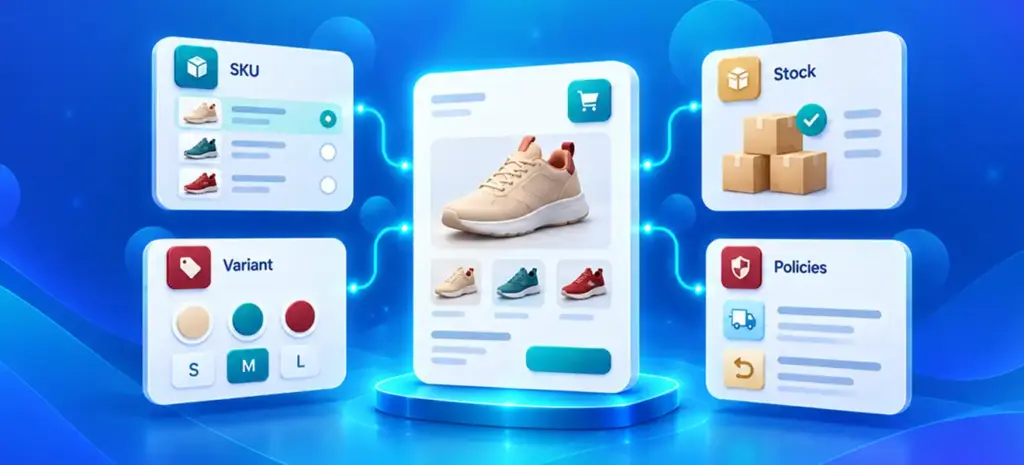
Treat variants as sellable units. A shopper asking for a black size-10 shoe needs that precise item, image, stock status and price. Do not collapse all variants into one ambiguous listing. The stable OpenAI feed specification explicitly supports variant-level modeling; similar discipline improves catalog quality regardless of channel.
Disclose policies and restrictions clearly. Shipping charges, delivery limitations, returns, warranties, subscriptions, age restrictions and other material conditions may change a purchase decision. A persuasive summary that omits a critical limitation is worse than a precise description with fewer adjectives.
Improve photography and page usability. Clear product photos, accessible alternative text, reliable image URLs, responsive layouts, and functioning product/checkout pages help customers verify an AI recommendation. There is no documented magic image aspect ratio or keyword count that guarantees a ChatGPT product recommendation.
Preserve truth across systems. If a merchant changes price in an ERP but not in the storefront, both shoppers and discovery systems can see stale information. Assign owners to catalog, inventory, merchandising and technical delivery. A regular discrepancy report is more useful than an unverified claim that every channel is always real-time.
The underlying value is not platform-specific. A product feed, public page, on-site search index and customer-support chatbot should agree about the same item. Your on-site search roadmap and external product-discovery roadmap should remain distinct: on-site retrieval improves your own store’s search experience; ChatGPT Shopping discovery depends on the external channel’s data sources and selection process.
6. Use a Merchant Readiness Checklist Before Launch
Test a small, representative set of products before making sweeping claims about catalog visibility. The following checklist is an editorial QA framework, not an official certification program or a list of guaranteed ranking factors.
| Check | How to validate it | Owner |
|---|---|---|
| Channel route | Confirm Shopify Catalog eligibility or approved direct-feed onboarding status | Ecommerce lead |
| Catalog identity | Match a sample of stable IDs/SKUs and parent-variant relationships | Catalog operations |
| Core fields | Inspect titles, factual descriptions, brand, seller and media URLs | Merchandising |
| Inventory and pricing | Compare source system, store product page and channel feed where accessible | ERP/ecommerce engineer |
| Shipping and policies | Verify visible terms, returns, checkout region and actual checkout outcome | Operations/legal |
| Crawl access | Test public pages, robots.txt, CDN/WAF and response codes without weakening security | SEO/developer |
| Data freshness | Audit updated, removed and newly launched products; inspect failed sync jobs | Integration owner |
| Quality review | Evaluate real shopper questions against verifiable item attributes | Merchandiser |
| Analytics | Test referral attribution and downstream events where data is actually exposed | Analytics lead |
| Escalation | Document who fixes inaccurate prices, misidentified variants and broken links | Store manager |
A useful sample includes best sellers, seasonal items, products with many variants, products recently discounted, out-of-stock items and items that cannot ship to a particular region. Check negative cases, too: a sold-out item should not be confidently described as available; a restricted item should not be promoted as eligible merely because a product title contains popular search terms.
Example: a common mismatch and its fix
Imagine a store offering four sizes of the same walking shoe. Its homepage has a beautiful lifestyle image, but the backend stores a single generic product record. The size-9 variant is available; size-10 is sold out. An AI shopping result based on the generic record may not be sufficiently precise for a shopper asking for size 10.
The right fix is not to add an “AI-optimized” paragraph. Give each purchasable variant a durable identifier, accurate variant-specific link, relevant image and current stock status; keep source and storefront synchronized; then validate what downstream channels receive. This example is illustrative, not a claim about a tested merchant or a guaranteed effect on ChatGPT results.
7. Measure What You Can—and Troubleshoot What You Cannot
There is no credible way to promise a specific ChatGPT Shopping position or a fixed volume of ChatGPT referrals. OpenAI says product and merchant selection depends on the shopper’s context, available product data and other considerations; some products are simply not shown. Treat appearance in one example query as an observation, not proof of stable ranking.
Use the measurement sources actually available to your business. For Shopify, inspect the channel and order-attribution information Shopify makes available in your account. For an approved direct feed, follow OpenAI’s feed best practices, including stable product URLs and appropriate attribution parameters where supported. In website analytics, record observed ChatGPT referrals and permitted conversion events, but note that browsing environments, redirects, privacy protections and multiple visits can obscure attribution.
A simple operating dashboard should distinguish operational health from business outcomes:
| Operational health | Business outcomes |
|---|---|
| Share of catalog items with complete required fields | Observed visits referred by supported AI shopping surfaces |
| Variant/ID mismatch count | Product-detail engagement on observed referral sessions |
| Stale price/availability incidents | Add-to-cart and completed purchases from attributed sessions |
| Failed feed or catalog sync jobs | Conversion quality, returns and net contribution where measurable |
| Product-page accessibility errors | Customer support complaints about misleading product information |
When a product does not appear
First check whether the store and item qualify for the relevant route. Next verify that the page and images load publicly, the product is offered in the buyer’s market, the price and availability agree across systems, and the merchant has not excluded the channel where settings permit. For an approved feed, inspect delivery and validation results. For a Shopify store, review Shopify Catalog eligibility and channel mapping rather than attempting to create an unnecessary second feed.
If those checks pass, the product still may not appear. ChatGPT selects results in context; different user constraints can favor different options. Do not buy a third-party “guaranteed ChatGPT ranking” service, fabricate reviews, stuff product descriptions with assistant keywords, or manipulate public pages to make unsupported claims. Improve accurate coverage and observe real customer outcomes instead.
Review the live platform documentation again after meaningful product changes or policy updates. This ecosystem changes quickly; the enduring work is precise catalog data, dependable merchant pages, trustworthy policies and controlled operations—not a fixed collection of AI SEO tricks.
Frequently Asked Questions
Can any ecommerce website submit products directly to ChatGPT?
Not automatically. OpenAI publishes product-feed specifications, but direct onboarding is currently available to approved partners. Other merchants should check the current access process and keep public product information accurate and accessible. Eligible Shopify merchants use the Shopify Catalog route.
Do Shopify merchants need a special ChatGPT Shopping app?
No separate direct feed or special app is required for eligible products to be discoverable through Shopify Catalog. Merchants still need to meet Shopify’s eligibility rules, maintain product data and policies, and check their account’s current status.
Does appearing in ChatGPT Shopping cost a fee?
OpenAI describes product recommendations as separate from paid ads. Shopify’s current documentation says its ChatGPT selling channel does not add a separate selling fee beyond standard payment-processing fees. This is platform-specific information, not a universal promise about every merchant integration or future commercial arrangement.
Will correct product schema guarantee a ChatGPT listing?
No. Accurate structured data can improve machine readability and supports relevant platform integrations, but no published OpenAI rule guarantees shopping results from Schema.org markup or a complete product feed. Google merchant-listing eligibility is a separate program.
What are the most important fields in an OpenAI product feed?
The current stable discovery schema lists item_id, title, description, url, brand, seller_name, image_url, availability, and price as nine required basic fields. Variant-specific data and other fields may be needed for a particular product or integration.
Can WooCommerce stores get products into ChatGPT Shopping?
WooCommerce merchants can make accurate public product pages available and may pursue direct-feed onboarding when eligible and approved. That is different from Shopify Catalog’s specific integration. Product visibility is not automatic merely because the store uses WooCommerce or a third-party feed plugin.
Is OAI-SearchBot the same thing as the OpenAI product feed?
No. OAI-SearchBot is OpenAI’s web-search crawler, controlled separately from GPTBot. A product feed is structured catalog data sent through an approved commerce integration. Permitting the crawler does not create feed access or guarantee a product-carousel listing.
Can customers purchase directly inside ChatGPT?
The checkout experience depends on the merchant platform and the integration made available. For Shopify’s documented ChatGPT channel, the customer completes the purchase through the merchant’s online-store checkout. Product discovery and a separately enabled direct-checkout integration should not be conflated.
How often should product prices and inventory be updated?
Update them whenever the authoritative values change, using the cadence and mechanisms supported by the relevant integration. OpenAI’s documented full-snapshot feed guidance recommends at least daily delivery for approved feed setups; fast-changing inventory may require additional controls to prevent outdated offers.
How can merchants tell whether ChatGPT is generating sales?
Review the channel reporting, referral and checkout analytics your platform actually exposes. Track observed product visits, add-to-cart actions and completed orders while accounting for attribution gaps. Do not infer total AI-driven revenue from a few screenshots or assume every ChatGPT-influenced purchase is identifiable.
Conclusion
Getting products found in ChatGPT Shopping starts with eligibility and trustworthy commerce data, not an AI-specific ranking trick. Shopify merchants should review their existing Catalog route and policies. Other merchants should distinguish public-page discoverability from approved direct-feed access. For everyone, clean variants, factual descriptions, current prices, reliable inventory, accessible pages and working checkout are the durable foundations.
If your catalog, storefront and ERP disagree—or you need help assessing feed readiness, product-data quality and integration boundaries—WebbyCrown’s ecommerce development services can support an implementation discussion grounded in your actual platform and selling rules.