

Summarize This Article With AI
Choosing object detection vs image segmentation is one of the most important decisions in computer vision projects. Advances in computer vision technology have significantly expanded the capabilities of both object detection and image segmentation, enabling more accurate and efficient solutions across various industries. Both techniques help machines understand an input image (or image or video), but they solve different problems.
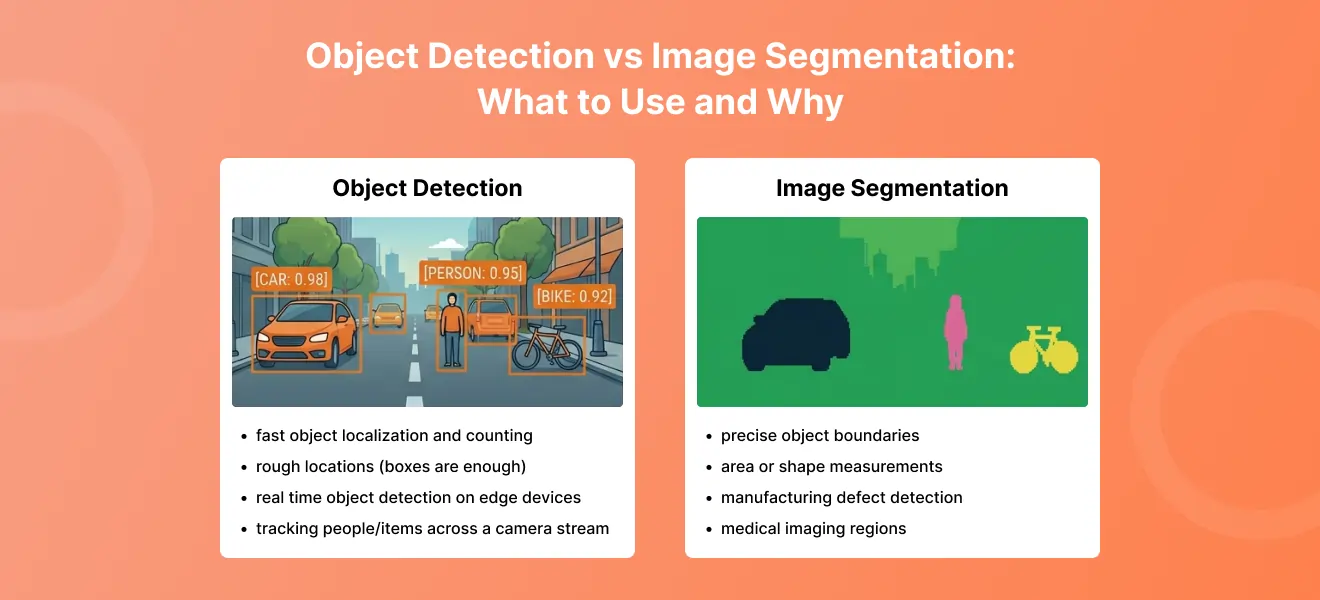
- Object detection finds and localizes objects using bounding boxes (fast, practical, often best for real-time use).
- Image segmentation identifies object regions at the pixel level (more precise for boundaries, measurements, and small defects).
This guide serves as a comparative analysis of object detection vs image segmentation, highlighting how understanding their differences is crucial for advanced computer vision applications. It explains the key differences, where each approach fits, and how to choose the right method for your computer vision tasks in manufacturing, healthcare, retail, and autonomous systems.
If you need help designing a production-grade vision pipeline, contact WebbyCrown Solutions:
The 60-second answer (quick decision)
Use object detection when you need:
- fast object localization and counting
- rough locations (boxes are enough)
- real time object detection on edge devices
- tracking people/items across a camera stream
Use image segmentation when you need:
- precise object boundaries
- area or shape measurements
- manufacturing defect detection (scratches, dents, surface issues)
- medical imaging regions (tumors, organs, lesions)
- segmentation is critical for precise area measurement in agriculture or satellite image analysis
If you need masks for each individual object, choose instance segmentation. If you only need pixel labels by category (e.g., “road,” “sky”), choose semantic segmentation, which involves assigning class labels to each pixel for accurate scene understanding.
| Goal | Best choice |
|---|---|
|
Count or locate multiple objects |
Object detection |
|
Precise object regions and boundaries |
Image segmentation |
|
Separate each object instance |
Instance segmentation |
|
Pixel-level categories across the entire image |
Semantic segmentation |
|
Edge-friendly speed |
Often object detection |
First: image classification vs object detection vs segmentation
These three are often confused. Computer vision techniques, such as image processing, classification, detection, and segmentation, are used to analyze images and videos for various applications. Image processing serves as a foundational step, preparing and enhancing images before further tasks like classification, object detection, or image segmentation are performed.
Image classification
Image classification assigns labels to the entire image (e.g., “cat,” “damaged product,” “pneumonia present”). Image classification is commonly used for image tagging, where descriptive labels are automatically assigned to images based on their content. Classification tells you what is in the image, not where.
Classification excels in applications such as image tagging, face recognition, and disease diagnosis in medical imaging.
Object detection
Object detection answers: What objects are present and where are they? It is used for object detection tasks such as identifying and localizing objects in images. It produces class labels and bounding boxes for one or more detected object candidates in a single image. Object classification networks are used within object detection algorithms to identify and classify the detected objects.
Image segmentation
Segmentation answers: **Which pixels belong to what?**Segmentation techniques are used to differentiate objects and regions within images, allowing for more detailed analysis and understanding. It produces masks that outline objects or regions, enabling precise boundaries and measurements.
Image segmentation outlines the precise, irregular shape of each object through pixel-level classification.
What is object detection?
Object detection is a core area of computer vision where the model detects and localizes objects in an input image. Object detection is closely related to object recognition, which involves analyzing and identifying objects within images. The output typically includes:
- class label (what the object is)
- confidence score
- bounding box coordinates (where it is)
Object detection is a fundamental problem in computer vision that forms the basis of many downstream tasks.
This is why object detection is also described as precise object localization (within the limits of a box), as it allows systems to recognize objects and their locations.
How object detection works (high level)
Most modern object detection models use deep learning methods, particularly convolutional neural networks (CNNs), as the foundation of modern object detection. These networks learn feature extraction and then predict:
- bounding box regression (box coordinates)
- classifying objects (class label prediction)
In simple terms, the model learns patterns in digital images and predicts where objects are likely located.
Deep learning methods have significantly advanced the field of object detection, improving both speed and accuracy.
Common object detection methods
You’ll often see two categories of object detection algorithms:
- Two-stage detectors
- Use region proposal networks (RPNs) to propose candidate regions, then classify/refine them.
- Feature extraction networks analyze the proposals generated by RPNs to accurately classify and localize objects in images or videos.
- Often strong accuracy for complex scenes.
- Example family: Faster R-CNN style approaches.
- Single-stage detectors
- Predict boxes + class labels in one pass.
- Often preferred for real time object detection.
- Examples include SSD single shot multibox detector (SSD) and YOLO-style models, with SSD being known for its fast, real-time detection capabilities.
These are popular object detectors, including Faster R-CNN, YOLO, and SSD, because they balance speed and accuracy. RetinaNet is a sophisticated object detection architecture that utilizes feature pyramid networks (FPNs) to enhance detection accuracy.
Typical object detection applications
- people/vehicle detection in video analytics
- retail shelf monitoring and counting
- robotics object localization (finding tools/parts for picking)
- surveillance and safety monitoring
- product counting and customer behavior analysis in stores
- quality control for missing components (where boxes are enough)
- object tracking as a downstream application, such as following people or vehicles across frames in video surveillance
- identifying specific objects in scenarios like surveillance, agriculture (e.g., crop monitoring, pest detection), and retail analytics for accurate localization and recognition
- diagnosing diseases in healthcare through analysis of medical images like CT and MRI scans
- enabling autonomous driving by recognizing pedestrians, traffic signs, and other vehicles
- automating inspection tasks in smart video surveillance systems, especially in remote locations
- automating tasks such as counting and inspection across various business value chains to enhance operational efficiency
Object detection is widely used in video surveillance, agriculture, and retail analytics.
What is image segmentation?
Image segmentation assigns labels at the pixel level. Instead of boxes, segmentation identifies regions and shapes, which is why it’s used when boundaries matter. One of the differentiating factors detection and segmentation is the level of detail in identifying objects and their boundaries—segmentation provides precise outlines, while detection focuses on locating objects with bounding boxes. Understanding the factors detection helps in choosing the right approach for a given application.
Semantic segmentation
Semantic segmentation labels each pixel by class (e.g., “road,” “person,” “car”). It does not separate two objects of the same class; all pixels share the same class label.
Example: In autonomous driving, segmentation identifies drivable areas and lane regions, even if there are multiple cars.
Instance segmentation
Instance segmentation separates each individual object—even if they belong to the same class.
Example: detecting and masking each separate apple on a conveyor belt, or each person in a crowd.
Instance segmentation is often chosen when you must distinguish multiple objects of the same class and measure each separately.
Why segmentation is powerful
Segmentation is best when you need:
- fine boundaries
- defect shapes
- pixel-accurate measurements
- region-based analysis
That’s why segmentation is common in:
- medical image analysis (tumor regions, organs, lesion boundaries)
- manufacturing defect detection (scratches, cracks, material issues)
- autonomous vehicles (drivable area segmentation)
- robotics (precise grasp planning)
Object detection vs image segmentation: the real differences
Here’s the practical comparison that matters for production systems.
1) Output format: boxes vs masks
- Object detection uses bounding boxes to estimate location, providing not only class labels but also precise object locations.
- Segmentation uses masks to capture object boundaries precisely.
2) Accuracy needs: “good enough” vs “must be exact”
- Detection is good when you only need approximate location (e.g., count items, identify objects). Detection is concerned with pinpointing specific objects and their locations, while segmentation aims to identify detailed object shapes and regions.
- Segmentation is needed when the boundary drives decisions (e.g., measure defect area).
3) Labeling cost and time
- Detection labels (boxes) are faster to create.
- Segmentation labels (masks) are more expensive and time-consuming.
- Traditional classification methods relied on handcrafted features and classical machine learning algorithms before the adoption of deep learning, which has influenced how labeling approaches have evolved.
4) Inference cost and speed
- Detection often runs faster, especially for real-time scenarios. Dense object detection approaches are specifically designed to efficiently handle crowded scenes, balancing speed and accuracy.
- Segmentation can be heavier, depending on the model and resolution.
5) Failure patterns
- Detection can “miss” thin defects or irregular boundaries.
- Segmentation can be sensitive to inconsistent labeling and low-quality training masks.
How to choose (decision framework)
Use these six questions to decide quickly:
1) Do you need precise boundaries?
If you must measure a region, choose segmentation. If you only need location and counting, detection is often enough.
2) Are defects thin or subtle?
Thin scratches, cracks, or small shape changes often require segmentation, especially in manufacturing defect detection.
3) Do you need measurements?
Area, perimeter, percentage coverage, and shape-based decisions require segmentation masks.
4) Do you need real-time performance?
If you need real time object detection on edge hardware, object detection models are often the better first choice.
5) What is your labeling budget?
Segmentation labeling costs more. If the budget is limited, start with detection and upgrade later if needed.
6) Are there multiple similar objects close together?
If you need to separate each instance of the same class, instance segmentation is usually required.
Real-world examples by industry
Manufacturing quality control
- Missing parts or wrong placement → object detection
- Scratches, cracks, surface defects → image segmentation
- Measuring defect area for pass/fail decisions → segmentation masks
Healthcare and medical imaging
For medical imaging workflows like tumor detection or organ region detection, segmentation is often the best fit because it provides pixel-level outlines, not just boxes.
Retail and logistics
- Counting items on shelves → object detection
- Detecting correct placement or presence/absence → object detection
- Damaged package region measurement → segmentation (if boundary matters)
Autonomous vehicles and robotics
- Detecting pedestrians and vehicles → object detection
- Lane/drivable area segmentation → semantic segmentation
- Picking/grasp planning → segmentation or instance segmentation
- Robotics object localization often starts with detection and improves with segmentation for precision. In advanced robotics and autonomous vehicles, neural information processing systems leverage deep learning frameworks to enhance detection and scene understanding.
Data and labeling requirements
Object detection labeling
Typically requires:
- bounding box per object
- class label assignment
- consistent guidelines (what counts as an object, overlap rules)
This makes detection a good baseline approach when you want to ship faster.
Image segmentation labeling
Requires:
- pixel masks per object or per class
- consistent boundary rules
- careful QA to avoid noisy masks
Segmentation performance depends heavily on labeling quality and training data consistency.
Metrics that matter
For object detection
- precision and recall
- IoU (intersection over union)
- average precision and mAP (mean average precision)
For segmentation
- IoU for masks
- Dice score (often used in medical image analysis)
- boundary accuracy (optional)
The correct metric depends on the business goal: missing a defect may be more costly than a false positive in some industries.
Deployment considerations (edge vs cloud)
Before choosing, consider:
- latency requirements
- model size and compute budget
- camera resolution and FPS
- environment changes (lighting, angle, motion blur)
- monitoring and retraining plans
Many production systems use detection first for speed and then apply segmentation only where precision is needed (a staged pipeline).
Common mistakes to avoid
- Choosing segmentation when boxes are enough (over-spending on labeling and compute)
- Choosing detection for boundary-driven tasks (defects, medical regions)
- Underestimating labeling guidelines and QA
- Skipping real-world testing across lighting, angles, and device conditions
- Treating training as one-time instead of continuous improvement
Work with WebbyCrown Solutions
WebbyCrown Solutions builds computer vision systems for real business workflows—from data readiness and labeling strategy to deployment and monitoring, and also delivers AI agent, chatbot, and automation solutions that integrate computer vision with conversational interfaces and back-office processes.
If you need production-grade implementation, explore computer vision development services or broader machine learning development & consulting services, or partner for mobile application development to bring vision-powered apps to iOS and Android users.
By combining robust vision models with Vue.js development services for modern web applications, teams can embed real-time detection or segmentation directly into responsive dashboards and control panels.
FAQs
By leveraging WordPress AI development services, you can embed detection or segmentation outputs into content workflows, dashboards, and reporting portals without rebuilding your entire web stack.
Is segmentation more accurate than object detection?
Segmentation is more precise for boundaries because it works at the pixel level. Object detection can be accurate for localization, but it does not capture exact shapes. Vision pipelines that expose their outputs via chat or voice interfaces often rely on enterprise AI chatbot development services so users can query detections, segmentation results, and analytics in natural language.
What is the difference between semantic and instance segmentation?
Semantic segmentation labels pixels by class. Instance segmentation separates each individual object and provides a mask per instance. When the goal is to surface detection or segmentation insights in a marketing site or customer portal, teams frequently pair vision APIs with Builder.io-based headless CMS experiences for flexible content management.
Which is cheaper to build?
Object detection is usually cheaper because labeling bounding boxes is faster than creating segmentation masks. For fast marketing and documentation sites that visualize example detections and segmentations, Webflow development services provide a no-code-friendly way to publish interactive demos tied to your models.
Can I start with detection and move to segmentation later?
Yes. Many teams start with detection for quick ROI and move to segmentation when boundary accuracy becomes important. Organizations that use detection or segmentation on customer data often connect these outputs into Dynamics 365 CRM development and integration to enrich profiles and automate follow-ups.
Which approach is best for defect detection?
If defect shape and area matter (scratches, cracks), segmentation is typically best. If you only need to detect missing components, detection can be enough.