Summarize This Article With AI
In today’s data-driven world, machine learning (ML) is transforming industries across the globe. As a subset of artificial intelligence, machine learning plays a crucial role in automating decisions and recognizing patterns, providing organizations with a strategic advantage. Whether you’re in healthcare, finance, or marketing, machine learning consulting services process is vital to building scalable, data-driven models that solve real-world problems. But navigating the machine learning lifecycle can be complex without proper guidance.
This blog will break down the process step-by-step, from data preparation to machine learning model deployment. Machine learning projects rely on high quality and relevant data, and data science expertise is crucial for success. We’ll cover the role of data scientists, exploratory data analysis (EDA), feature engineering, and model training to help you understand the entire process and maximize your ROI.
Throughout the machine learning lifecycle, ML algorithms are used to extract meaningful patterns from existing data and training data, enabling the development of intelligent systems. A structured roadmap for machine learning skills development—including hands-on projects and Python as the primary programming language—is key for building practical, job-ready expertise in this field.
The Machine Learning Consulting Process
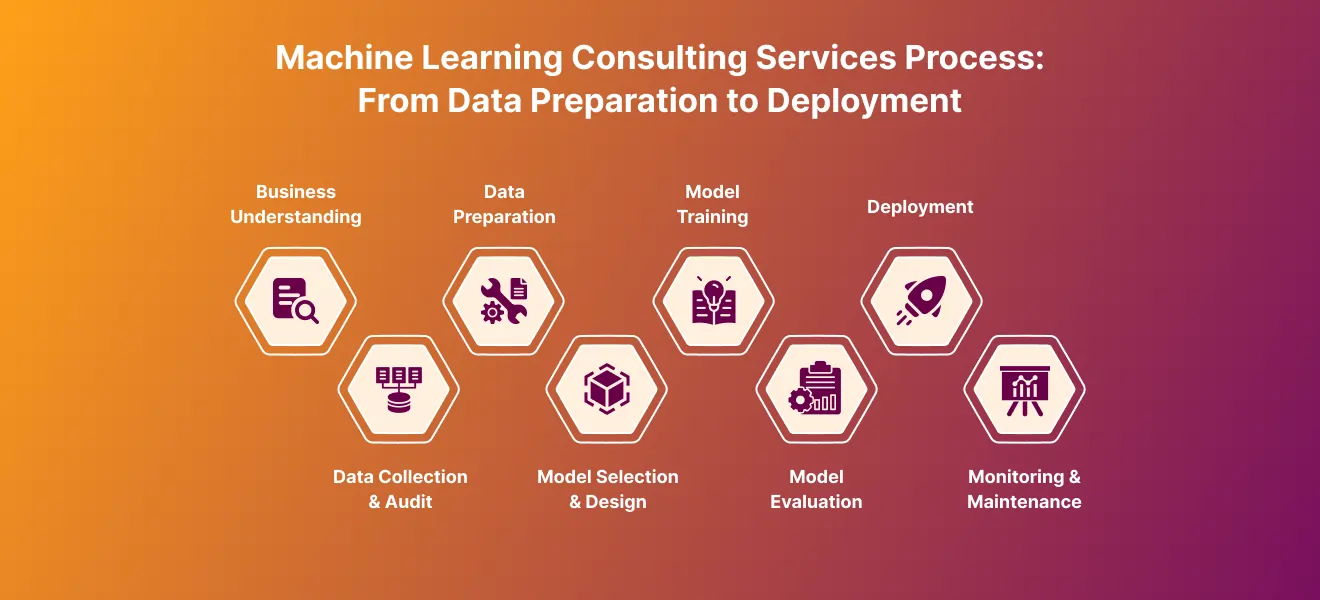
The machine learning consulting process typically involves several phases, each building on the previous one. Here’s how a machine learning consultant guides clients through a successful ML project:
Discovery and Business Requirements
In this phase, machine learning consultants meet with stakeholders to understand the business requirements and success metrics. They work collaboratively with stakeholders to identify business pain points, set objectives, and determine where AI can provide the highest ROI, including establishing clear, measurable KPIs.
Consultants define how machine learning models can solve specific problems and provide measurable business outcomes. This is where supervised learning and unsupervised learning come into play to understand data patterns, including the identification of the data required for training, suitable machine learning algorithms, and defining performance metrics.
Data Preparation and Cleaning
Data collection and preparation are critical steps in building a successful machine learning model, with up to 80% of a project’s duration often spent on these tasks. The success of any machine learning project depends on its training data, making data gathering and preparation crucial. The data scientists ensure that the data is of high quality, eliminating noise, and handling missing values.
High-quality data is the foundation upon which reliable, accurate, and effective machine learning models are built. Proper data transformation, including data cleaning and data manipulation, is essential. Consultants evaluate existing data infrastructure, quality, and quantity to ensure it can support model training through a data quality assessment.
They identify and document various data sources and collect relevant data points to serve as essential units of information for model training. Ensuring the input data is properly formatted and relevant is crucial for compatibility with the chosen machine learning model and to reflect real-world scenarios. They also conduct exploratory data analysis (EDA), including data exploration and correlation analysis, to identify relationships between features, detect data quality issues, and gain insights into data structure before further processing or modeling.
Feature Engineering
Feature engineering is the process of selecting and transforming variables that improve the model’s performance. At this stage, data scientists will extract the most meaningful features and underlying patterns from the raw data to create labeled data suitable for training. Machine learning practitioners play a key role in this process, ensuring that the features engineered capture intrinsic data relationships. Feature engineering directly impacts how well a machine learning model will perform, making this a critical step in the machine learning lifecycle.
Model Training and Tuning
Once the data is prepared, it’s time to train the machine learning models. Training and tuning involve iterative testing of thousands of variations to improve the accuracy of ML models. Depending on the problem, machine learning consultants may choose between a variety of machine learning algorithms such as linear regression, logistic regression, or more advanced deep learning models that utilize complex neural networks and neural networks for tasks like image recognition and natural language processing.
The choice of algorithm depends on several factors, including the problem type, data characteristics, and performance requirements. In this phase, data scientists optimize the model settings using techniques like cross validation techniques to optimize model performance, improve accuracy, and reduce overfitting. They may also use multiple models (ensembles) to enhance predictive accuracy and robustness. Both supervised and unsupervised learning approaches are considered, utilizing labeled data for prediction tasks and unlabeled data for discovering hidden structures.
Model Evaluation and Testing
Model evaluation is done using performance metrics like precision, recall, and F1 score to ensure that the model meets business goals. The subsequent step following model training and fine-tuning is to assess the ML model’s performance using unseen data.Models are validated against a separate dataset to ensure performance accuracy and generalization.
The evaluation metrics help in deciding if the machine learning model is good enough for deployment or needs more fine-tuning, and performance evaluation encompasses more than just accuracy, as different metrics suit different applications. Example applications include natural language processing for tasks such as enterprise AI chatbot development services and translation. Consultants also track model versions to maintain reproducibility and manage the model lifecycle.
Model Deployment and Monitoring
After evaluation, the machine learning model is deployed into the production environment. Deploying machine learning models into production involves several challenges, such as ensuring hardware compatibility, managing scalability, and monitoring performance.
The integration of the ml model into the client’s existing IT infrastructure and workflows is essential for deployment. To overcome deployment challenges, consultants establish robust infrastructure such as REST APIs using tools like FastAPI or comprehensive solutions like ClicData.
In this phase, operationalization involves setting up MLOps pipelines to automate deployment and ensure model functionality within existing IT environments. Deployment involves making your model available to end users. Model monitoring ensures that the model continues to perform as expected and identifies when model drift occurs, requiring retraining with new data. Ongoing monitoring, regular evaluation, and retraining are part of maintenance to ensure ongoing accuracy and reliability.
Continuous Improvement and Retraining
Machine learning models are never static. To ensure long-term success, models need continuous monitoring and retraining. Regularly updating models to accommodate changes in data patterns ensures ongoing accuracy and reliability. Maintaining comprehensive documentation for data sources, transformations, and quality checks facilitates collaboration among data scientists.
Consultants provide documentation and training to internal team members to ensure client system maintenance and educate internal teams on how to maintain and interpret the model outputs. Ongoing support and maintenance services are commonly provided to resolve technical problems, update models as new data becomes available, and adjust solutions to evolving business needs. This iterative process ensures the model adapts and improves over time.
Machine learning consulting services can be categorized into staff augmentation and managed projects. Staff augmentation projects involve placing highly-specialized experts directly on a client’s team to increase capacity or meet specific project requirements, while managed projects involve the ML consulting firm handling the entire project from start to finish, including building or optimizing machine learning models.
Engaging with an ML consulting service is a collaborative process involving specialized teams of data scientists, software development engineers, and AI experts working with internal stakeholders. Consultants often create a Proof of Concept to validate the approach and a Minimum Viable Product (MVP) to test hypotheses and validate data solutions before full system development. Pilot programs are conducted to test the model in a real-world environment before full deployment.
The ultimate goal of machine learning consulting is to assist clients in enhancing their business operations and unlocking new avenues for growth and innovation. Partnering with a custom AI development company for software and ML solutions ensures scalable, secure implementations that align with strategic business goals. The pricing of machine learning consulting projects depends on the complexity and scope of work and the experience of the consultants. Businesses in all industries can benefit from machine learning consulting, especially those that collect and process large amounts of data.
Why Machine Learning Consulting Matters
While machine learning solutions are powerful, building successful models requires expertise in several areas, including data collection, feature engineering, and model deployment. The machine learning consulting services process helps companies navigate these challenges by providing expert guidance at each stage of the project.
Machine learning consulting services help businesses automate processes and improve work efficiency and accuracy, similar to how AI agents in business with safe use cases, risks, and governance controls can streamline complex workflows while managing compliance and risk. Machine learning consulting involves specialized teams of data scientists, software development engineers, and AI experts working closely with internal stakeholders. The primary objective of a machine learning project is to enhance business operations and unlock new avenues for growth and innovation.
By partnering with a team of experienced machine learning consultants who understand how to position AI agents vs chatbots vs automation for different use cases, organizations can:
- Leverage the right machine learning techniques for their data.
- Build custom models tailored to their specific needs.
- Ensure that their models are scalable and adaptable as business requirements evolve.
Common Machine Learning Challenges and How to Overcome Them
While machine learning models hold great potential, there are several common challenges businesses face, including:
- Data quality issues: Low-quality or inconsistent data can lead to inaccurate models. Machine learning practitioners play a crucial role in managing data quality and addressing these challenges throughout the project lifecycle.
- Lack of expertise: Many organizations lack the necessary machine learning engineers to build and deploy models.
- Overfitting or underfitting: Without proper tuning, models may either overfit or underfit the data, leading to poor performance.
- Bias detection and mitigation: Proactive steps are taken to ensure fair and ethical ML models by identifying and addressing potential biases in the data and algorithms.
Many ML consulting engagements extend beyond initial deployment to include ongoing support and maintenance services. Regular assessments and adjustments guarantee that the model maintains optimal performance as new data is introduced or as business needs change.
By partnering with ML consultants, businesses can avoid these pitfalls and ensure a smooth, successful ML project.
Machine Learning Ethics
Machine learning ethics is an essential pillar of the machine learning lifecycle, guiding organizations to develop machine learning models that are fair, transparent, and responsible. Data scientists and machine learning consultants must be vigilant about the societal impact of their models, considering issues such as discrimination, privacy, and accountability from the earliest stages of data collection and data preparation.
By applying rigorous exploratory data analysis (EDA) and thoughtful feature engineering, practitioners can uncover and address hidden biases or imbalances in the data, ensuring that model development aligns with ethical standards.
Ethical machine learning also means prioritizing transparency and explainability, so stakeholders can understand how decisions are made and trust the outcomes.
This is particularly important in sensitive applications like healthcare, finance, or hiring, where model predictions can have significant real-world consequences. By embedding ethical considerations into every phase—from data preparation to model deployment—organizations not only comply with regulations but also build trust with customers and partners, paving the way for sustainable and responsible machine learning solutions that can extend to areas like WordPress AI development services for customer-facing digital experiences.
Machine Learning Governance
Machine learning governance provides the framework for managing and overseeing machine learning initiatives within an organization. Effective governance ensures that machine learning projects are not only technically sound but also aligned with business objectives, regulatory requirements, and ethical standards. This involves setting clear policies and procedures for model development, deployment, and ongoing model monitoring, as well as defining roles and responsibilities for data scientists, machine learning engineers, and business stakeholders.
A robust governance strategy includes thorough documentation, version control for model changes, and regular validation and testing to prevent poor performance or unintended consequences. By fostering collaboration across teams and maintaining transparency throughout the machine learning workflow, organizations can minimize risks such as data breaches, compliance failures, or model drift. Ultimately, strong machine learning governance supports accountability, facilitates regulatory compliance, and helps organizations realize the full value of their machine learning investments.
Machine Learning Security
Machine learning security is a critical consideration for any organization deploying machine learning models in production. As these models become integral to business operations, they also become targets for a range of security threats, including data poisoning, adversarial attacks, and model inversion. To safeguard machine learning systems, data scientists and machine learning engineers must implement comprehensive security measures at every stage—from secure data collection and encrypted storage to controlled model deployment and access management.
Regular model evaluation and cross-validation are essential for identifying vulnerabilities and ensuring that models are robust against manipulation or exploitation. Continuous model monitoring allows organizations to detect unusual patterns or performance drops that may signal a security incident. Additionally, compliance with regulations such as GDPR and HIPAA is vital to protect sensitive data and maintain customer trust. By prioritizing security in the machine learning lifecycle, organizations can defend against threats, ensure the integrity of their AI systems, and maintain the reliability of their machine learning solutions.
Conclusion
Understanding the machine learning consulting process is key to ensuring that your machine learning models deliver valuable results. From data preparation to model deployment, each phase of the project is designed to build high-quality, actionable models that drive business outcomes. By working with a machine learning consultant, you can streamline the process and focus on achieving tangible ROI.If you’re looking to implement machine learning models in your business, get in touch with WebbyCrown Solutions. We offer expert machine learning consulting services that help you leverage data and technology for real business impact.
FAQs
How long does the machine learning consulting process take?
The timeline varies depending on the complexity of the project. On average, an ML project can take anywhere from a few weeks to several months, with each phase requiring careful planning and execution.
What is the most critical phase in the machine learning consulting process?
Data preparation is often the most critical phase. Without high-quality, clean data, even the best algorithms will fail to produce reliable results.
Can machine learning models be deployed immediately after training?
Not necessarily. Models need to be evaluated and validated before they are deployed into production to ensure they meet performance metrics.
How can I measure the ROI of a machine learning model?
ROI can be measured through improved operational efficiency, enhanced decision-making, and cost savings that result from automated processes.
What are the key performance metrics for machine learning models?
Performance metrics include precision, recall, F1 score, and others, depending on the specific problem and business goals.