Summarize This Article With AI
Choosing the right approach to optimize large language models (LLMs) can be challenging. Teams often pick the wrong method—prompting, retrieval augmented generation (RAG), or fine-tuning—leading to suboptimal results, wasted resources, or delayed deployments.
This article provides a clear decision framework to help you understand the differences, benefits, and tradeoffs of each approach. We’ll also include practical use cases and considerations for cost, latency, and maintenance, guiding you to the best choice for your needs. Whether you want up-to-date answers, consistent model behavior, or rapid prototyping, this guide will steer you in the right direction.
Introduction to Large Language Models
Large language models (LLMs) are advanced AI systems designed to understand and generate human language at scale. Trained on massive datasets, these language models can perform a wide range of tasks, from answering questions and summarizing documents to translating languages and engaging in natural conversations. Their versatility has made them indispensable across industries like customer support, healthcare, and education, where they streamline workflows and enhance user experiences.
However, while generic LLMs excel at general knowledge tasks, they often need further adaptation to handle specific tasks or domain requirements. This is where retrieval augmented generation (RAG) and fine tuning come into play.
By leveraging retrieval augmented generation RAG, organizations can connect LLMs to external data sources for more accurate, up-to-date responses. Meanwhile, fine tuning allows teams to specialize large language models for particular tasks or industries, embedding domain expertise directly into the model. Together, RAG and fine tuning unlock the full potential of language models, enabling them to deliver tailored, high-impact solutions for complex, real-world challenges.
Quick definitions
Prompting
Prompting involves crafting instructions or queries that guide a pre-trained large language model’s behavior without altering its internal parameters. Through precise prompt engineering, you can elicit desired responses by framing the user’s query effectively. For example, a customer support chatbot might use prompting to answer FAQs by carefully phrasing questions and instructions. Prompting is fast to implement and requires minimal resources but depends heavily on the quality of prompts and the model’s existing general knowledge.
Retrieval Augmented Generation (RAG)
Retrieval augmented generation (RAG) enhances an LLM’s outputs by connecting it to external data sources such as enterprise knowledge bases or document repositories. When a user submits a query, the RAG system retrieves relevant data—often using vector databases and semantic search techniques—and incorporates this retrieved data into the prompt before generating a response. This approach ensures answers are grounded in accurate, up-to-date information, reducing hallucinations and improving factual accuracy.
Fine-Tuning
Fine-tuning adapts a pre-trained model by training it further on a labeled data set, which is a curated collection of data specifically annotated for the target domain or task. The quality and relevance of the labeled data set are crucial, as they enable the model to learn domain-specific terminology and improve its performance in specialized applications. The training process involves adjusting the model’s parameters using this labeled data set to better align with the requirements of the domain.
This process adjusts the model weights to specialize its behavior for particular tasks, styles, or formats. The result is a model fine-tuned for domain-specific tasks, often referred to as a fine-tuned model or fine-tuned LLM, which excels in delivering accurate and relevant results in focused applications.
Fine-tuning excels in producing consistent outputs and handling complex domain knowledge, such as legal documents or medical reports. The goal is to improve the model’s predictions for specific tasks, ensuring higher accuracy and reliability in real-world scenarios, making it a strong fit for organizations investing in custom AI development solutions to address specialized business problems at scale.
However, it requires substantial high-quality data, computational resources, and ongoing maintenance to keep the model current.
The real differences
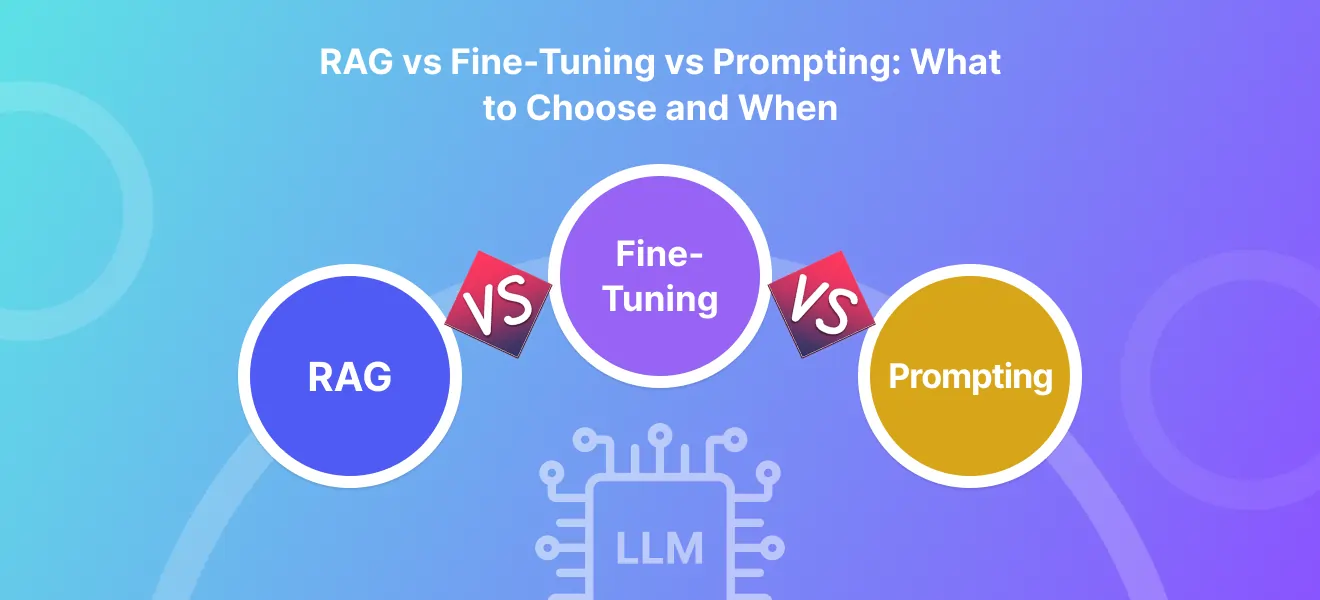
The key differences between RAG, fine-tuning, and prompting lie in how each approach customizes large language models for specific needs, their strengths, and their ideal use cases.
- Data freshness: RAG wins by accessing up-to-date data at query time, making it ideal for dynamic information.
- Behavior consistency: Fine-tuning wins by embedding domain knowledge and style directly into the model weights for predictable outputs. Fine-tuning works best for domain-specific tasks and when adapting a model to a specific domain, such as legal, medical, or customer service applications. Through supervised learning on a specialized dataset, fine-tuning allows the model to excel at tasks that require deep expertise or specialized terminology.
- Speed to ship: Prompting wins as it requires no training or infrastructure changes, enabling rapid prototyping.
- Governance: All approaches need controls, but fine-tuning and RAG require more rigorous processes for data privacy, model configuration, and evaluation.
When comparing both RAG and fine-tuning, it’s clear that both RAG and fine-tuning can be used together to enhance large language model performance. Both RAG and fine-tuning offer complementary benefits: RAG provides dynamic retrieval of current information, while fine-tuning enables deep specialization for domain-specific tasks.
A hybrid approach allows organizations to leverage fine-tuning’s deep domain expertise alongside RAG’s dynamic information retrieval. For example, a model fine-tuned on specialized domain data can be deployed in a RAG architecture to use its domain expertise to retrieve the most relevant information during response generation.
This hybrid approach can deliver excellent results by fine-tuning the model moderately and using RAG for anything not covered in training. The hybrid approach is particularly powerful in professional domains where both expertise and currency matter.
Decision framework
Ask yourself these questions to choose the best approach:
| Need | Best Fit |
|---|---|
|
Do answers depend on private or up-to-date knowledge? |
RAG (retrieves relevant information based on the user’s query) |
|
Do you need consistent style/format at scale? |
Fine-tuning (a model fine tuned on domain-specific data can produce reliable and specialized model’s output) |
|
Is this mostly a prompt/UX problem? |
Prompting |
|
Is accuracy and citations required? |
RAG + evaluation (RAG provides accurate answers and more accurate responses by grounding the model’s output in accurate data) |
|
Do you have enough high-quality training data? |
Fine-tuning may be viable (a model fine tuned on high-quality, domain-specific data can improve the model’s output) |
Best-fit use cases
- Support knowledge assistant: A RAG model or RAG architecture can leverage internal data and internal data sources to provide accurate, context-specific answers based on enterprise knowledge. Data engineers play a crucial role in setting up and maintaining the retrieval infrastructure that enables these systems to access and integrate internal data efficiently.
- Policy/compliance Q&A: RAG can help with sensitive data and enhance security and privacy by keeping proprietary information in a secure database, rather than embedding it in the model. Fine-tuning is best for ensuring consistent terminology and output formats, which is essential for compliance and regulatory requirements.
- Internal enablement assistant: Prompting is the fastest, cheapest, and easiest method for rapid prototyping and iteration. Natural language processing skills are valuable for crafting effective prompts and optimizing model output for specific internal use cases.
- Ticket triage and summarization: RAG can process unstructured data and incorporate external knowledge to improve the accuracy and relevance of summaries, especially when paired with hybrid search strategies that balance semantic and keyword retrieval. This is particularly valuable in industries where information changes frequently, such as finance or healthcare.
- Sales enablement Q&A: RAG retrieves both new data and existing data to provide up-to-date and relevant answers. Fine-tuning can adapt a generic AI model or AI model for specific sales tasks, improving performance on domain-specific queries, while organizations running content-heavy sites can apply similar techniques through WordPress AI development services to deliver tailored, high-converting experiences.
- Other applications: RAG can be used in chatbots to provide accurate answers based on company-specific policies and procedures, in educational software to deliver context-specific explanations, in legal tasks by referencing the latest legal precedents, and in medical applications by integrating up-to-date clinical guidelines and medical data. RAG also enhances customer support by providing real-time, contextually relevant answers.
RAG is typically more cost-effective than fine-tuning because it utilizes existing data and avoids the need for extensive training phases. However, implementing RAG requires building and maintaining a sophisticated retrieval infrastructure and continuously updating the knowledge base to ensure fast query response times. RAG is also limited by the context window of the LLM, which can constrain implementations when relevant information spans multiple lengthy documents.
Cost, latency, and maintenance tradeoffs
- Prompting: Cheapest and fastest to start; minimal infrastructure but limited control over model behavior.
- RAG: Requires engineering effort to build data pipelines, maintain retrieval quality, and monitor latency and cost per query. RAG is generally more cost-efficient than fine-tuning because it leverages existing data, including internal data and external knowledge, to provide accurate data at query time without the need for extensive retraining.
- Fine-tuning: Demands data preparation, a labeled data set, and a complex training process. Fine-tuning requires a machine learning training pipeline, including gathering labeled data, managing the data set, and having infrastructure such as GPUs or TPUs to train the model, which increases resource requirements and complexity.
Monitoring, evaluation, and regression testing are essential for all approaches to maintain grounding, reduce hallucinations, and ensure compliance with data privacy and governance standards.
Parameter Efficient Fine Tuning
Parameter efficient fine tuning (PEFT) is a modern approach to adapting pre-trained language models for specific tasks without the heavy computational demands of traditional fine tuning. Instead of updating all the parameters in a large model, PEFT focuses on modifying only a small, targeted subset. This makes the process faster, more cost-effective, and accessible even for organizations with limited resources.
PEFT is especially valuable when you need to fine tune a model for a particular task—such as sentiment analysis, document classification, or domain-specific Q&A—without retraining the entire model. By updating just the most relevant parameters, you can achieve high performance while minimizing infrastructure costs. Additionally, parameter efficient fine tuning can be combined with retrieval augmented generation to further enhance the relevance and accuracy of model outputs, ensuring that your language models deliver precise, context-aware responses for your business needs.
Importance of Relevant Information
Ensuring that large language models have access to relevant information is essential for generating accurate and useful responses. While pre-trained models are powerful, they may lack the latest updates or deep domain specific knowledge needed for specialized tasks. This gap can lead to outdated or irrelevant answers, especially in fast-changing fields or when handling nuanced queries.
By integrating external data through retrieval augmented generation and applying fine tuning with domain specific data, organizations can provide their models with the most up-to-date and contextually appropriate information.
This approach not only improves factual accuracy but also enhances the model’s ability to perform sentiment analysis, answer complex questions, and deliver insights grounded in real-world data sources. Leveraging relevant information through rag and fine tuning reduces hallucinations, increases trust in the model’s predictions, and ensures that outputs remain aligned with business goals and user expectations.
How to combine them
- Prompting + RAG: The most common approach, combining fast prototyping with grounded, accurate responses.
- Fine-tuning + RAG: When you need both consistent behavior and access to up-to-date data, both RAG and fine-tuning can be combined for optimal results. A fine-tuned model, trained on specialized domain data, can be deployed within a RAG model or RAG architecture.
This allows the fine-tuned model to leverage its domain expertise while the RAG model retrieves the most relevant and current information during response generation. The hybrid approach is particularly powerful in professional domains where both expertise and currency matter, delivering excellent results by moderately fine-tuning the model and using RAG for anything not covered in training.
- Prompting + tools: Light agent workflows that extend prompting capabilities with external APIs or tools.
What to validate before production
- Retrieval quality and relevance (for RAG systems), using robust RAG evaluation metrics for accuracy and faithfulness
- Faithfulness and grounding of generated content
- Red-team testing for prompt injection and adversarial inputs
- Access controls and audit logging for data privacy
- Evaluation on offline datasets to benchmark performance and accuracy
FAQs
Is RAG better than fine-tuning?
RAG excels when you need up-to-date, private, or dynamic data with traceability. It is also better for handling sensitive data, as RAG enhances security and privacy for enterprise use by keeping proprietary data in a secure database under the organization’s control, rather than embedding it into the model itself. Fine-tuning is better for consistent output style and domain expertise embedded in the model.
When is fine-tuning worth it?
Fine-tuning is valuable when you have sufficient labeled domain specific data and require precise control over model behavior and output format.
Can prompting replace fine-tuning?
Prompting enables rapid prototyping and works well for many use cases but cannot fully replace fine-tuning’s ability to embed domain knowledge and ensure consistent outputs.
How do I reduce hallucinations?
Using RAG to ground responses in retrieved relevant data, combined with evaluation and monitoring, greatly reduces hallucinations.
What is the fastest path to production?
Prompting is the quickest to implement, followed by RAG integration. Fine-tuning requires more time for data preparation and training but yields specialized models. For expert guidance on implementing RAG, explore our RAG Development Services. To learn more about ethical AI deployment and governance, consider our Generative AI Consulting Services. Ready to choose the right approach for your AI project? Contact WebbyCrown today to get started.