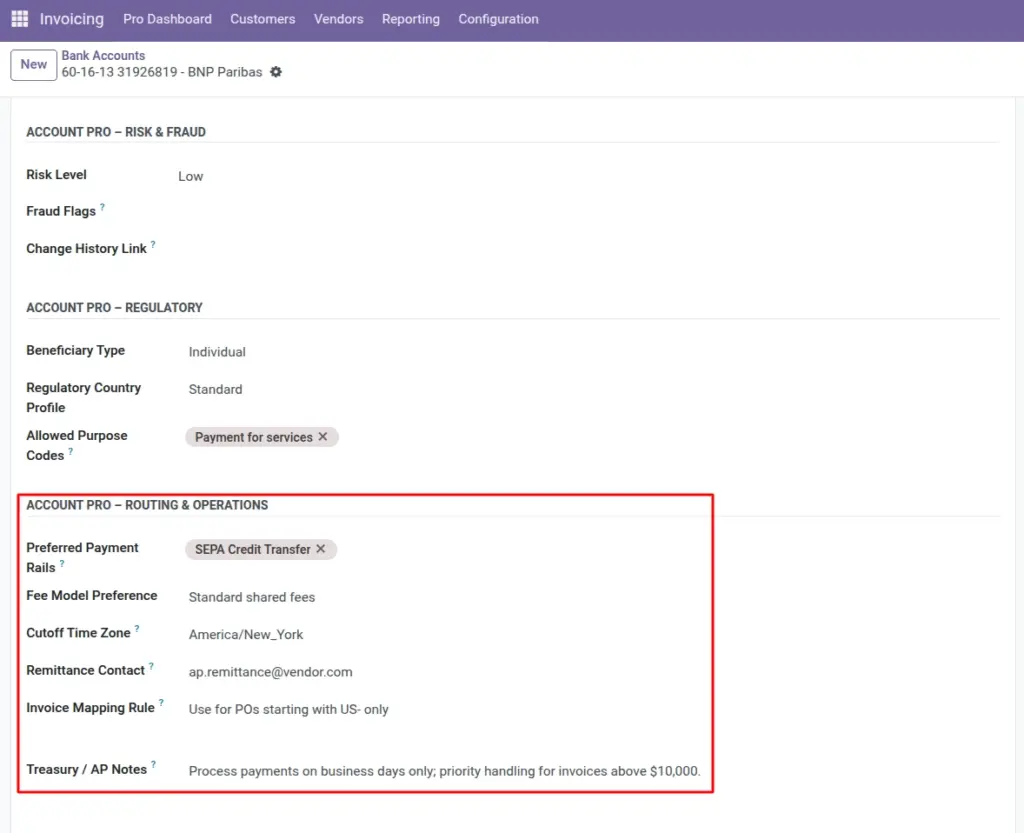
Tell treasury which payment networks to prefer, how fees should behave, and any invisible rules about using this IBAN.
Overview
With Routing & operations enabled, each partner bank record can list preferred rails (SEPA, SWIFT, instant payments), a default fee profile, cut-off time zone, remittance contact, mapping rules, and free-form treasury notes.
How it works
These fields guide humans and automation when several accounts exist. They do not replace bank master data from your house bank – they annotate how your company should treat this counterparty account.
Step-by-step guide
- Open the partner bank account needing routing guidance.
- Tick every Preferred payment rail the beneficiary supports.
- Link the Fee model preference profile (shared vs sender-pays-all, etc.).
- Type the Cutoff time zone used to judge same-day eligibility (IANA names like “Europe/Brussels”).
- Add Remittance contact email or phone specifically for remittance advices.
- Describe Invoice mapping rules in plain language (“Use for subsidiary X invoices only”).
- Use Treasury / AP notes for internal cautions (“Dormant – confirm before first use in 2026”).
Fields table
| Field name | Description | Example |
|---|---|---|
Preferred payment rails |
Networks treasury should try first when paying this account. |
SEPA Instant + SEPA standard. |
Fee model preference |
Link to a maintained profile describing expected fee split. |
“Premium OUR (sender pays).” |
Cutoff time zone |
Time zone name for interpreting cut-off windows. |
America/New_York. |
Remittance contact |
Direct contact for remittance advice issues. |
|
Invoice mapping rule |
Free-text instructions tying invoices or entities to this IBAN. |
“Use for POs starting with US- only.” |
Treasury / AP notes |
Internal-only reminders for treasury or accounts payable. |
“Do not use for >€1M without CFO sign-off.” |
Field explanations
Each item matches one row in the table above, in the same order.
Preferred payment rails
Which networks treasury should try first (SEPA, SWIFT, instant, domestic clearing). A routing hint only: the bank may still reject if limits or cut-offs fail.
Fee model preference
Default fee-profile record (shared vs sender-pays-all, etc.) for this IBAN. Pairs with the payment’s own Fee model so staff see the usual rule before overriding.
Cutoff time zone
IANA-style time zone name for judging same-day and cut-off windows (e.g. Europe/Brussels). Must match where the paying bank’s cut-offs are evaluated.
Remittance contact
Email or phone specifically for remittance-advice problems on this account, when it differs from the vendor’s main AP inbox.
Invoice mapping rule
Plain-language rules tying this IBAN to certain entities, company codes, or PO prefixes so shared-service teams pick the right account every time.
Treasury / AP notes
Internal-only cautions (dormant account, large-payment approval, “use only for USD”) that should not appear on external documents.
Tip: Keep Treasury / AP notes factual and dated (“Reviewed 2026-03-01 – limit €250k”) so future readers know whether the note is still valid.
Common mistake: Putting legally binding contract text in Invoice mapping rule – store contracts in the document app; keep this field to short routing instructions.
Image