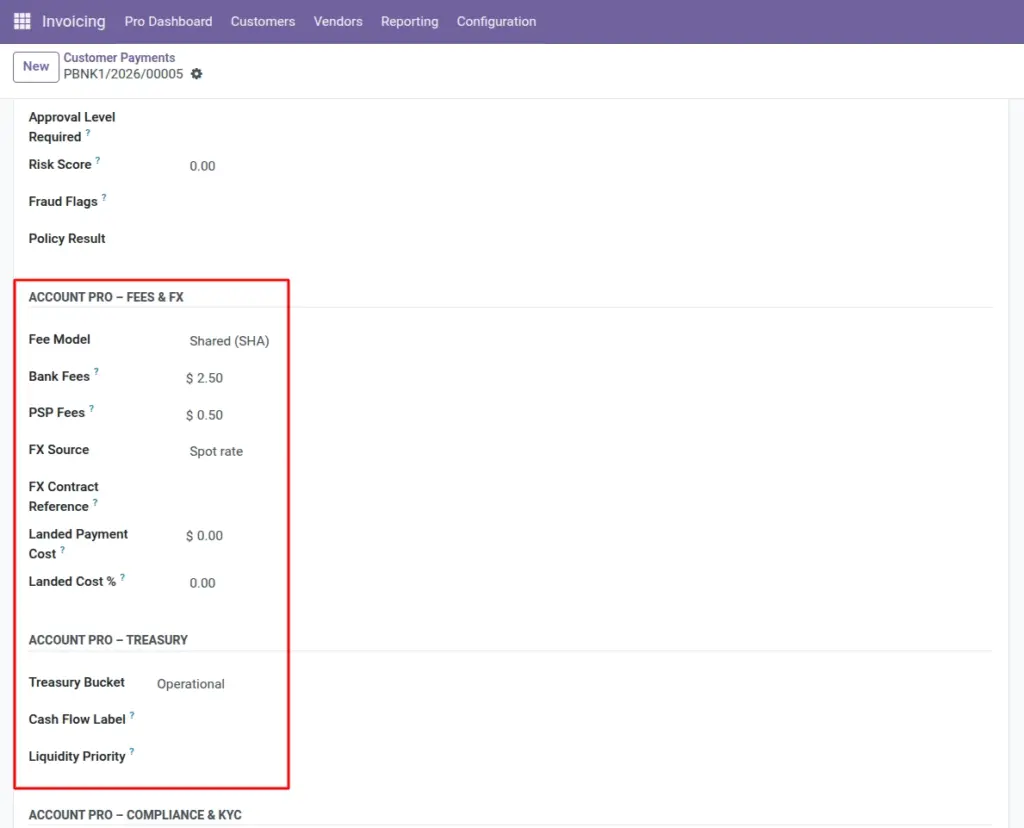
See the true cost of moving money and tag each payment for cash-flow forecasts and liquidity planning.
Overview
Enable Fees & FX and Treasury to unlock monetary and planning fields on payments. The app can also compute Total cost (amount plus fees or landed cost) for dashboards.
How it works
Fee model follows banking shorthand: SHA (shared), OUR (sender pays all), BEN (beneficiary pays). FX source tells whether the exchange rate came from the spot market, a formal contract, or an internal policy rate. Treasury fields classify the payment for forecasting tools.
Step-by-step guide
- After the bank confirms charges, open the posted payment.
- Select Fee model to match the bank instruction you sent.
- Enter Bank fees and PSP fees in payment currency.
- Choose FX source when the payment currency differs from your policy rate origin.
- If hedged, type the FX contract reference.
- Optionally fill Landed payment cost (total of fees + FX spread) and Landed cost % if finance provides those figures.
- Assign a Treasury bucket (Operating, Tax, Payroll pool, etc.).
- Add a short Cash flow label for scenario planning (“Base case Q2”).
- Pick Liquidity priority when multiple bank balances could fund the same run.
Fields table
| Field name | Description | Example |
|---|---|---|
Fee model |
Who pays wire charges according to the instruction set. |
OUR so the vendor receives the full invoice amount. |
Bank fees |
Amount the bank charged for this transfer. |
€25. |
PSP fees |
Fees from card or wallet providers separate from the bank. |
€1.20 card processing. |
FX source |
Where the exchange rate came from: spot, contract, or internal table. |
FX contract. |
FX contract reference |
Deal ticket or treasury reference for the hedge. |
“HEDGE-77821.” |
Landed payment cost |
Total extra cost (fees + spread) in payment currency. |
€42 sum of all charges. |
Landed cost % |
Same cost expressed as percent of the payment amount. |
0.35%. |
Treasury bucket |
Classification bucket for reporting pools of cash. |
“Operating EUR.” |
Cash flow label |
Free-text tag for forecasting scenarios. |
“Stress case – delayed receipts.” |
Liquidity priority |
Which internal rule decides which account to spend first. |
“Use primary operating account before backup.” |
Total cost (read-only) |
Amount plus landed cost, or amount plus bank + PSP fees when landed cost empty. |
€10,042 total outflow for a €10,000 wire. |
Field explanations
Each item matches one row in the table above, in the same order.
Fee model
Banking shorthand for who pays wire charges: SHA (shared), OUR (sender pays all), or BEN (beneficiary pays all). Should match what you instructed the bank.
Bank fees
The amount your house bank charged for this payment, in payment currency. Used for true cost of cash and for reconciling against the bank statement.
PSP fees
Fees from card schemes, wallets, or payment service providers separate from the bank wire fee. Keeps card acceptance cost visible next to the same payment.
FX source
States whether the exchange rate came from spot market, a formal FX contract, or an internal policy rate. Auditors expect this when currency differs from your company standard.
FX contract reference
Ticket or deal ID from treasury’s hedging system so finance can prove which rate or hedge applied.
Landed payment cost
One number capturing total extras (fees plus FX spread) in payment currency when you prefer a single field instead of splitting lines.
Landed cost %
The same landed cost expressed as a percent of the payment amount-useful when comparing small-value vs large-value wires.
Treasury bucket
A classification such as operating cash, tax, or payroll pool so liquidity reports group payments consistently.
Cash flow label
Free-text tag for forecasting scenarios (“base case”, “stress case”) so exports into Excel or BI match your treasury model names.
Liquidity priority
Which internal rule or ranking decides which bank balance to spend first when several accounts could fund the payment. Values come from a maintained list.
Total cost (read-only)
Calculated: payment amount plus landed cost when landed cost is set; otherwise amount plus bank fees plus PSP fees. Use it to see all-in outflow in one column.
Double-counting note
If Landed payment cost already includes all fees and spread, do not also expect the system to add bank and PSP fees again-follow your finance policy for whether to fill landed cost or the separate fee fields.
Tip: Reconcile Bank fees monthly against the bank statement fee lines – small drift is easier to fix when caught early.
Common mistake: Leaving FX source blank on every foreign payment – auditors will ask how the rate was justified at posting time.
Image