Summarize This Article With AI
Outsourced engineering remains a major enterprise expense. Deloitte’s 2024 Global Outsourcing Survey of more than 500 executives found that 80% planned to maintain or increase third-party outsourcing. The main question is no longer whether to hire a partner, but how to structure payment, staffing, and accountability.
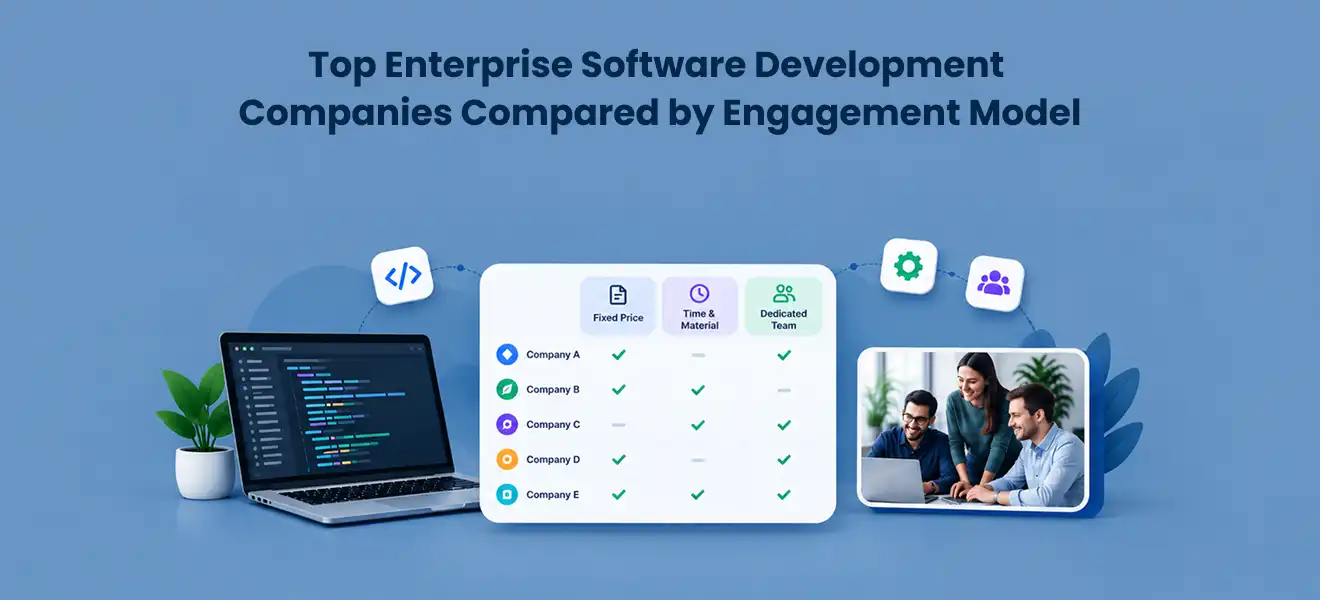
Vendors with similar capabilities may use very different engagement models. One offers a fixed price after discovery, another bills hourly against an evolving backlog, and a third provides client-managed engineers. Buyers can also compare flexible engagement models such as fixed-price projects, time-and-materials contracts, and dedicated teams. Each model changes who carries the cost risk, controls the IP, and owns delivery.
This guide compares 10 top enterprise software development companies by engagement model. It also covers key statement-of-work clauses and a 4-week process for evaluating finalists.
Buying Patterns Behind Enterprise Software Contracts
Enterprise buyers continue to increase spending on outside delivery, but they are also asking harder questions about value, accountability, and long-term ownership. Research from BCG, McKinsey, and Deloitte shows why the engagement model can matter as much as the vendor’s technical capabilities.
Failed technology programs can cost far more than the original vendor contract. BCG estimates that one unsuccessful large-scale program can cost a typical large company more than €20 million annually. The figure comes from its 2024 Build for the Future research, which surveyed more than 1,000 C-suite executives. These losses can include delayed launches, duplicated work, operational disruption, and internal teams remaining tied to systems that were supposed to be replaced.
Technical debt from earlier projects also reduces the budget available for new development. In a McKinsey survey of 50 CIOs at financial services and technology companies with annual revenue above $1 billion, respondents estimated that resolving technical debt consumes 10% to 20% of the technology budget intended for new products. A vendor may deliver features quickly while leaving behind undocumented integrations, outdated dependencies, or architecture that becomes expensive to maintain. Buyers should therefore evaluate whether the vendor can support legacy application modernization and leave the system maintainable after handoff.
The financial returns from outsourcing remain inconsistent. In Deloitte’s 2024 Global Outsourcing Survey, only 25% of executives reported lower vendor service costs or improved service quality. This suggests that hiring an outside team doesn’t automatically produce savings or better delivery. Results also depend on staffing continuity, governance, pricing terms, technical ownership, and the client’s ability to maintain the software after theengagement ends.
Together, these findings explain why enterprise buyers increasingly compare contract models alongside technical expertise. Hourly rates and project estimates provide only part of the cost. The stronger comparison includes who carries scope risk, who controls the code and intellectual property, how staffing changes are handled, and what the client receives when the contract ends.
Top Enterprise Software Development Companies Engage: 10 Profiles
Enterprise vendors offer similar technical capabilities, but their engagement models, staffing terms, and ownership structures vary widely. Buyers evaluating AI-focused projects should also consider how vendors approach AI product engineering, including architecture, development, testing, and long-term handoff. Each profile ends with published evidence you can verify.
1. Baytech Consulting
Among the top enterprise software development companies in this guide, Baytech Consulting uses a commercial model built around certainty before code. Discovery concludes with a written agreement covering the cost, schedule, scope, and technical approach. Founders Bryan Reynolds and Jeff Skvorc remain accountable for that agreement through launch.
All engineers work in-house and onshore, so the team estimating the project also delivers it. Development follows a phased, MVP-first process that connects early spending to working software. Other engagement options include dedicated teams, project rescue for stalled builds, and ongoing support through service contracts.
Across more than 120 projects for clients ranging from small businesses to Fortune 500 companies, Baytech Consulting has worked with .NET, Angular, SQL Server, and AWS. Its industry experience covers healthcare, finance, construction, energy, manufacturing, and legal services. A published multi-year engagement with Ralis Services Corp, valued at $4 million, delivered a multi-tenant CRM platform with intelligent call routing.
Published proof: A debt-free operating model, more than 154 years of combined team experience, and a $4 million multi-year CRM engagement with Ralis Services Corp.
2. Fresh Consulting
Fresh Consulting’s cross-disciplinary teams combine strategy, experience design, software, hardware, and AI/ML capabilities. These teams work alongside client groups throughout product planning and delivery.
The strategy practice includes innovation sprints, product strategy, and systems design. The same studio also handles rapid prototyping, custom robotics, robotic systems integration, manufacturing automation, web and mobile applications, and AI agents.
Jeff Dance and Steve Hulet co-founded Fresh Consulting in 2007. Its industry experience covers healthcare, aerospace, technology, and financial services.
Published proof: More than 350 employees, 500 clients, and 63 awards.
3. Lean TECHniques
3 practices structure the Lean TECHniques portfolio: digital transformation, IT modernization, and software delivery. Modernization services cover engineering excellence, cloud migration, and updated approaches to product development and operations.
Software delivery includes data engineering, digital products, and systems integration. The transformation practice focuses on strategy, organizational culture, customer experience, and AI adoption.
Partner credentials include Microsoft, AWS Select Tier Services, and Select Partner status in the Claude Partner Network. Published client testimonials include Vermeer and Retirement Nextgen.
Published proof: AWS Select Tier Services Partner and Microsoft Partner credentials.
4. Sparq
Senior U.S. leaders oversee nearshore engineering teams under Sparq’s AI-enabled delivery model. The company emphasizes staffing continuity rather than treating engineers as interchangeable resources.
Service lines include connected data and intelligence, enterprise AI and agentic readiness, AI-accelerated legacy modernization, and workflow optimization. Intelligence Studio and The Shop package specific parts of these services.
Sparq works across travel and logistics, real estate and construction, retail and supply chain, and financial services and insurance. Partnerships include Anthropic Select Services Partner status, AWS Advanced Tier Services, and Snowflake Elite Services.
Published proof: SOC 2 certification completed through A-LIGN.
5. Allata
AI, data, and platform services form the three main areas of the Allata portfolio. Multidisciplinary project teams combine former IT leaders with consulting and engineering professionals working in an agile delivery rhythm.
Typical engagements address digital products, AI exploration, platform modernization, and data products. Matt Rosen founded Allata in 2016 and continues to serve as CEO.
Industry practices cover energy and utilities, financial services, health and life sciences, high technology, manufacturing, real estate, and travel and hospitality.
Published proof: Founder-led since 2016, with dedicated practices across eight sectors.
6. Improving
Clients can work with Improving through training and enablement, managed solution delivery, or team augmentation. Engineering services cover AI-enabled application development, modernization, enterprise integration, APIs, DevOps, platform engineering, and data governance.
Published clients include Medtronic, McKesson, Berkshire Hathaway Energy, Lakeshore Learning, and Simpson Strong-Tie. One engagement for Norwegian Cruise Line Holdings involved a team of more than 40 people.
The company also reports more than 70 certified Kubernetes engineers. DragonSpears now operates under the Improving brand.
Published proof: Application engagements have an average partnership length of 7.5 years.
7. Very
Very offers 4 engagement types: consulting, sprints, product partnership, and team augmentation, with phased work and defined checkpoints between stages. Projects move through defined phases with review points between each stage.
Senior engineers use AI-assisted delivery across IoT platforms, AI agents, generative AI applications, embedded systems, and hardware and firmware development. Packaged sprints cover UX and UI design, industrial design, AI workflows, and cloud cost reduction.
Larger product programs may continue for several years. The team also works on products subject to FDA, FCC, and SOC 2 requirements. Published testimonials include SUN Automation, CSC ServiceWorks, Telly, and Thrive Global.
Published proof: Operating since 2011, with published testimonials from CSC ServiceWorks and Thrive Global.
8. Clear Function
Payments represent a distinct part of Clear Function’s work. Its services include payment orchestration, payment architecture, and payment consulting, along with custom development for enterprise and SaaS companies.
Projects follow 6 stages: discovery, planning, development, testing, deployment, and iteration. The broader service portfolio includes healthcare software, data warehousing and integration, digital product management, and AI strategy.
Colin Neller founded the company in 2015 with three engineers. Clear Function also provides a fixed-price AI assessment for smaller organizations. Its published work includes a payment orchestration case study for VisitPay, an R1 company.
Published proof: SOC 2 certification and a published VisitPay payment orchestration case study.
9. Codal
4 practices make up Codal’s service portfolio: strategy, experience design, unified commerce, and product engineering. Engineering services include CMS implementation, cloud infrastructure, custom development, AI and data science, and quality assurance.
Unified commerce work centers on Shopify and BigCommerce. Strategy services include technical due diligence and AI planning.
Published case studies cover Charles Schwab, Flexport, Children’s Health, Thermos, and Mantl. Client testimonials include CostPlus Drugs and cpap.com. Platform partnerships include AWS, Shopify, Sanity, BigCommerce, and Contentstack.
Published proof: Public case studies for Charles Schwab and Flexport.
10. Dualboot Partners
Dualboot Partners combines nearshore engineering with U.S.-based product leadership through its Global Talent, U.S.-Led Team model.
Services cover AI and machine learning, AI-enhanced security, AWS, data and analytics, product development, and staff augmentation. System modernization also sits within the product development practice.
Fractional leadership roles provide another engagement option. Clients can bring in a Fractional Chief AI Officer for AI strategy or a Fractional CTO for product and engineering leadership.
Sector experience spans healthcare, financial services, private equity, manufacturing and supply chain, utilities, and real estate.
Published proof: More than 400 team members.
Contract Clauses That Protect an Enterprise Build
The engagement model sets the overall structure, while the contract defines who controls the team, code, budget, and handoff. Include these five clauses in the statement of work.
- Named key personnel. List the lead architect and senior engineers assigned to the project. Require written approval before the vendor replaces anyone in a named role.
- IP transfer at each milestone. Transfer ownership of source code, documentation, designs, and other deliverables as each phase closes rather than waiting until the end of the engagement.
- Acceptance criteria for each release. Define the functional, technical, security, and performance tests each release must pass. Connect milestone payments to software that meets those agreed criteria.
- Written change control. Require both parties to document and approve changes to scope, price, and schedule before the additional work begins.
- Exit and transition assistance. Define how the vendor will transfer repositories, credentials, documentation, runbooks, environments, and system knowledge if either party ends the engagement.
Running a 4-Week Vendor Evaluation
A structured evaluation turns marketing claims into evidence your team can compare. Use this process to assess 3-5 finalists.
Week 1: Send the brief and written questions
Give every vendor the same brief covering your goals, current systems, constraints, security requirements, and timeline.
Request written answers about the proposed team, engagement model, pricing structure, IP ownership, and handoff terms. A consistent format makes side-by-side comparison easier.
Week 2: Run a technical deep dive
Schedule a working session between your architects and the engineers the vendor plans to assign to the project.
Review one important integration from your technology environment. For projects involving CRM, ERP, or other business platforms, experience with enterprise system integrations can be relevant to the technical evaluation. Pay attention to the questions each team asks about data, dependencies, security, failure modes, and operational constraints.
Week 3: Check references and past work
Contact two references for each finalist. Prioritize clients with a similar technology environment, project scale, or regulatory profile.
Ask what changed after the contract was signed, how the vendor handled delays, and whether the original team remained assigned throughout delivery.
Week 4: Review proposals and run paid discovery
Compare each proposal line by line with your draft contract. Review staffing commitments, acceptance criteria, change controls, IP transfer, and exit assistance.
For the preferred vendor, consider a short paid discovery phase. It should produce a validated scope, architecture, delivery plan, risk register, and cost estimate before the full commitment.
Conclusion
Enterprise software programs can run for years and affect every department that depends on them. A poor engagement model may lead to cost overruns, staffing disruption, and ownership disputes long after the contract is signed. The organization then pays for both the original delivery and the work required to correct it.
A 4-week evaluation and modest discovery budget cost far less than months of rework. When comparing top enterprise software development companies, verify the proposed team, pricing model, ownership terms, and handoff process before making a multi-year commitment.