Summarize This Article With AI
Maximising Local Search Rankings When Using AI Content Generators
The shift toward artificial intelligence in content marketing has completely transformed how businesses approach digital growth. According to enterprise surveys conducted in 2026, scaling AI content generation is now ranked as the number one strategic priority for organisations looking to maximise their search visibility. However, despite the massive influx of globalised digital content, local intent remains a dominant factor in consumer behaviour, driving approximately 46% of all Google search queries. Local search is a critical touchpoint where generic campaigns often fall short, making it an essential focus for marketers.
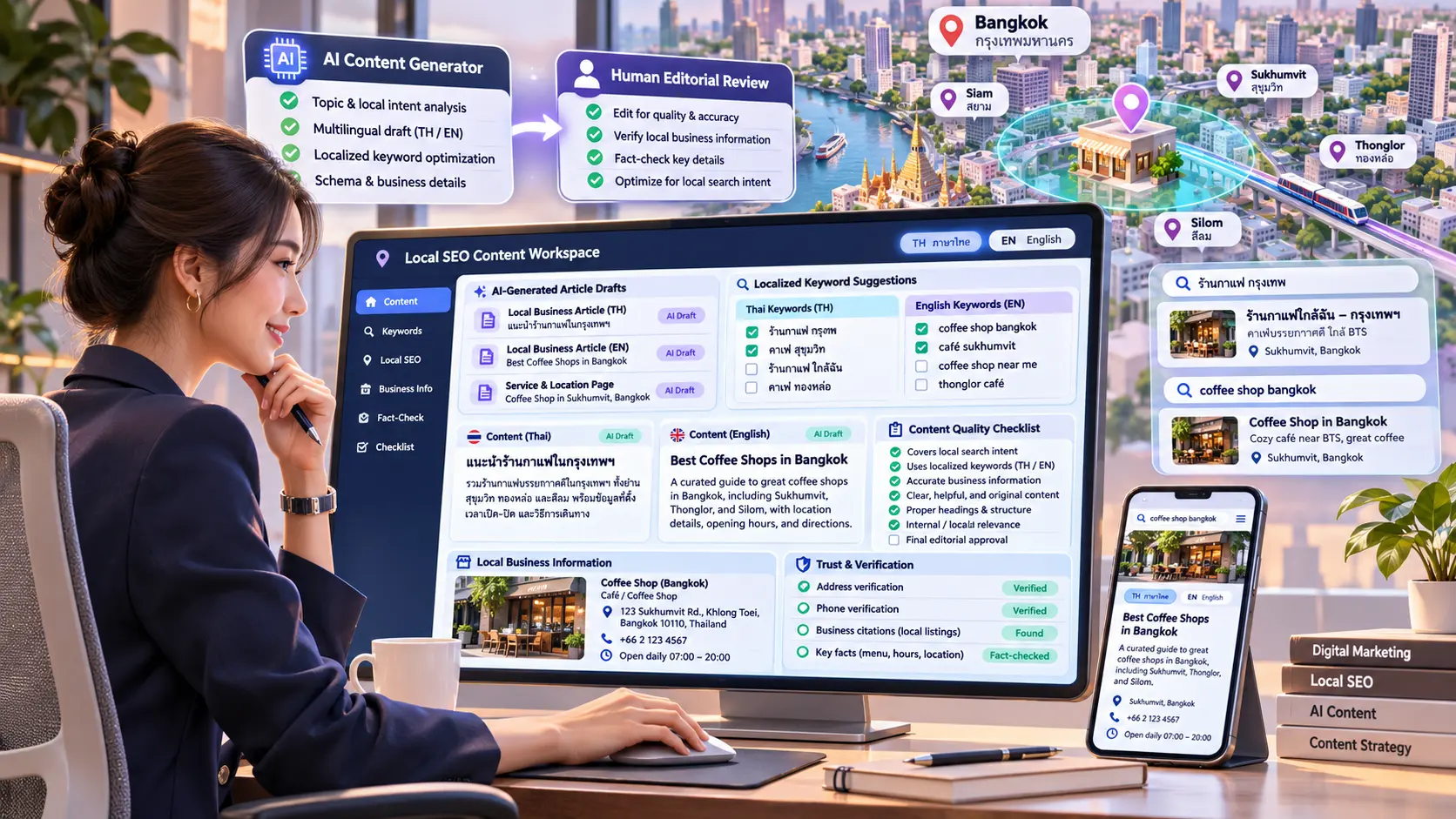
To succeed in today’s highly competitive digital landscape, marketing teams must find a sustainable way to merge mass production with hyper-local relevance. Raw AI output offers incredible speed, but human refinement is required to capture regional nuances and secure top local rankings. For example, achieving effective SEO in Bangkok involves understanding subtle cultural nuances, geographical relevance, and mixed-language search habits that an automated tool simply cannot grasp on its own. Whether you are managing campaigns globally or targeting specific regional hubs, local knowledge remains paramount.
Building a Scalable Content Foundation
The advantages of automating your initial content creation process are undeniable. Recent market reports indicate that marketing teams combining AI tools with built-in SEO optimisation and human brand training can increase their production speed by eight times whilst cutting costs by up to 80%. By the start of 2025, a significant majority of B2B digital marketing businesses had already successfully integrated these generation tools into their core scaling efforts. This shift underscores a reality in modern marketing; manual drafting alone cannot keep pace with the massive demands of an international audience.
To achieve this unprecedented level of efficiency, developers and site owners must implement robust automated pipelines tailored to their specific technical ecosystem. For WordPress users, this often begins with installing an AI content generator plugin to rapidly create multilingual posts and metadata. These foundational tools handle the heavy lifting of scheduling, formatting, structuring data, and generating high-volume drafts across multiple languages. Once the technical workflow is firmly established and seamlessly generating raw content, the strategic focus must immediately shift to regional customisation and editorial review.
Why Search Engines Demand Human Refinement
While automation provides the necessary volume to compete, search engines actively monitor how that volume impacts the end-user experience. Google’s monumental March 2024 Core Update permanently altered the digital landscape by integrating the helpful content system directly into the core ranking algorithm. This shift successfully reduced low-quality, unoriginal search results by 45% and introduced strict new spam policies targeting scaled content abuse. Sites that mass-produce content solely to manipulate rankings without adding original value face severe manual penalties. Therefore, relying on unmodified, machine-generated text represents a significant operational risk rather than a sustainable business strategy.
To rank safely and consistently, site owners must demonstrate strong Expertise, Experience, Authoritativeness, and Trustworthiness (E-E-A-T). In fact, Google Search Central’s official generative AI content guidelines clarify that it is critical to manually fact-check and review all AI-generated content for accuracy and trustworthiness before publishing. Search algorithms evaluate not just what is said, but who is saying it, rewarding content that displays genuine human insight and verifiable expertise.
This need for human oversight is especially critical in complex international markets. Consider Thailand, where Google maintains an overwhelming dominance with a 99.56% search engine market share. Search behaviour in the capital is distinctly bilingual, with users frequently mixing both Thai and English within the exact same search phrase. Because basic AI translation cannot accurately interpret these sector-specific search habits, local specialists must step in to meticulously refine automated drafts for cultural relevance, tone, and correct colloquial usage.
Strategies for Localising Automated Content
Bridging the gap between automated scale and regional search intent requires a highly structured editorial process. Site owners should layer human-driven local optimisation on top of their AI outputs by focusing on several key areas designed to maximise user engagement.
- Target bilingual search queries: Ensure your keyword strategy reflects how locals actually search. Instead of relying on direct translations, blend languages naturally where appropriate to match regional behaviour. A structured approach to creating multilingual AI content can help teams prepare content in different languages, while local editorial review ensures cultural accuracy. Doing so ensures your pages capture highly qualified, intent-driven traffic that competitors might miss.
- Build human trust signals: Trust remains critical for converting automated traffic into physical footfall. A 2025 consumer behaviour study found that 91% of customers search online before interacting with a local business, and 85% of those searchers visit the physical location within one week. Furthermore, 97% of consumers read online reviews before choosing a provider, meaning client testimonials must be manually woven into your AI service pages. Integrating authentic human experiences helps to counterbalance the clinical tone sometimes produced by artificial intelligence algorithms.
- Optimise for mobile performance: With the widespread expansion of 5G infrastructure throughout major global cities, mobile-first optimisation and fast page-load speeds are absolute necessities for local ranking success. Automated imagery must be compressed and formatted correctly.
- Adapt to evolving discovery methods: A growing segment of younger consumers are initiating local searches directly within social applications like TikTok and LINE, alongside modern AI assistants. Content must be structured to answer direct queries concisely for these diverse platforms. Marketers should also understand how to track AI search traffic in GA4 and Google Search Console to assess visibility, referral visits, and meaningful business outcomes.
Consumer reliance on artificial intelligence for local business discovery is accelerating rapidly. In 2026, 45% of consumers reported using generative AI assistants to find local businesses, up drastically from just 6% the previous year. As these sophisticated technologies continue to evolve, the most successful brands will be those that use AI to build their structural foundation but rely on expert human insight to master the local market. Balancing technological scale with authentic regional expertise remains the definitive blueprint for dominating modern local search results.