Summarize This Article With AI
Direct answer: RAG development cost has two parts: the one-time work to connect and prepare knowledge, build and test retrieval, secure the application, and deploy it; and the ongoing expense of model calls, search infrastructure, data refreshes, evaluation, monitoring, and support. There is no dependable fixed price for every RAG project. The most useful budget is a scoped engineering estimate plus a monthly usage model—not a price-per-token quote on its own.
Key takeaways
- Separate build from operations. A retrieval-augmented generation (RAG) proof of concept is not a production deployment with access controls, monitoring, and recovery procedures.
- Your documents determine much of the work. Clean, permissioned content is easier to index than fragmented PDFs, duplicated policies, scanned records, and constantly changing data.
- Estimate usage explicitly. Model input/output tokens, retrieval requests, indexing frequency, support hours, and human review all matter.
- Include acceptance tests before launch. A cheap system that cites the wrong document or exposes restricted content has not met the business requirement.
- Demand a comparable quote. Ask every implementation partner to price the same data sources, evaluation targets, integrations, exclusions, and post-launch responsibilities.
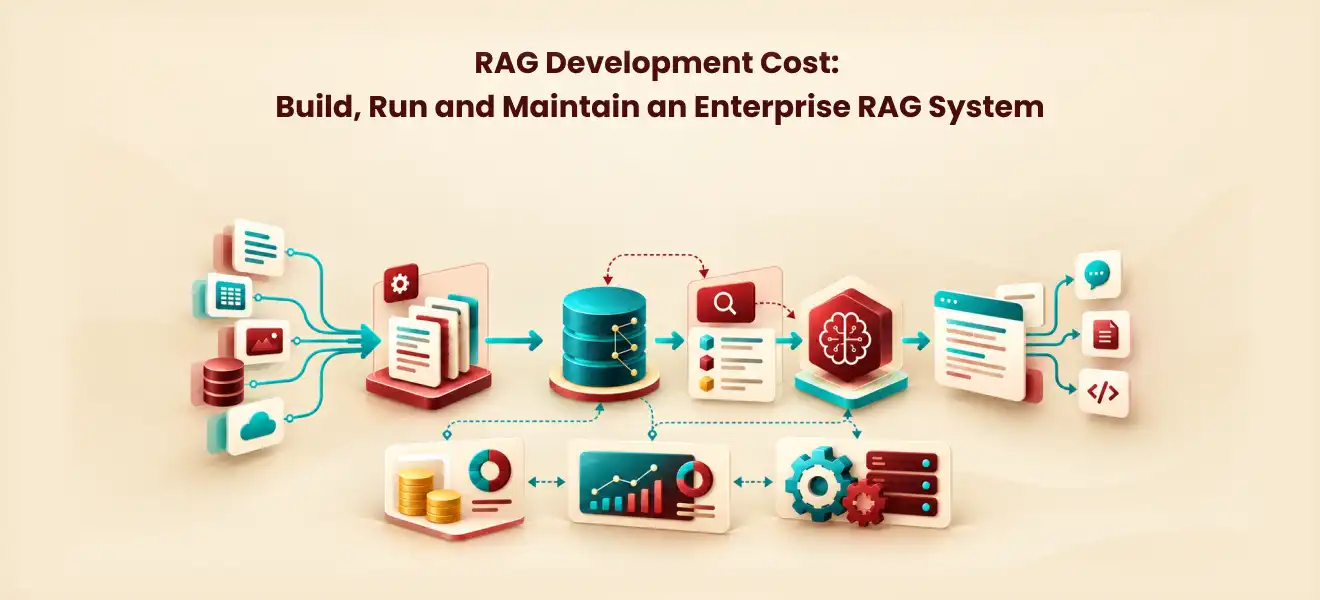
A RAG system retrieves approved source content and supplies it to a language model when answering a user’s question. It may use keyword, vector, or hybrid search, and its answers should be evaluated against their supporting evidence. Microsoft’s RAG architecture guidance explains why retrieval, indexing, grounding, evaluation, and access controls are separate parts of the solution. Those parts are also separate budget decisions.
The goal of this guide is to show how a US business can estimate a realistic RAG implementation budget, stress-test monthly operating costs, and write a scope that can be quoted. All labor rates, project hours, infrastructure allowances, and financial scenarios below are illustrative assumptions, not market averages, vendor offers, or WebbyCrown quotes. Where a live public API price is used, it is identified by name and date.
1. What Do You Actually Pay to Build a RAG System?
A proposal that says “RAG chatbot: one fixed price” conceals important scope choices. A well-scoped RAG development project should account for the knowledge sources, the retrieval pipeline, the user experience, the security model, and proof that the answers work for the intended task.
| Cost component | What the work includes | Questions that change the estimate |
|---|---|---|
| Discovery and data audit | Identify users, use cases, documents, owners, and sensitive fields | Are the source files current, readable, and permissioned? |
| Ingestion and preparation | Connect sources; parse, clean, deduplicate, chunk, and update content | How many formats, systems, languages, and refresh cycles? |
| Retrieval and indexing | Embeddings, keyword/vector/hybrid search, filters, reranking, and citations | Are exact terms, permissions, or cross-document answers essential? |
| Application and integrations | Interface, APIs, identity, SSO, CRM/portal embedding, fallback paths | Must users work inside an existing product? |
| Evaluation and security | Test questions, relevance labels, access tests, prompt-injection defenses, audit logs | Who owns failure thresholds and high-risk answers? |
| Deployment and handover | Environments, observability, alerts, backups, documentation, and ownership | What uptime, response time, and escalation coverage are required? |
These are engineering work packages, not vendor line items you can safely estimate by document count alone. Five thousand tidy product articles with consistent metadata may be simpler than 300 scanned contractual documents with conflicting versions and restricted access. Total corpus size matters, but so do its structure and governance.
Proof of concept, production application, or enterprise platform?
A proof of concept (PoC) should answer a narrow feasibility question. It can work with one approved corpus, a representative question set, a basic interface, and limited users. It should also demonstrate when retrieval fails rather than only showing polished examples. Its budget should not silently include production readiness.
A production RAG application needs repeatable ingestion, defined access rights, deployment automation, support ownership, and monitoring. If a document changes today, someone must know when its indexed representation becomes current. If the index is unavailable, users need a controlled fallback, not a confident fabricated answer.
An enterprise platform may serve departments with different document permissions, integrate multiple repositories, manage regional or tenant boundaries, and pass formal security and operational reviews. These are separate requirements that can add development, validation, and recurring administration cost. Do not compare an enterprise proposal with a demo estimate as though both deliver the same outcome.
Practical scoping rule: First specify one decision the assistant must improve, one defined group of users, and a list of approved source systems. Expand only after you can evaluate relevance and useful outcomes for that baseline.
2. RAG Implementation Cost: Build a Transparent Engineering Estimate
Instead of presenting unsupported “industry averages,” start with work packages and assumed effort. The following budget model is a hypothetical mid-sized, single-department production rollout for illustration. It assumes existing APIs are available, no bespoke model training is needed, and the organization has already approved its source data for use.
| Work package | Illustrative hours | Assumed rate | Illustrative amount |
|---|---|---|---|
| Data audit, parsing, and ingestion | 100 | $100/hour | $10,000 |
| Retrieval/index design and tuning | 100 | $100/hour | $10,000 |
| Application, API, and identity integration | 80 | $100/hour | $8,000 |
| Security and permissions implementation | 60 | $100/hour | $6,000 |
| Evaluation harness and acceptance testing | 50 | $100/hour | $5,000 |
| Deployment, monitoring setup, and handover | 30 | $100/hour | $3,000 |
| Illustrative one-time build total | 420 | Assumed, not quoted | $42,000 |
Calculation: 420 assumed engineering hours × an assumed fully loaded $100 per hour = $42,000. This is neither a WebbyCrown estimate nor an independently measured market median. Your actual scope, staffing model, internal effort, and commercial terms may be completely different. It also excludes procurement, tax, major document remediation, specialized compliance work, third-party licenses, and later scope changes.
To build your own version of the model, replace each hour estimate with a reviewed range: low, expected, and high. Do the same for the loaded engineering rate. Have both IT and the business owner approve what “complete” means for each row, including a testable deliverable.
Scope choices that raise or lower development effort
Data preparation. Document extraction can be straightforward for structured HTML and more demanding for mixed tables, scanned pages, diagrams, OCR errors, and versioned policies. Budget time to resolve duplicates, stale content, content ownership, and missing metadata; embedding poor text does not repair it.
Retrieval quality. A keyword-only baseline may be adequate for exact policy codes or SKU names. Vector search can help with semantically phrased questions. Hybrid search, reranking, and metadata filters can be justified when measured against your test set. Microsoft’s retrieval engineering guidance explicitly recommends comparing retrieval approaches against representative queries, including quality, cost, and latency. For an implementation-level explanation, see WebbyCrown’s hybrid search for RAG guide.
Permissions. A company handbook and confidential finance records should not share unrestricted retrieval. Security filters must be applied before retrieved content reaches the language model. Building and testing permission-aware retrieval across different user roles can be a significant project within the project.
Evaluation. Write representative questions and expected evidence with actual knowledge owners. Test citations, missing-answer handling, conflicting documents, wrong permissions, and outdated content. The RAG evaluation metrics guide explains why retrieval quality and answer faithfulness should not be collapsed into one vague “accuracy” claim.
Integrations and delivery. A standalone pilot is very different from a system that must work in an intranet, customer portal, or CRM with SSO, logging, and an established incident process. Estimate the interface and operational handover separately.
3. What Does a RAG System Cost to Run Each Month?
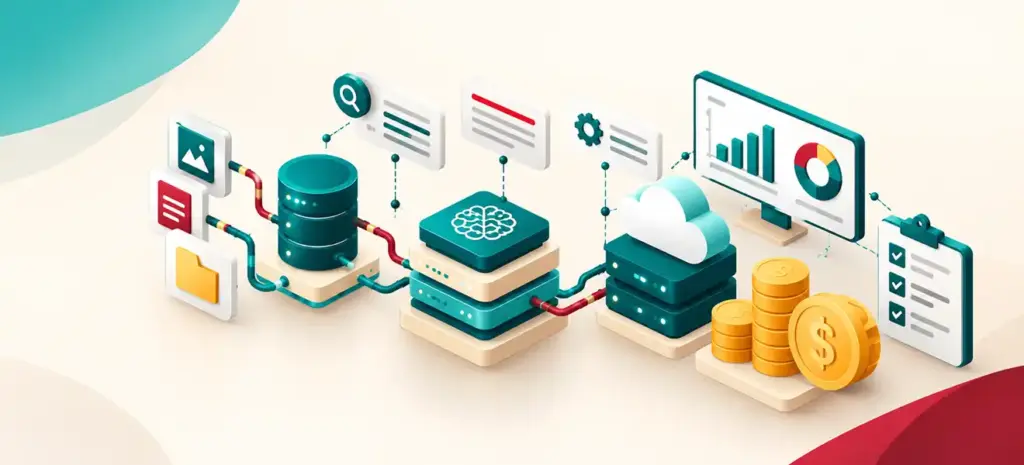
The recurring bill is a stack of services and people, not just a generative-model charge. Microsoft identifies retrieval operations, embeddings, and added prompt tokens as RAG-specific contributors to cost and latency. See its official RAG guidance.
| Monthly cost line | How to estimate it | Common blind spot |
|---|---|---|
| Model generation | Input tokens × input rate + output tokens × output rate | Retrieved passages and retries expand input usage |
| Query embeddings | Queries × embedding tokens per query × unit rate | Query rewriting or multiple retrieval attempts |
| Index refreshes | New/changed source tokens × embedding rate | Reprocessing unchanged or duplicate documents |
| Search/index hosting | Selected service tier, compute/storage, requests | Minimum capacity, replicas, and retention |
| App/logging infrastructure | Compute, bandwidth, telemetry, secure storage | Environments, logs, and backup/restore |
| Evaluation and support | Human review hours, incident response, tuning | Ongoing quality checks, permission changes |
| Other features | OCR, rerankers, translation, compliance controls | Charged requests, premium options, regions |
A low per-million-token rate is useful for one row of this table. It does not make the remaining rows zero. In particular, a system with 10,000 monthly questions can need continuous source synchronization, on-call response, and review of unanswered or wrong answers even if its model bill is modest.
A worked model-and-embedding calculation
The following example uses publicly listed OpenAI API rates checked October 27, 2026, as neutral pricing evidence only, not a recommendation of any vendor or product. The model documentation lists GPT-5.4 Mini at $0.75 per 1 million input tokens and $4.50 per 1 million output tokens, while `text-embedding-3-small` is listed at $0.02 per 1 million embedding input tokens. Rates, eligibility, regional uplifts, and model availability may change; check the generation model price and embedding model price before publishing or implementing. This illustration assumes standard token billing with no discounts, regional uplifts, extra tool calls, or other model usage.
Assume a RAG application processes 10,000 questions per month, with an average 3,000 billable model input tokens, 350 output tokens, and 100 query-embedding tokens for each question. Suppose an initial batch of approved documents requires 50 million embedding input tokens to index once.
| Hypothetical usage | Calculation at cited rates | Result |
|---|---|---|
| Generation input, monthly | 10,000 × 3,000 = 30M tokens × $0.75/M | $22.50 |
| Generation output, monthly | 10,000 × 350 = 3.5M tokens × $4.50/M | $15.75 |
| Query embeddings, monthly | 10,000 × 100 = 1M tokens × $0.02/M | $0.02 |
| Monthly modeled API subtotal | Generation + query embeddings | $38.27 |
| Initial document embeddings, one-time | 50M tokens × $0.02/M | $1.00 |
What this does not mean: A secure RAG platform costs $38.27 a month. That figure excludes vector/index hosting, application hosting, ingestion pipelines, retries, reranking, OCR, networking, monitoring, human review, maintenance, taxes, support, and model-dependent processing differences. Large reasoning or multi-step pipelines can use additional billable tokens. It is a deliberately narrow metered-API illustration.
A complete monthly operating scenario
Add the following invented planning assumptions to that same 10,000-query workload. These are placeholder budgeting figures, not verified vendor prices:
| Assumed operating line | Illustrative monthly expense |
|---|---|
| Model generation and query embeddings (calculated above) | $38.27 |
| Managed search/index infrastructure (assumed allowance) | $350.00 |
| Application hosting, logging, backups (assumed allowance) | $200.00 |
| Quality review: 10 hours × assumed $75/hour | $750.00 |
| Support/tuning: 6 hours × assumed $100/hour | $600.00 |
| Illustrative monthly operating total | $1,938.27 |
That is $23,259.24 annually at the same monthly usage and assumptions, excluding the $1 one-time initial embedding and any document refresh or other unmodeled charges. If the illustrative build from Section 2 cost $42,000, the illustrative first-year cost is $65,260.24 ($42,000 + $23,259.24 + $1). Over an assumed 120,000 annual questions, that is approximately $0.54 per question in year one, including the one-time build. In subsequent years, the operating-only modeled figure is about $0.19 per question, if volumes, rates, requirements, and support effort stay unchanged.
This is a budgeting worksheet, not an offer or universal cost benchmark. A regulated deployment, higher traffic, multiple data stores, private hosting, complex retrieval, or a different model can change the result substantially. In your own forecast, separate the initial build, contracted recurring expenses, variable usage charges, and the risk reserve.
4. Where RAG Budgets Commonly Go Wrong
A good business case should identify the failure mode and who pays to correct it. The largest underestimated items are often not the initial embedding calls but the work needed to make the answer safe, reliable, and useful.
Treating every source document as equally trustworthy
A knowledge base may contain archived procedures, unpublished notes, conflicting versions, and documents with different permission levels. Without document owners and lifecycle metadata, the system may retrieve obsolete or restricted material. The project then needs additional classification, version selection, deletion handling, and content approval. This should be discovered before promising a rollout date.
Treating retrieval evaluation as an optional extra
The model can sound confident when it was given poor context. Separate retrieval quality (did we fetch the right passages?) from answer quality (was the claim supported, complete, and appropriate?). Build an evaluation set that includes common requests, critical edge cases, unanswerable questions, and permission tests. Microsoft’s RAG evaluators describe retrieval-focused measures and how they differ from answer-level assessment.
Define quality gates before production. For example, agree with business owners on a minimum acceptable result for each critical test category, an escalation path for missing citations, and a review cadence. Do not invent a universal “95% accuracy” threshold: the acceptable error profile depends on the task and the harm an incorrect answer can cause.
Underbudgeting security and operational recovery
Retrieved content is untrusted input. A document can contain instructions intended to manipulate model behavior, and an improperly partitioned index can disclose information between roles or tenants. OWASP’s LLM08 vector and embedding guidance describes these risks and recommends permission-aware access, source validation, and monitoring. Budget for threat modeling, access testing, logging, retention decisions, and incident response rather than treating these as final-day checks.
For high-impact answers, require confirmation or human approval before the system triggers external actions. Allow the application to refuse or defer a question when evidence is unavailable. Preserve a kill switch for risky workflows and a way to revoke access rapidly if permissions change. If an ordinary search interface meets the requirement more safely, do not pay for generation merely because RAG is fashionable.
Ignoring the cost of content freshness
Freshness means more than scheduled re-embedding. It requires recognizing a source update, identifying which records changed, invalidating stale chunks, retaining appropriate audit history, and testing whether the new policy appears in answers. An index that was accurate at launch can become misleading after a policy, product, or access change. Include update frequency, failure alerts, and source owners in the quote.
Confusing larger context with better retrieval
Sending more passages to a model can increase input tokens without improving accuracy. Measure retrieval relevance, rerank selectively, respect source boundaries, and use small controlled tests to find the best balance of answer quality, latency, and cost. The existing RAG chunking strategies guide covers one component of this trade-off; this article’s purpose is to attach budget consequences to those design decisions.
5. How to Reduce RAG Cost Without Reducing Trust
The right optimization target is not simply “lowest cost per question.” It is cost per accepted, appropriately grounded answer under defined quality, access, and latency conditions. A faster but less reliable system can increase escalations and rework.
Start with one business workflow. Use a bounded source corpus and a representative set of actual questions. Avoid indexing every file the company owns before you know which sources solve the target problem. A focused pilot creates a baseline you can expand deliberately.
Reuse infrastructure where it makes sense. Evaluate an existing document store, search stack, identity provider, and deployment pipeline before buying a new service. Reuse is only economical when the current stack can satisfy permissions, reliability, and retrieval requirements. “Free to install” software still has hosting and maintenance cost.
Use retrieval methods that prove their value. A single keyword or vector search may be enough for some tasks. Add hybrid retrieval or reranking when your evaluation set demonstrates a relevant gain. If you introduce more searches or models per answer, include those calls in both latency and cost measurements.
Reduce unnecessary tokens. Remove duplicate context, constrain passage counts, use clear answer formats, and route simple tasks appropriately. Use caching only when it will not serve outdated or unauthorized content. Record the effective number of billable tokens per accepted answer, not just the advertised model rate.
Limit re-indexing to changed content. Use document IDs, update timestamps, and change detection where supported. Track failed ingestion jobs and access-rule changes. It may be economical to refresh high-change sources frequently and static reference sources less often; the decision needs a documented freshness requirement.
Keep human review proportional to risk. You do not need the same approval process for a low-impact FAQ draft and an answer involving finance, legal rights, or regulated decisions. Classify workflows and route sensitive or low-confidence cases to people. For risk governance, NIST’s Generative AI Profile provides a voluntary framework that can inform requirements and oversight.
Review performance with real usage. At minimum, track: query volume, answer acceptance or escalation, retrieval relevance on labeled tests, groundedness, citation validity, p95 latency, permission violations, monthly infrastructure spend, model tokens, and hours spent maintaining the system. Publish neither a success rate nor a cost-saving claim without measurements.
6. How to Budget ROI and Compare RAG Development Quotes
RAG is worthwhile when it improves a measurable workflow enough to justify the build and ongoing responsibility. For some businesses, the value is shorter support handling time; for others, faster document lookup or more consistent internal answers. Do not equate a generated response with a resolved customer issue or a dollar saved.
A break-even illustration
Using the hypothetical first-year total of $65,260.24 from the earlier example, suppose each verified successful case saves 20 minutes of a staff member’s time, and that staff time is valued at an assumed loaded cost of $30/hour. That is an illustrative $10 benefit per successful case (20/60 × $30). On these assumptions, the team would need at least 6,527 verified time-saving cases per year to approximately cover that first-year cost before considering other benefits and exclusions; to exceed it, use 6,527+ cases rather than claiming a guaranteed return. This is not a forecast. Actual savings depend on whether capacity is redeployed, errors decline, users adopt the tool, and the saved time has economic value.
A safer ROI model uses four values: (1) eligible workflow volume, (2) measured adoption, (3) verified time or rework saved per accepted outcome, and (4) the fully loaded cost of the workflow. Subtract ongoing operation, human oversight, residual errors, and the amortized build expense. If the system increases review time or introduces risk, subtract those effects as well.
Quote-comparison checklist
Before choosing a development partner or approving internal engineering work, insist that every quote answers the same questions:
- Use case: Which workflow, users, expected outcomes, and out-of-scope use cases are named?
- Source inventory: Which repositories, file formats, owners, permissions, and refresh requirements are included?
- Data readiness: Who handles OCR, deduplication, metadata correction, and restricted information?
- Retrieval: Which baseline and alternative search approaches will be evaluated, and against which questions?
- Evidence quality: What are the citation, refusal, human-approval, and escalation rules?
- Security: Where are source permissions enforced, how are secrets handled, and what is logged or retained?
- Deployment: Who owns hosting, alerting, incident response, backups, and disaster recovery?
- Acceptance: What signed-off quality, latency, and access tests are required before launch?
- Commercial terms: Which work is fixed-fee, time-and-materials, third-party subscription, or client responsibility?
- Ongoing costs: What does the supplier expect to monitor, update, re-evaluate, and support each month?
For a broader technical architecture discussion beyond budgeting, WebbyCrown’s enterprise knowledge assistant RAG architecture guide explains the permission-aware design choices that procurement teams should ask about. If you have a defined use case and need a scoped implementation assessment, review WebbyCrown’s RAG development services and bring a source inventory and sample questions to the discussion.
A credible proposal should identify assumptions, explicitly excluded work, milestones, acceptance evidence, responsibilities after handover, and the conditions under which costs might change. If a supplier will only quote a token price, the solution scope is incomplete.
Frequently Asked Questions
How much does RAG development cost for a proof of concept?
A PoC can be estimated only after defining one use case, source corpus, test questions, and minimal access requirements. Its main deliverable is evidence of feasibility, not production uptime or enterprise security. Use work-package estimates rather than treating a generic online price range as a quotation.
What is the biggest factor in enterprise RAG implementation cost?
There is no universal single factor. Data readiness, number of repositories, retrieval quality targets, access rules, integration scope, and operational requirements interact. A small but sensitive document library can be more expensive to implement safely than a larger public reference corpus.
Do embeddings cost more than the language model?
Not necessarily. Embeddings are commonly billed for source indexing and query preparation, while the language model is called to generate answers. In the worked example above, generation costs more than the assumed embedding calls, but infrastructure, model selection, refresh frequency, and workload can change the balance.
Do we need a paid vector database to build RAG?
Not always. Some projects can reuse search infrastructure or database extensions that support the required retrieval mode. Evaluate total operational cost, permissions, reliability, and performance rather than assuming a new managed vector database is mandatory or that self-hosting is free.
How does document volume affect RAG cost?
More content can increase parsing, indexing, and storage work, but quality and format often change effort more than raw file count. Frequent updates, scans, language variation, metadata gaps, or inconsistent access rules create additional engineering and ongoing management work.
Is a RAG chatbot cheaper than an enterprise knowledge assistant?
A limited chatbot may have fewer user interfaces and integrations, but the label alone says little about cost. An internal assistant with permission-aware cross-system search, evaluation, and audit requirements can demand more work than a simple public FAQ bot. Compare functional scope, not branding.
How often should we re-index a RAG knowledge base?
Set an update policy based on how quickly each source changes and how harmful stale answers could be. Incremental refreshes may help limit unnecessary work; verify that deletions, permissions, and superseded policies are also reflected promptly.
How do we prevent cost spikes after launch?
Measure token use per request, cap unnecessary retries, monitor search and model calls, alert on ingestion loops, and track spend by feature or department. Set usage budgets and escalation paths, and review whether added reasoning, reranking, or retrieval steps improve accepted-answer quality.
When should a company avoid custom RAG development?
Consider an existing search tool or simpler rules-based system when users only need to find exact documents, the knowledge set is stable and small, or data governance is not ready. Custom RAG is hard to justify if you cannot define useful answers, source ownership, and acceptance tests.
What information should we prepare before asking for a RAG development quote?
Bring your user groups, top questions, sample approved documents, source systems, access roles, target integrations, expected monthly requests, response-time needs, data freshness requirements, and acceptance criteria. Ask partners to separate one-time build, usage-based charges, and post-launch support.
Conclusion: Budget the Whole System, Not Just the Model
RAG development cost is determined by the work required to produce reliable, permission-correct answers and by the people and infrastructure needed to keep them reliable. Build a budget from the data, retrieval, integration, evaluation, security, and operations scope; then model recurring token and infrastructure usage separately. A limited PoC can establish whether the approach works, but only defined acceptance tests and ownership make it ready for a production business workflow.
For teams ready to move from a rough budget to an implementation scope, explore WebbyCrown’s RAG development services with your sample queries, approved knowledge sources, and support requirements. That gives both sides a practical basis for estimating work without treating a generic figure as a promise.