Summarize This Article With AI
The B2B ecommerce market is booming, with Forrester Research predicting it will reach $35.2 trillion by 2026. As digital native millennials enter the decision making process and mobile commerce takes off, businesses are moving from traditional sales processes to online platforms fast. But not all ecommerce platforms are created equal—choosing the right b2b ecommerce platform requires understanding your business needs, technical capabilities and long term strategy.
This guide will take you through everything you need to know about choosing the best b2b ecommerce platforms for your business, from features and platform comparisons to implementation and future trends.
What are B2B Ecommerce Platforms?
A b2b ecommerce platform is specialized cloud-based software designed specifically for business-to-business transactions, enabling companies to sell products and services to other businesses through digital channels. Unlike traditional B2C ecommerce solutions that focus on individual consumers, these platforms cater to the complex requirements of wholesale transactions, bulk ordering, and intricate corporate account management.
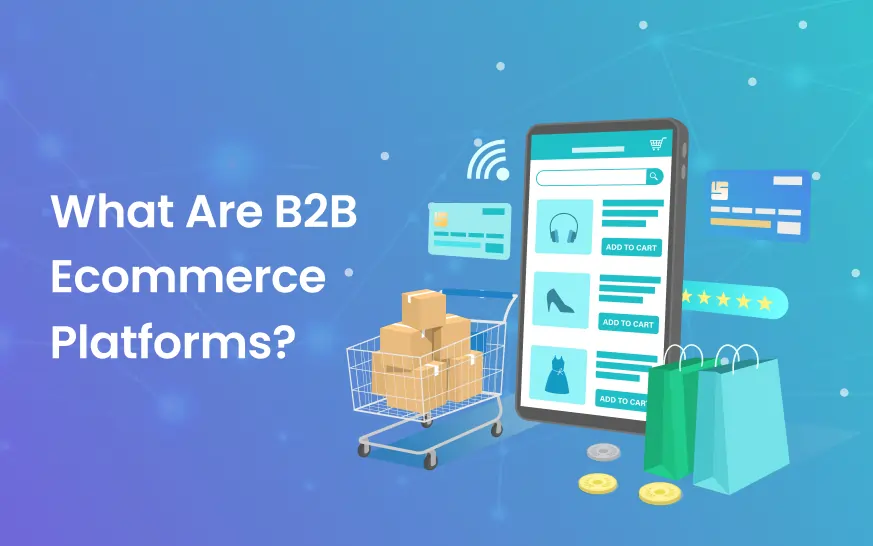
A b2b ecommerce platform is cloud based software designed for business to business transactions, allowing companies to sell to other businesses through digital channels. Unlike b2c ecommerce solutions that focus on individual consumers, these platforms cater to the complexities of wholesale transactions, bulk ordering and corporate account management.
The main difference is in functionality. While b2c platforms focus on user experience and quick checkout, b2b ecommerce solutions focus on custom pricing, contract pricing and extensive customisation.
Key features that differentiate B2B platforms are:
Restricted Access and Account Based Commerce: B2B platforms provide controlled access to customer accounts, showing only relevant products and pricing for specific customer segments. This allows businesses to have different product catalogues and pricing for different customer groups.
Complex Approval Workflows: These platforms accommodate multi level approval processes common in corporate purchasing where multiple buyers and stakeholders need to review and approve orders before completion. This includes spending limits, departmental budgets and role based permissions.
Advanced Integration: Modern b2b ecommerce platforms integrate with existing business systems including erp systems, crm systems and marketing tools. This seamless integration ensures unified customer data across all touchpoints and streamlines operations.
Sophisticated Pricing Models: Unlike fixed retail pricing, B2B platforms support tiered pricing, volume discounts, customer specific pricing and contract based rates that adjust dynamically based on purchase history, customer segments and negotiated agreements.
These platforms are key to digital transformation for manufacturers, wholesalers and distributors by automating manual processes and enhancing customer experience through self service portals and streamlined operations.
The B2B Ecommerce Market in 2026
The b2b ecommerce landscape is changing fast, driven by changing buyer behaviour and technology. Market size projected to be $35.2 trillion by 2026 according to Forrester Research is a reflection of the rapid shift to digital commerce in the business world.
Recent studies show 77% of B2B buyers prefer self service purchasing options over traditional sales interactions. This preference for self service account management is a fundamental change in how businesses want to transact, so we need online stores that allow businesses to research, configure and purchase products independently.
Mobile commerce is becoming more important, 73% of B2B buyers use mobile devices during research phases. This means mobile optimisation across all platform features from custom catalog browsing to order processing and customer account management.
Several growth drivers are shaping the market:
Digital-Native Decision Makers: As millennials take over leadership roles they bring expectations of streamlined, technology driven purchasing experiences similar to their personal shopping habits.
Remote Work Adoption: The shift to remote work has accelerated demand for digital procurement solutions that allow distributed teams to collaborate on purchasing decisions.
Supply Chain Digitization: Companies are realising the operational efficiencies of automated inventory management, real time inventory management and integrated order processing systems.
Customer Experience Expectations: B2B buyers expect the same level of personalisation and user experience as they get in B2C transactions, so we need advanced features like personalised catalogs and AI powered recommendations.
Essential Features of Modern B2B Ecommerce Platforms
Customer-Specific Catalogs and Pricing
Modern ecommerce platforms deliver personalized experiences through customer specific catalogs that show only relevant products for each buyer. This allows you to:
- Control Product Visibility: Restrict access to specific products based on customer agreements, geographic restrictions or product categories
- Account-Based Pricing: Show customer specific pricing that reflects negotiated rates, volume discounts or contract terms
- Complex Pricing: Manage tiered pricing where costs decrease based on purchase volumes or customer loyalty levels
- Dynamic Pricing: Update pricing in real-time based on inventory levels, customer purchase history or market conditions
Advanced platforms use complex algorithms to optimize inventory management by analyzing customer behavior and purchase patterns, so you can predict and suggest automated reordering.
Advanced User Management
Good corporate account management requires robust user management that can handle complex organizational structures:
Multi-Level Approval Workflows: Configure approval processes that route orders to the right people based on order value, product category or departmental budgets. These workflows can have multiple buyers, budget approvers and final authorizers.
Role-Based Permissions: Assign granular permissions that control what users can see, order and approve. Common roles are:
- Buyers with ordering limits
- Approvers who review and approve purchases
- Administrators who manage account settings and user access
- Viewers who can see order history and account info
Departmental Controls: Allow organizations to have separate budgets, approval chains and product catalogs for different departments or cost centers so you can have proper financial controls and compliance.
ERP and CRM Integration
Seamless integration with your existing systems is the backbone of b2b ecommerce:
ERP Integration: Connect with major erp and crm systems like sap commerce cloud, microsoft dynamics, NetSuite and Oracle to sync critical business data. These integrations allow:
- Real time inventory management to prevent overselling
- Automated order processing that flows into fulfillment systems
- Synchronized customer data to keep data consistent across platforms
- Unified financial reporting to consolidate online and offline sales
CRM Integration: Integration with crm systems gives sales reps comprehensive customer insights, order history and behavioral data to improve customer relationships and upsell opportunities.
Third Party Apps and Extensions: Modern platforms have extensive ecosystems of third party apps that can handle specialized requirements like accounting, shipping or industry specific compliance.### Self-Service
Self service portals allow customers to manage their own relationships and reduce admin burden on your sales teams:
- Order Tracking and History: Customers can see order status, shipment tracking and full purchase history
- Reorder: Quick reorder of frequently purchased items or saved shopping lists
- Quote Management: Quote request, negotiation and conversion to order
- Account Analytics: Dashboards to see spending patterns, budget usage and purchasing trends
- Invoices and Payments: Access to invoices, payment status and flexible payment options including purchase orders and net terms
Top B2B Ecommerce Platforms Comparison
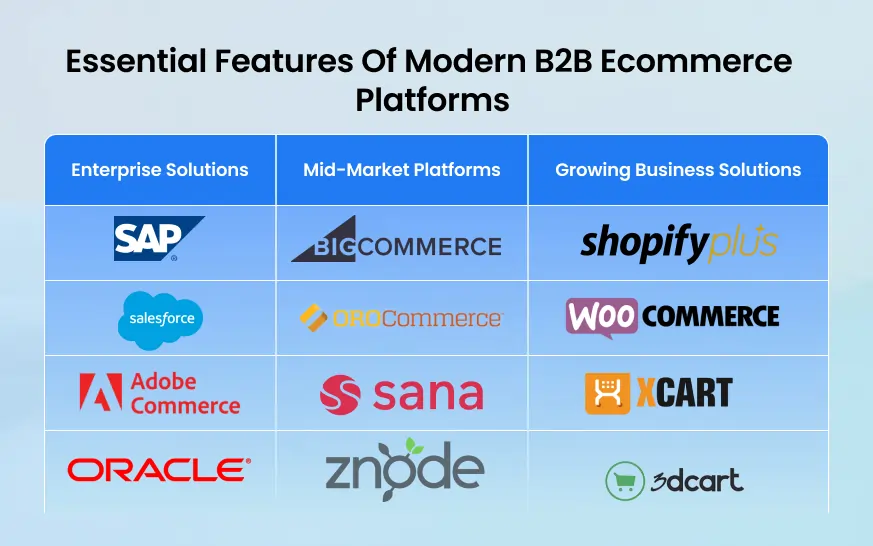
Enterprise Solutions
SAP Commerce Cloud is the go-to for large enterprises already invested in the SAP ecosystem. Pricing starts at $50,000+ per year and offers full integration with sap commerce cloud infrastructure and customization capabilities. It’s great for complex product configurations, multi-site management and global operations.
Salesforce B2B Commerce Cloud requires implementation costs of $150,000+ but is great value for organizations heavily using Salesforce CRM. It offers deep customer data integration, advanced analytics and automation tools to enhance customer relationships and sales performance.
Adobe Commerce (Magento) offers enterprise features with pricing starting at $22,000+ per year. Known for customization capabilities, it supports complex product catalogs, multi channel selling and sophisticated marketing tools. It’s flexible for businesses that need highly customized solutions.
Oracle Commerce Cloud offers enterprise features with robust support for complex product configurations and global commerce requirements. Pricing follows enterprise models but has powerful tools for inventory management and customer segmentation.
Mid-Market Platforms
BigCommerce B2B Edition is rapid deployment at $400-1,500/month with built-in b2b features including customer groups, custom pricing and approval workflows. You can launch fast and scale for growth.
OroCommerce is an open-source solution designed for B2B workflows. Hosting costs vary but offers deep customization and workflow automation tools to streamline operations.
Sana Commerce focuses on deep erp system integration, priced at $2,000+ monthly. It’s great for companies that prioritize integration over customization.
Znode offers headless architecture solutions from $1,000-5,000/month with extensive APIs and flexible features for businesses that need modern, API-driven commerce experiences.
Growing Business Solutions
Shopify Plus has the easiest setup at $2,000+/month with an extensive B2B app ecosystem. It’s scalable and user-friendly with minimal training required.
WooCommerce B2B uses WordPress flexibility with plugin-based B2B functionality, priced at $500-2,000/month including necessary extensions. It’s great for businesses already using WordPress.X-Cart has traditional B2B features with modern interfaces at $495-1,995/month for growing businesses without enterprise complexity.
3dcart has budget options at $79-229/month for smaller businesses just starting their digital journey.
Platform Selection Criteria
Business Requirements
Choosing the right ecommerce platform means evaluating specific business needs:
Product Catalog Complexity: How many SKUs, product variants and config options do you manage? Complex product catalogs with lots of customization require platforms with robust product info management.
Customer Base Analysis: Who are your customers—wholesale buyers, retail partners, distributor relationships—and what do they need? Different customer segments may require separate pricing, approval workflows and product access levels.
Order Volume and Transaction Analysis: Review current order patterns, average order values and seasonal fluctuations. High volume operations require platforms with robust order management and scalable infrastructure.
Integration Requirements: What business systems do you have—erp, crm, accounting software, warehouse management tools? Seamless integrations are key to operational efficiency and data accuracy.
Technical
Deployment: Cloud-based SaaS or on-premise? SaaS is faster to implement and lower maintenance, on-premise gives you more control and customization options.
Development Resources: How many technical resources do you have in-house to handle platform customization and integration projects? Some platforms require a lot of dev resources, others have a lot of out-of-the-box functionality.
API and Integration: Does the platform have robust APIs for custom integrations and support for your business systems? Modern platforms should have headless commerce for maximum flexibility.
Security and Compliance: Does the platform meet industry specific compliance requirements like PCI DSS, GDPR, SOC 2 or sector specific regulations? Security features should include data encryption, access controls and audit trails.
Budget and Timeline
Total Cost of Ownership: Calculate all costs—platform licensing, implementation services, customization, training and ongoing maintenance. Hidden costs can blow your budget.
Implementation Timeline: What are your go-live dates and plan accordingly. Enterprise platforms take 6-12 months to fully implement, mid-market 3-6 months.
ROI Projections: Build a business case for expected returns from operational efficiency, increased sales and customer satisfaction. Most see ROI within 12-18 months of implementation.
Implementation Best Practices
Implementation requires careful planning and execution across multiple phases:Data Migration is the foundation of a successful implementation. Start by auditing existing customer data, product catalogs and order history to identify data quality issues early. Clean and standardize data before migration to avoid ongoing operational problems. Create data mapping procedures to ensure customer accounts, pricing structures and product relationships transfer correctly to the new platform.
User Training should cover multiple stakeholder groups—sales teams, customer service reps, customer administrators. Create role-specific training materials that focus on daily tasks and common scenarios. Consider video tutorials and documentation that users can reference post-go-live.
Phased Rollout minimizes risk by starting with pilot customer groups before full deployment. Start with internal users and friendly customers who can provide feedback on functionality and user experience. Gradually roll out to additional customer segments while monitoring performance and gathering feedback.
Performance Monitoring and Optimization should start post-launch. Track key metrics—page load times, order completion rates, user engagement. Optimize search, product browsing and checkout based on real user behavior data.
Change Management ensures organizational adoption. Communicate benefits to internal teams and customers. Address resistance by showing how new processes improve efficiency and customer satisfaction. Provide support during the transition period to keep momentum.
Future Trends Shaping B2B Ecommerce Platforms
B2B ecommerce platforms are evolving fast and several trends are changing how businesses approach digital commerce:
AI-Driven Personalization and Predictive Ordering by Q3 2026 will change customer experiences through automation. Machine learning will analyse customer behaviour, purchase history and seasonal trends to give personalized product recommendations and automate repeat ordering. Advanced analytics will allow platforms to predict customer needs and suggest products or services.
Voice Commerce with Amazon Alexa for Business and Google Assistant will allow hands-free ordering and account management. This will be super useful for warehouse and field workers who need to order while doing other tasks.
Augmented Reality Product Visualization will help customers understand complex B2B products through interactive 3D models and virtual demos. This will be especially useful for machinery, equipment and technical products where visual inspection is key to the buying decision.
Blockchain Smart Contracts will automate purchasing agreements and ensure transparent and secure transactions. Smart contracts will execute orders when conditions are met, reducing manual processing and ensuring compliance with agreed terms.
Headless Commerce Architecture will reach 60% by 2026 allowing businesses to deliver consistent experiences across multiple channels while having flexibility in front-end design and functionality. This architecture supports omnichannel and allows for rapid adoption of new technologies.
Common Issues and Solutions
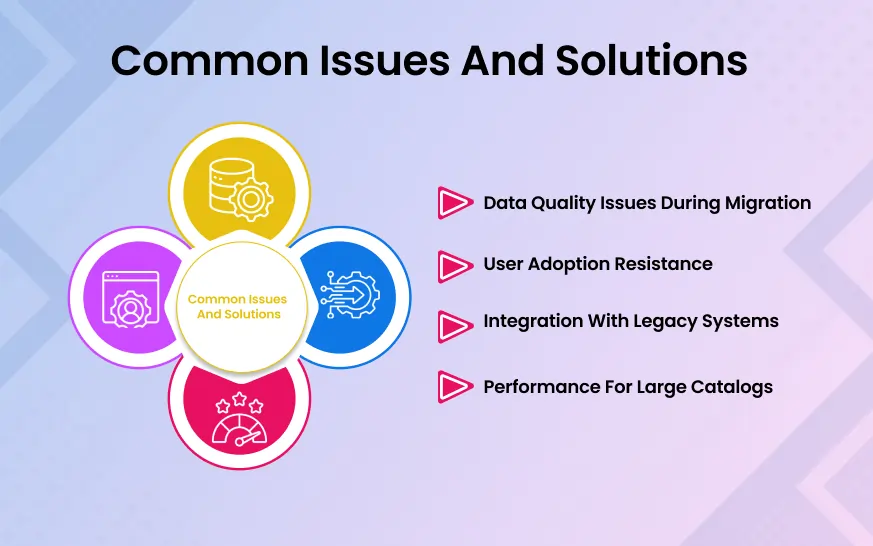
Despite careful planning, organizations run into predictable problems during platform implementations:
Data Quality Issues During Migration are the most common implementation roadblock. Legacy systems have duplicate records, inconsistent formatting and incomplete data. Fix these by implementing data cleaning protocols before migration, setting data governance standards and using automated validation tools to find inconsistencies.
User Adoption Resistance is usually due to change anxiety and unfamiliarity with new processes. Combat resistance with comprehensive training programs, clear communication on benefits and phased rollouts that allow users to adapt gradually. Identify platform champions within each user group who can provide peer support and encouragement.
Integration with Legacy Systems requires careful planning and often middleware solutions. Legacy erp systems may not have modern APIs, so custom development or third party integration platforms are required. Plan for extended integration timelines and consider phased approaches that gradually replace legacy system dependencies.
Performance for Large Catalogs becomes critical when managing thousands of products and complex configurations. Implement advanced search, optimize database queries and use caching to keep response times fast. Consider progressive loading for large product catalogs.
ROI and Success Metrics
Measuring return on investment from b2b ecommerce platform implementations requires tracking both quantitative metrics and qualitative improvements:
Order Processing Efficiency Gains typically see 40-60% reduction in manual tasks as automated workflows replace paper based processes. This efficiency translates to reduced admin costs and faster order fulfillment.
Customer Acquisition Cost Reduction happens through self service that reduces sales team involvement in routine transactions. Organizations see 20-30% reduction in acquisition costs as customers handle more of the purchasing themselves.
Average Order Value Increase of 15-25% comes from personalized recommendations, cross selling and bulk ordering. Advanced analytics helps identify upselling opportunities that would be missed in traditional sales processes.
Sales Team Productivity Gains come from automated workflows and better customer data. Sales reps can focus on relationship building and complex deals rather than routine order processing. Many organizations see 30-40% increase in sales team productivity.
Customer Satisfaction Improvements are measurable through Net Promoter Scores (NPS) and retention rates. Self service and faster order processing usually sees customer satisfaction scores increase by 25-35%.
Operational Efficiency Gains are seen through streamlined operations, reduced errors and better inventory management. Real time inventory management prevents stockouts and overordering, automated processes reduce human error rates. Measure baseline metrics before implementation and track monthly for the first year post launch. Key metrics should be order completion rates, average order processing time, customer portal usage and integration uptime.
The best implementations balance immediate operational gains with long term strategic benefits. While efficiency gains are quick wins, the real value comes from better customer experiences, more data visibility and a scalable business model that supports growth.
Choosing the right b2b ecommerce platform requires evaluation of business requirements, technical capabilities and long term strategic goals. The best b2b ecommerce platforms align with your organization’s needs and provide flexibility for future growth and change.
Success isn’t just about platform selection, it’s about thoughtful implementation that addresses change management, user training and system integration. Organizations that invest time in planning and execution will see big returns in operational efficiency, customer satisfaction and sustainable growth.