Summarize This Article With AI
Introduction to Ecommerce
Ecommerce platform market share is more than a number, it’s a guide for merchants to build, grow and scale. Ecommerce platforms are driving online shopping and digital sales globally and tracking ecommerce platform usage share helps businesses choose the right tools for their customers and goals. In this report-style overview we’ll walk through global ecommerce trends, platform market dynamics and practical takeaways for 2026
Global Ecommerce
The global ecommerce industry is growing fast with new and established ecommerce platforms competing for merchants and consumers everywhere. Understanding global ecommerce platforms, and ecommerce platform market share by country, is key for brands that sell internationally. While marketplaces like Amazon and Alibaba dominate certain verticals and regions, a mix of website builders, hosted SaaS solutions and open-source platforms power millions of individual online stores.
When you look at global ecommerce platform market share by revenue and by store count you’ll see fragmentation: different providers lead in different markets and use cases. The largest online marketplaces still capture a big share of overall online sales but platform-level market share (the share of online stores using each platform) tells a different story, one that’s important for merchants, agencies and analysts.
Ecommerce Platform
Analysts estimated the global ecommerce platform market size to be USD 9.59 billion in 2024 and growth is expected to continue through 2032. Growth is being driven by AI, mobile commerce, headless commerce adoption and an omnichannel push that combines physical stores, social commerce and websites into one customer journey.
Ecommerce platforms help businesses manage online sales, transactions and customer interactions. As platform adoption increases businesses evaluate providers based on fees, ecosystem (apps, payment gateways), performance and how well a platform supports omnichannel growth.
Top Ecommerce Platforms
When looking at ecommerce platforms market share, a few names keep popping up:
- WooCommerce is often cited as the leader in terms of number of online stores it powers globally, because it’s the default plugin for millions of WordPress sites. Discussions of WooCommerce market share focus on small-to-medium merchants and content-driven stores.
- Shopify has a strong global presence and leads the US ecommerce platform market. Comparisons like Shopify vs WooCommerce market share are common in merchant research, Shopify leads on ease-of-use and hosted SaaS features, while WooCommerce attracts users who prefer WordPress flexibility.
- Wix Stores, Squarespace, Ecwid, BigCommerce, and Magento are also big players, each with their strengths: site building, design, enterprise features or extensibility.
If you’re looking for “which ecommerce platform has the most market share?” the answer depends on whether you measure by store count, revenue processed or regional penetration. For example, Shopify often leads in revenue processed and US market share, while WooCommerce frequently tops the list by number of stores.
Market Share of Ecommerce Platforms
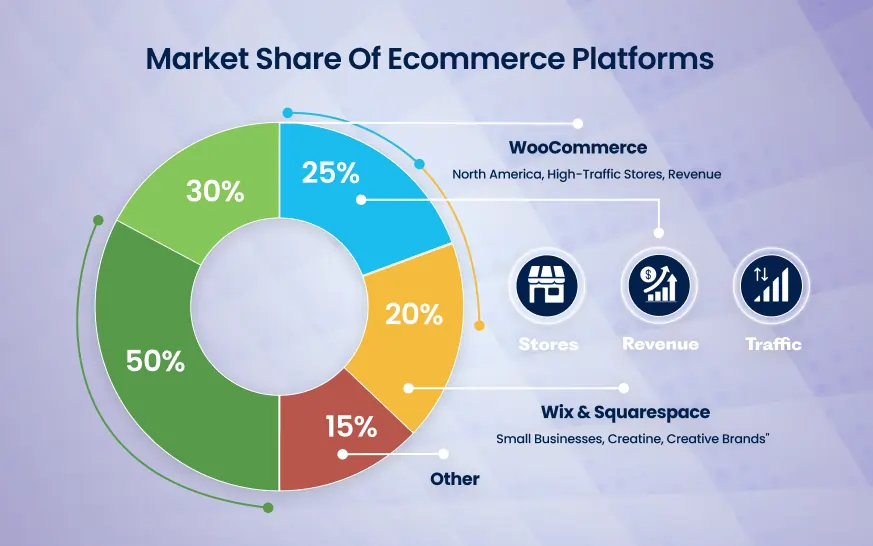
Ecommerce by platform is fragmented. WooCommerce powers a large chunk of online stores worldwide and is often listed as the top platform by number of websites using ecommerce plugins. Shopify has a strong presence in North America: it has a big share of the US ecommerce platform market and is often cited in merchant counts and revenue stats. Wix Stores and Squarespace do well among small businesses and creative brands.
When comparing Shopify market share 2026 vs historical numbers or looking at “how much market share does Shopify have” make sure to specify the metric: stores, revenue or traffic. BigCommerce market share and Magento market share vs Shopify come up in enterprise selection conversations especially for merchants weighing hosted SaaS against self-hosted or open-source solutions.
Ecommerce Websites & Best Practices
Ecommerce websites are the front-facing asset for most brands. To capture traffic and sales online stores need to be mobile-friendly, SEO-optimized and secure (SSL certificates, trust badges). Search visibility and conversion depend on good product data, fast page speeds and payment flexibility, including digital wallets and local payment options that increase conversion in specific regions.
From an SEO and content perspective using the right keywords, like market share of ecommerce platforms and ecommerce platform market penetration, in long-form content, case studies and comparison pages helps merchants attract evaluation-stage traffic.
Consumer Electronics and Vertical Trends
Consumer electronics is a high volume category on many ecommerce platforms. Marketplaces like Amazon, eBay and Walmart own electronics sales while independent ecommerce sites and direct-to-consumer (DTC) brands use platforms like Shopify stores, WooCommerce and BigCommerce to power their branded stores. Vertical data (which categories perform well on which platforms) can help merchants focused on electronics, fashion, home goods or subscription services choose the right platform.
Ecommerce Sales Forecast
Ecommerce sales are growing strong. 2026 projections have global ecommerce sales in the trillions driven by convenience, competitive pricing and an expanding mobile-first shopper base. Retail ecommerce sales will be a growing share of total retail sales and platforms that make mobile commerce seamless have a competitive advantage.
E-Commerce Trends Shaping Market Share

- Social commerce — Platforms and integrations that allow merchants to sell directly through social media Platforms are growing fast. This is leveraging the power of social media and influencer marketing to reach online shoppers where they spend most of their time, driving sales and engagement.
- Mobile commerce — Over 50% of online sales are now coming from mobile; platforms optimized for mobile storefronts win market share in mobile-first markets. The rise of smartphone users and increased internet penetration globally is backing this trend, so mobile-friendly ecommerce solutions are essential.
- AI integration — Personalization, recommendation engines and AI-powered customer service are becoming table stakes, influencing platform choice. AI tools help ecommerce businesses improve customer experience and operational efficiency, driving platform adoption.
- Headless commerce — Brands looking for performance and custom front-ends are turning to headless ecommerce architectures, influencing headless ecommerce market share. This offers flexibility and scalability, appealing to larger companies and those with complex needs.
- Sustainability — Eco-conscious merchants and consumers are favoring platforms and partners that support sustainable packaging and logistics. This trend reflects growing consumer demand for responsible business practices and can influence platform choice.
Ecommerce Statistics & Measurement Considerations
When you look for ecommerce platforms market share statistics and trends, remember that metrics differ: store count vs revenue vs gross merchandise volume (GMV) vs traffic.
How is commerce platform market measured? Here are common approaches:
- Counting live stores and plugins installed (favors open-source platforms).
- Measuring revenue processed or GMV (favors marketplaces and hosted payment processors).
- Tracking site traffic and conversion metrics (favors platforms with higher-traffic merchants).
Because these metrics produce different leaderboards, comparison pages (Shopify vs WooCommerce market share) should be clear about the metric used.
AI integration and Platform Capabilities
AI is a differentiator. Platforms with native AI or robust APIs for AI services help merchants automate merchandising, personalize marketing and forecast demand. AI based inventory management and automated product recommendations increase average order value and reduce churn.
Regional Analysis
Platform preferences vary by region:
- North America — Shopify and BigCommerce are popular; hosted SaaS platforms are easy to use. US market has high ecommerce sales and many Shopify stores.
- Europe — mix of hosted and open-source; GDPR considerations influence platform choice. European businesses want platforms with strong data protection and localization features.
- Asia-Pacific — fast growth; local marketplace competition and mobile-first experiences. Chinese market led by Alibaba Group platforms like Taobao and Tmall is growing rapidly.
- Latin America & Middle East — fast growth; unique payment and logistics requirements shape platform choice. South America is seeing increasing ecommerce penetration; US shoppers and other regions are influencing trends.
If you’re researching US ecommerce platform market share, UK ecommerce platform market share 2026 or India ecommerce platform market share, local payments, language support and shipping integrations are key decision factors.
Key Players & Market Dynamics
Shopify, WooCommerce, BigCommerce, Magento (Adobe Commerce), Wix, Squarespace and marketplace giants are innovating.
Market Opportunity and Restraints
Ecommerce platform market has opportunity but also restraints:
- Opportunities: growing merchant demand, cross-border expansion, AI driven automation and new channels like social commerce.
- Restraints: setup and maintenance costs, security and data protection concerns, technical expertise gaps and intense competition forcing differentiation.
Analysis by Model
ecommerce platform market also depends on business model. B2B ecommerce platforms, B2C storefronts, subscription sellers and marketplaces each want different functionality. Subscription based or transaction based pricing models impact total cost of ownership and platform choice.
Conclusion:
The ecommerce platform market is changing fast with technological advancements, changing consumer behaviour and regional dynamics. As online shopping grows globally businesses need to evaluate ecommerce platforms based on their needs, target market and growth strategy. Platforms like Shopify, WooCommerce and others have different advantages across multiple markets for different business sizes and industries.
With mobile devices and social media playing a bigger role in online sales, ecommerce platforms that have seamless mobile commerce and social selling features are set to grow big. The future looks bright with AI integration, omnichannel and the rise of personalized and sustainable shopping.