


Summarize This Article With AI
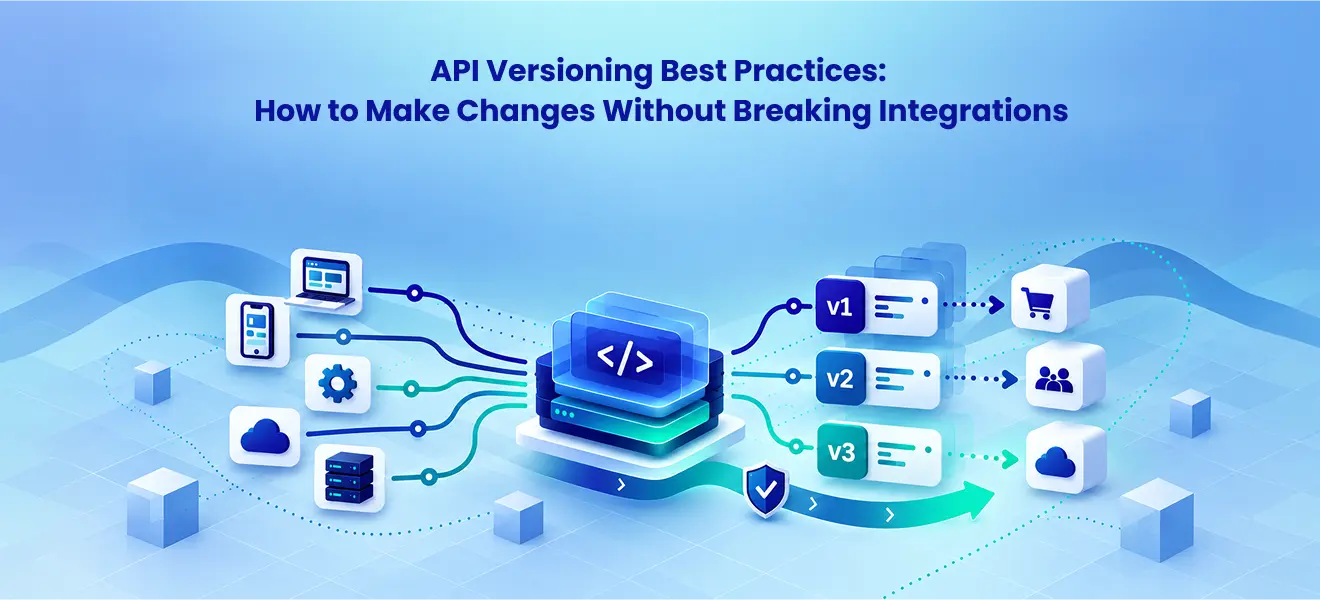
API versioning allows software teams to introduce new functionality or modify an API contract without unexpectedly breaking applications that depend on existing behavior. The safest approach is to make changes backward compatible whenever possible, publish a new API version when a breaking change is necessary, and provide consumers with a tested migration path. Effective versioning combines stable contracts, compatibility testing, release coordination, monitoring, and clear deprecation policies.
Key Takeaways
- Version APIs when the contract changes incompatibly, not automatically whenever backend code changes.
- Backward compatibility matters more than the versioning format; a /v2/ endpoint is not inherently safer than a properly managed version header.
- Use an expand–migrate–contract approach to introduce changes, transition consumers, and retire old behavior.
- Test consumer expectations and important business outcomes, not only schemas.
- Track usage of deprecated versions and publish clear migration guidance.
1. What Is API Versioning and Why Does It Matter?
API versioning is the practice of managing changes to a software interface so that consumers can understand which API contract they are using. An API contract includes endpoint addresses, request formats, response structures, field meanings, status codes, authentication requirements, and documented behavior.
Consider a SaaS platform exposing GET /api/v1/customers/123. Its response includes an ID, a name, and an is_active Boolean. A new requirement introduces more detailed account states. Replacing is_active with status may break an ERP integration or mobile app that still expects the Boolean.
For example, an older response could be:
{ “id”: 123, “name”: “Acme Inc.”, “is_active”: true }
A compatible transitional response could be:
{ “id”: 123, “name”: “Acme Inc.”, “is_active”: true, “status”: “active” }
The transitional option can work if both fields retain clear, consistent meanings. If the new status model cannot be represented truthfully by the original Boolean field, the provider needs an explicit compatibility policy or a new API contract.
API versioning versus application versioning
An API version is not necessarily the same as the software release version. Teams can deploy backend changes frequently without changing the externally supported contract. This separation makes bug fixes, security improvements, and internal refactoring possible without requiring every client to upgrade.
2. REST API Versioning Strategies Compared
Common versioning approaches include URI paths, query parameters, request headers, and media types. Their suitability depends on client needs and the conventions already established by the platform.
| Approach | Example | Advantage | Trade-off |
|---|---|---|---|
| URI path | /api/v2/orders | Visible, easy to document | More versioned endpoint paths |
| Query parameter | /api/orders?api-version=2 | Simple explicit request | Requires consistent query handling |
| Custom header | API-Version: 2 | Stable resource URL | Less obvious when inspecting URL |
| Media type | Accept: application/vnd.example.v2+json | Representation-specific selection | More negotiation complexity |
URI path versioning
Path versioning puts the contract version into the endpoint, such as GET /api/v1/products and GET /api/v2/products. This is often approachable for public API developers and simple to route through an API gateway. It does not mean the team must duplicate every layer of its backend; version-specific adapters may share domain logic.
Query-parameter versioning
A request such as GET /api/products?api-version=2 is another valid approach, particularly when an ecosystem already follows this convention. Document how unsupported or missing values behave, and ensure caching and routing preserve the intended contract.
Header versioning
Header versioning can use GET /api/products with API-Version: 2. It keeps resource URLs stable but requires good tooling and logs so developers can identify which effective contract handled a request.
Media-type versioning
Content negotiation can select versions through an Accept header such as application/vnd.example.v2+json. This can fit representation-oriented APIs but is not automatically necessary for ordinary SaaS endpoints.
Which method should you choose?
For a new public REST API, path versioning is a reasonable default when discoverability and simple documentation are priorities. For established platforms, consistent use of an existing convention generally matters more than adopting a different format for aesthetic reasons.
3. What Counts as a Breaking API Change?
A breaking API change causes an existing consumer, written against the previous supported contract, to stop working correctly. Incompatibility is not limited to JSON schema changes; behavioral changes may also affect customers.
| Change | Classification | Reason |
|---|---|---|
| Remove response field | Breaking | Consumers may require it |
| Rename request parameter | Breaking | Old requests may fail |
| Change Boolean to string | Breaking | Data type changes |
| Make optional input required | Breaking | Previously valid requests may fail |
| Remove endpoint | Breaking | Client loses functionality |
| Change established business rule | Potentially breaking | Behavior changes |
| Add optional response field | Usually compatible | Assumes consumers allow extra fields |
| Add independent endpoint | Usually compatible | Old endpoints remain |
| Reduce rate limit | Potentially breaking | Old request patterns may be rejected |
Behavioral changes that schemas may miss
Imagine an invoice endpoint that previously returns invoices in ascending order but starts returning them newest-first after an optimization. The schema is unchanged, yet a consumer relying on the earlier ordering may malfunction. Similar risks arise from modified pagination defaults, rounding, status-code behavior, and changed error semantics.
Consumers should avoid relying on undocumented behavior. However, providers should investigate observed dependencies before changing behavior that customers actually use. An OpenAPI diff is useful evidence but cannot establish complete compatibility by itself.
4. How to Introduce Breaking Changes Safely
A practical migration workflow is expand–migrate–contract: temporarily add the new interface while keeping the old one, move consumers safely, then retire legacy behavior after reaching agreed exit criteria.
Step 1: Inventory existing consumers
Identify first-party web and mobile clients, customer integrations, partners, internal services, scheduled jobs, and client libraries. Record the endpoints and API versions each uses. Unknown consumers create retirement risk; where privacy and policy allow, telemetry can reveal real usage.
Step 2: Define the replacement contract
Document the new request/response shapes, altered behavior, status codes, authentication, and error cases. Use an OpenAPI specification when appropriate and include examples illustrating old versus new behavior.
Step 3: Introduce temporary compatibility
If both the old is_active field and the new status field can be represented accurately, expose them together during the migration. Define how they stay consistent. Do not silently convert unknown states into arbitrary Boolean values.
Step 4: Update consumer applications
Update SDKs and applications to read the replacement field. A former test such as customer.is_active may become customer.status === “active”. Real migrations may also affect validation, caching, serialization, analytics, database models, and error handling.
Step 5: Verify outcomes, not just HTTP success
Test core workflows under the new contract. A successful response does not prove payments, order synchronization, permissions, or record updates behave correctly. Where feasible, use staged rollout, canary exposure, or opt-in access.
Step 6: Deprecate with communication
Document the affected version, replacement instructions, expected deadlines, and support process. A deprecated version may remain operational during transition; retirement means the old contract is no longer available.
Step 7: Retire after measurable exit criteria
Before removing the old version, evaluate remaining active consumers, critical operations, contractual commitments, security risk, and migration support needs. Avoid using raw request volume as the only signal: a low-volume client may perform a high-impact operation.
5. API Compatibility Testing and Release Governance
Version numbers protect only when the implementation actually honors each contract. Combine schema tests, contract tests, end-to-end workflow testing, security review, and progressive release checks.
Contract and behavioral testing
Contract tests validate agreed provider–consumer expectations. Schema checks can confirm that an order total is numeric, but may fail to detect a change from dollars to cents. Test business semantics as well as field types, especially for money, permissions, dates, pagination, and idempotent operations.
Specification comparison
OpenAPI comparisons can flag removed endpoints, changed required parameters, incompatible types, and altered response structures. Treat automated results as review inputs, not a proof of zero breaking changes.
| Release gate | Owner | Evidence |
|---|---|---|
| Contract change review | API architect | Impact assessment |
| Security review | Security engineer | Authorization/data review |
| Compatibility testing | QA/backend | Old and new client results |
| Migration documentation | Documentation owner | Upgrade instructions |
| Recovery readiness | Release engineer | Rollback or mitigation plan |
| Consumer communication | Product/API owner | Notification record |
| Post-release monitoring | Operations | Errors and adoption metrics |
Integrations involving SDKs, webhooks, or external providers need special care. For example, a platform’s API request version and its webhook event representation may have different configuration rules; verify the exact provider documentation for the integration being changed.
6. API Deprecation, Monitoring, and Rollback Planning
Maintaining every historical contract indefinitely creates maintenance and security costs, while retiring an old contract too quickly can interrupt customers. A clear support policy should distinguish deprecated and retired versions and explain what maintenance is provided during the transition.
Measure adoption and remaining risk
| Metric | Purpose |
|---|---|
| Requests by version | Shows traffic distribution |
| Active consumers by version | Identifies migrations outstanding |
| Error rates by version | Detects regressions |
| Critical operations by version | Shows business impact |
| Deprecated endpoint usage | Supports retirement decision |
| Migration-related support incidents | Highlights upgrade friction |
Review both volume and criticality. One high-volume user may dominate traffic; one low-volume integration may handle crucial financial or order operations.
Rollback planning
Rolling back application code does not automatically reverse persistent data migrations or external operations. Determine before release whether both old and new API contracts can safely run against the current data model. Use compatible schema phases, traffic controls, and tested mitigation plans where appropriate.
When a new version is unnecessary
A new API version is often unnecessary for internal optimizations, bug fixes that restore the documented contract, genuinely optional capabilities, or an independent endpoint. Still review their effects on real consumers. Avoid versioning every internal release without a compatibility reason.
7. Practical API Versioning Checklist for SaaS Teams
| Area | Question |
|---|---|
| Contract | Do inputs, outputs, or documented behavior change? |
| Compatibility | Can old clients still work correctly? |
| Consumers | Do we know the affected clients? |
| Policy | Does this change require a new version? |
| Documentation | Are migration steps complete? |
| Testing | Are contract and business workflow tests passed? |
| Dependencies | Are SDKs, webhooks, and downstream systems affected? |
| Security | Are data access and permission effects reviewed? |
| Rollout | Can the deployment be staged? |
| Recovery | Is rollback or mitigation defined? |
| Deprecation | Is the transition plan communicated? |
| Monitoring | Can we detect errors and remaining old-version use? |
A small SaaS team may begin with an OpenAPI contract, automated compatibility checks, and one accountable API owner. As consumer count and integration risk grow, formalize the review, communication, support, and retirement practices.
Frequently Asked Questions
What is API versioning?
API versioning manages different supported API contracts so changes can be introduced without unexpectedly breaking existing consumers.
What are the main REST API versioning methods?
URI path, query parameter, request header, and media-type versioning are common approaches.
Is API versioning always necessary?
No. Compatible changes and internal implementation improvements often do not require a new public API version.
What is backward compatibility in APIs?
It means existing consumers continue functioning correctly within the expectations of the previously supported contract.
What is a breaking API change?
A change such as a removed field, incompatible data type, new required parameter, or altered documented behavior that disrupts existing clients.
Which method is best for SaaS APIs?
It depends on clients and platform conventions. URI path versioning is a practical option for public discoverability, not a universal rule.
Should API versions match software release versions?
No. Backend software may release frequently while the external API contract stays stable.
How long should old API versions be supported?
There is no universal period; base the policy on customer needs, contracts, security, and migration complexity.
Can automated testing detect every breaking API change?
No. Schema and contract tests identify many issues, but behavior and actual client assumptions also require testing.
How can SaaS teams migrate APIs without downtime?
Run compatible interfaces during a staged migration, monitor outcomes, and prepare rollback or forward-recovery paths. Versioning alone cannot guarantee zero downtime.
Conclusion
API versioning is ultimately about preserving trust between a platform and its users. Avoid breaking changes when possible, define compatibility clearly, and make unavoidable migrations predictable through testing, progressive rollout, monitoring, and realistic deprecation policies.
For SaaS teams with complex integrations or outdated contracts, WebbyCrown can help assess API architecture and plan a controlled modernization and migration approach.