Summarize This Article With AI
How Much Does It Cost to Build an AI Agent in 2026?
AI agent development can cost from a few thousand dollars for a tightly scoped low-code internal pilot to well over $100,000 for a production system that works across several business platforms. The model API is rarely the largest part of the initial budget. Workflow discovery, integrations, permissions, data preparation, evaluation, security, deployment, and ongoing human oversight usually determine whether the agent is inexpensive, dependable, or unexpectedly costly.
For early planning, a low-code proof of concept may fall around $5,000 to $10,000, a custom single-workflow pilot around $10,000 to $30,000, a production agent around $30,000 to $100,000, and a complex enterprise or multi-agent implementation above $100,000. These are editorial planning bands, not market averages, quotations, or promises. A responsible estimate requires a defined workflow, systems inventory, risk level, usage forecast, and acceptance criteria.
This guide explains what goes into the budget, how to estimate build and operating costs separately, when a multi-agent design is justified, and which questions to answer before requesting a proposal.
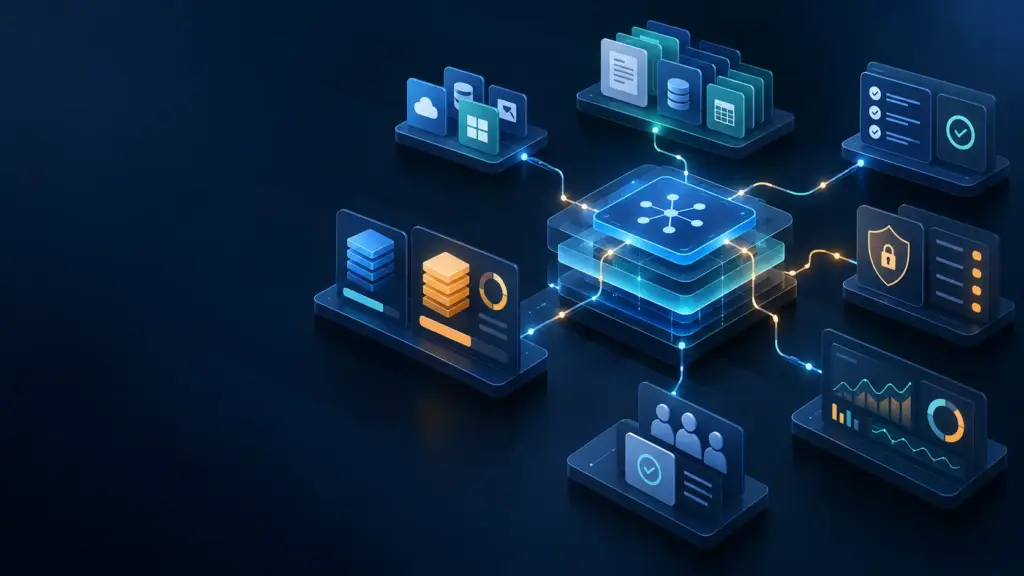
AI Agent Cost at a Glance
| Project type | Planning range | Typical scope | Usually excluded |
|---|---|---|---|
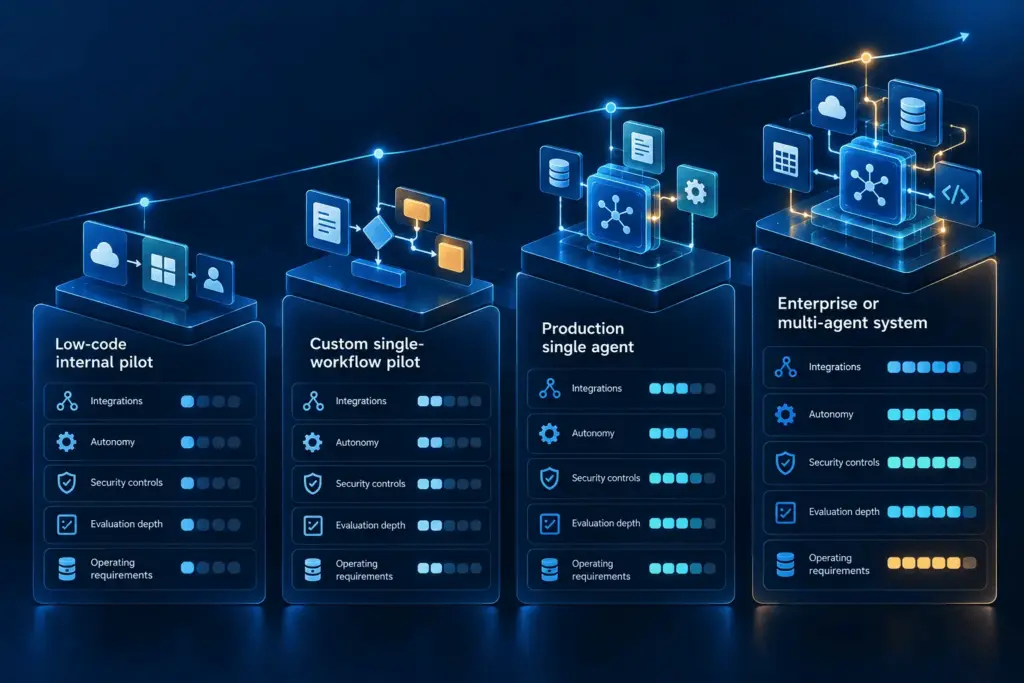
| Low-code internal pilot | $5,000–$10,000 | One narrow task, limited data, one platform, manual supervision | Enterprise security review, complex integrations, 24/7 operations |
| Custom single-workflow pilot | $10,000–$30,000 | Custom orchestration, one or two tools, basic evaluation, human approval | Large-scale migration, advanced compliance, broad rollout |
| Production single agent | $30,000–$100,000 | Multiple integrations, monitoring, evaluation, access controls, fallback and support | Major enterprise licenses and unusually high usage |
| Enterprise or multi-agent system | $100,000+ | Several workflows or agents, complex data, high availability, governance and security | Ongoing usage, vendor fees, future expansion unless contracted |
The same user-facing agent can land in different bands. An internal assistant that drafts responses from approved documents is not the same project as an agent that reads customer records, updates an ERP, issues refunds, and operates across regulated data. The second system needs stronger identity, tool controls, reconciliation, audit trails, testing, and escalation.
What Counts as an AI Agent?
An AI agent is more than a chatbot that generates an answer. It receives a goal, interprets context, selects or sequences actions, uses tools or APIs, observes results, and decides what should happen next within defined boundaries. Some agents only recommend an action. Others can write to a CRM, create a ticket, query an ERP, schedule a follow-up, or coordinate specialized agents.
Before estimating a project, confirm whether the use case really needs an agent. WebbyCrown’s guide to AI agents in business explains where agentic workflows add value and where permissions, governance, and human review matter.
If a deterministic rule, conventional automation, or a search interface can solve the problem reliably, an AI agent may add cost without adding enough value. The cheapest successful design is often the simplest architecture that meets the business outcome.
The Main Components of AI Agent Development Cost
1. Discovery and Workflow Design
The team must map the current process, exceptions, hand-offs, data sources, decision rights, and measurable outcome. A vague request such as “build a sales agent” is not an estimable scope. A defined request such as “qualify inbound leads, enrich company data, draft a CRM note, and request approval before sending outreach” is much closer.
Discovery cost increases when the process spans departments, depends on undocumented rules, or has no agreed baseline. Skipping this phase often moves the cost into rework after the pilot encounters real exceptions.
2. Agent Architecture and Orchestration
A simple agent may use one model, one prompt policy, and a small set of tools. More advanced systems add planners, routers, memory, retrieval, approval gates, deterministic checks, specialized models, or several agents. Every additional component creates new states to test and observe.
Multi-agent architecture should not be selected because it sounds advanced. It is justified when roles are meaningfully different, parallel work produces measurable value, or separate permissions and evaluation criteria are required. Otherwise, one well-bounded agent is usually cheaper to build and easier to debug.
3. Integrations and Tool Access
Integrations frequently drive the budget more than prompting. Each connected system may require authentication, field mapping, webhooks, rate-limit handling, retries, idempotency, error recovery, sandbox access, and coordination with another vendor or internal owner.
| Integration condition | Cost impact | Why |
|---|---|---|
| Documented read-only API | Lower | The agent retrieves data without changing the source system |
| Write access with approval | Medium | Actions need authorization, validation, logs, and rollback handling |
| Bidirectional synchronization | Higher | Conflicts, partial failures, retries, and reconciliation must be designed |
| Legacy or undocumented system | Higher | Discovery, custom adapters, data cleanup, and testing expand |
| Regulated or financial action | Highest | Evidence, segregation of duties, security testing, and human authorization are required |
4. Data and Retrieval
An agent using private company knowledge may need document ingestion, access-aware retrieval, metadata, content cleanup, freshness controls, and evaluation. Not every agent needs a vector database. Structured records may be better accessed through APIs or database queries, and small stable reference sets may fit simpler approaches.
When teams are unsure whether to use retrieval, model adaptation, or straightforward prompting, the comparison of RAG vs fine-tuning vs prompting helps connect architecture choice to cost, freshness, control, and maintenance.
5. User Experience and Human Approval
The agent may need a chat interface, inbox, task queue, approval screen, audit view, notifications, feedback controls, or embedded experience inside an existing application. Human-in-the-loop design is not simply an “approve” button. The system must show enough evidence for a reviewer to make a decision, route exceptions to the right person, preserve context, and record the outcome.
6. Evaluation and Testing
Traditional functional testing remains necessary, but it is not sufficient. Teams must evaluate task completion, tool selection, grounding, policy compliance, unsafe actions, latency, cost per successful outcome, and behavior under ambiguous or adversarial input. Regression datasets and acceptance thresholds are needed before model, prompt, tool, or retrieval changes can be released safely.
For retrieval-based agents, use metrics that reveal whether the system found useful evidence and stayed faithful to it. The RAG evaluation metrics guide covers retrieval quality, answer relevance, faithfulness, and production monitoring.
7. Security and Governance
Agents can hold credentials, invoke tools, retain memory, and take actions. That expands the security surface beyond ordinary model output. The OWASP Top 10 for Agentic Applications includes risks such as goal hijacking, tool misuse, identity and privilege abuse, memory poisoning, insecure inter-agent communication, and cascading failures.
Security work may include threat modeling, least-privilege tool scopes, secrets management, input and output controls, action validation, sandboxing, audit logs, red-team tests, data retention rules, incident response, and independent approval for high-impact actions. These controls add cost, but omitting them does not remove the risk; it postpones the cost until a failure or audit.
Use the enterprise AI security checklist to review access control, data governance, testing, monitoring, and incident readiness alongside the build estimate.
8. Deployment, Monitoring, and Operations
A production agent needs environments, CI/CD, configuration management, observability, alerts, versioning, rollback, backups where applicable, support ownership, and runbooks. The operating team should see model usage, tool-call success, failure categories, response time, approval rate, escalation rate, and cost per completed business outcome.
The Agent-as-a-Service operating model explains why ownership, permissions, monitoring, escalation, and continuous improvement are part of the system rather than post-launch extras.
Build Cost Is Only One Part of Total Cost
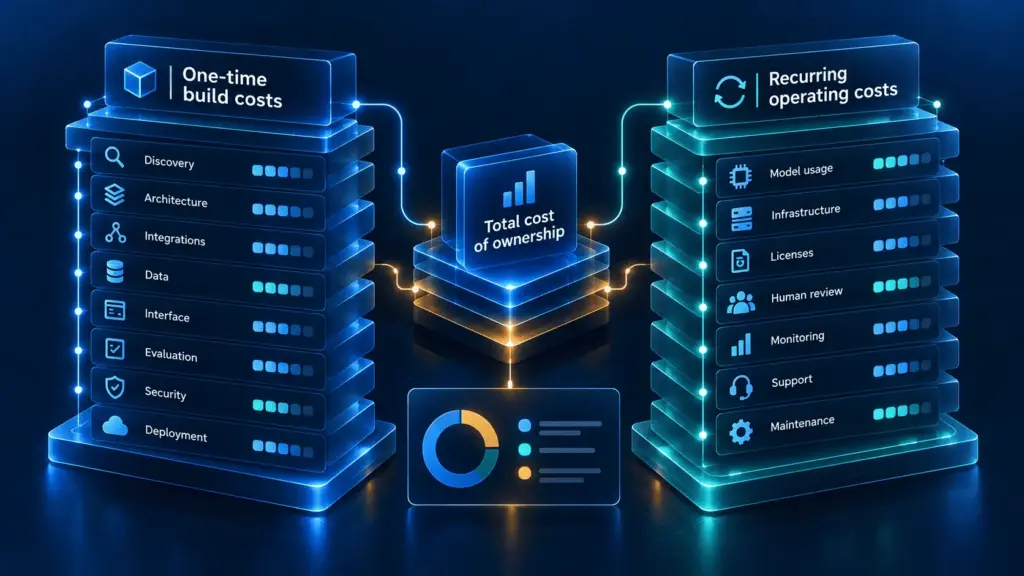
A useful budget separates one-time implementation from recurring operating cost. A low build quote can become expensive if the design uses an unnecessarily costly model, repeats large contexts, retries failed actions, requires constant manual correction, or depends on several licensed platforms.
| Cost layer | Examples | How to estimate |
|---|---|---|
| Initial build | Discovery, architecture, integrations, interface, evaluation, security, deployment | Work packages, roles, estimated effort, contingency |
| Model usage | Input, output, cached tokens, reasoning, images, audio, embeddings | Representative traces × expected task volume × current provider price |
| Infrastructure | Application hosting, queues, databases, retrieval, storage, logging | Load test plus production headroom and retention policy |
| Third-party tools | Agent platforms, observability, vector database, automation, data providers | License terms, usage tiers, seats, environments |
| Human operations | Approvals, exception handling, review, support, incident response | Minutes per case × case volume × loaded labor rate |
| Maintenance | Prompt, model, tool, policy, evaluation and integration changes | Planned monthly capacity plus change contingency |
Model prices change frequently and vary by provider, model, feature, context length, caching, and batch mode. Use official provider pricing at estimation time rather than copying an old rate from an article. The cost model should retain the assumptions so it can be recalculated when pricing or usage changes.
A Practical AI Agent Cost Formula
Use this planning equation:
Total first-year cost = discovery and build + integrations and data + testing and security + deployment + model and infrastructure usage + licenses + human operations + maintenance + contingency
For operating cost, estimate per successful business task rather than only per model call:
Cost per successful task = (model usage + infrastructure + tool fees + human review + allocated support cost) ÷ successfully completed tasks
This prevents a cheap model call from looking efficient when the workflow requires several retries or frequent human correction. Measure the business result, not just token consumption.
Worked Example for a Customer Support Agent
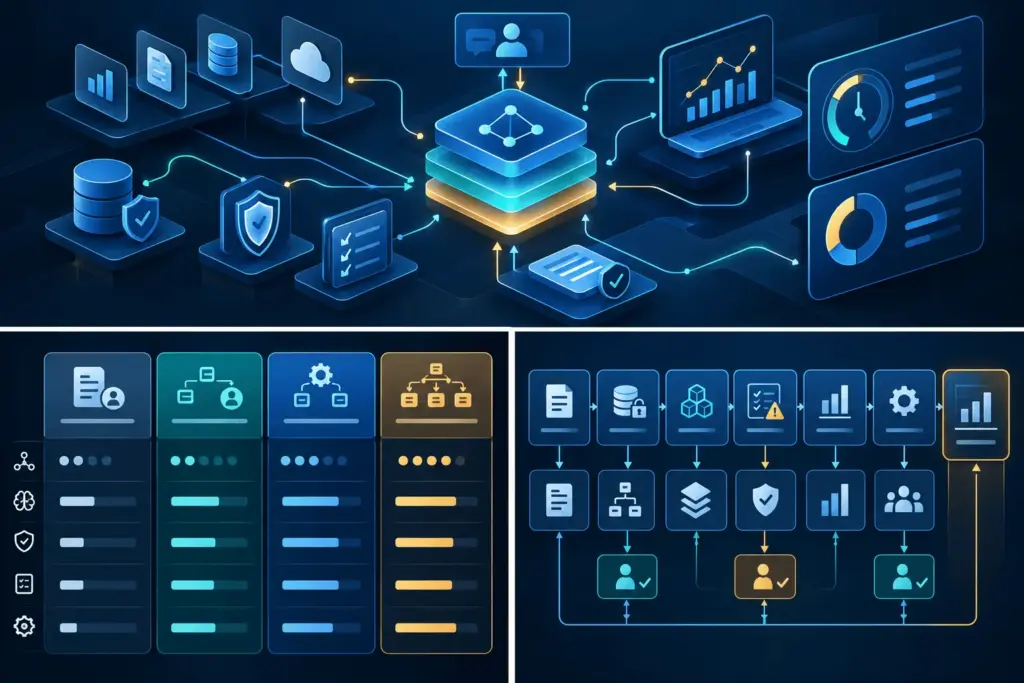
Consider an agent that classifies support requests, retrieves approved knowledge, drafts a response, updates the ticket, and asks a human to approve refunds or sensitive actions. The following is a scoping example, not a quotation.
| Workstream | Planning assumption | Cost effect |
|---|---|---|
| Discovery | One support team, documented policy, known ticket categories | Low to medium |
| Integrations | Help desk, identity provider, approved knowledge source | Medium |
| Actions | Draft reply and update ticket; refund requires approval | Medium |
| Retrieval | Permission-aware content with freshness and citations | Medium |
| Evaluation | Historical test set, policy checks, unsafe-action tests | Medium to high |
| Operations | Monitoring, escalation queue, monthly regression review | Recurring |
The estimate rises sharply if the agent can issue refunds without approval, serves several brands and languages, must meet strict response-time commitments, or accesses regulated data. It falls if the first release only recommends actions and operates on a small, well-documented workflow.
What Changes the Price Most?
- Number and quality of integrations: undocumented systems and write actions increase effort.
- Autonomy level: recommendation is cheaper to control than irreversible action.
- Workflow variability: exceptions and ambiguous inputs require more design and evaluation.
- Data readiness: inconsistent documents, permissions, and ownership increase preparation work.
- Risk and compliance: high-impact decisions require stronger evidence, security, and oversight.
- Scale and latency: high volume, long contexts, real-time response, and global availability affect architecture.
- Model strategy: one premium model for every step can cost more than deliberate routing among models and deterministic code.
- Reliability target: higher availability and recovery requirements add infrastructure and operational work.
- Multi-agent coordination: more agents create more hand-offs, traces, permissions, and failure modes.
- Change frequency: frequently changing tools, policies, and knowledge require sustained maintenance.
How to Reduce Cost Without Making the Agent Fragile
Start with One Bounded Workflow
Choose a high-volume task with clear inputs, a measurable outcome, and manageable risk. A focused agent provides better evidence than a broad “digital employee” prototype that touches many systems without reliable acceptance criteria.
Use Deterministic Logic Where It Works
Validation, calculations, permission checks, schema enforcement, routing rules, and irreversible-action gates often belong in conventional code. Use the model for language and judgment-intensive steps, not every step.
Route Tasks to the Smallest Suitable Model
A capable model may be needed for complex reasoning, while classification, extraction, or formatting can often use a smaller model or deterministic method. Measure quality and cost on representative tasks before routing automatically.
Control Context and Retrieval
Avoid sending entire document libraries or long histories on every request. Retrieve relevant evidence, summarize stable context carefully, use caching when supported, and set retention rules. Cost optimization must not hide missing evidence or weaken access controls.
Build Evaluation Before Broad Rollout
A small regression suite early in development catches expensive design errors before more integrations and users depend on the system. Track failed tasks and review effort, not only successful demos.
Limit Write Permissions
Begin with read-only or recommendation mode when possible. Add write access per action after validation, with scoped credentials, approvals for high-impact cases, audit logs, and tested rollback or reconciliation.
When a Low-Code Agent Is Enough
Low-code tools can be suitable when the workflow is narrow, connectors already exist, data sensitivity is manageable, the action is reversible, and the organization accepts platform constraints. They are useful for validating demand before custom engineering.
Custom development becomes more likely when the agent needs proprietary workflows, complex permissions, multiple systems, custom interfaces, strict latency, high volume, regulated data, independent deployment, advanced evaluation, or control over model and infrastructure choices.
When Not to Build an AI Agent
Do not build an agent merely because the technology is available. A conventional workflow may be better when rules are stable, outcomes must be fully deterministic, source data is unreliable, the action cannot be safely reviewed or reversed, or the expected value cannot cover ongoing operations.
Also postpone the project if nobody owns the business process, success cannot be measured, production access is unavailable, or stakeholders expect a prototype to operate without maintenance. These conditions make estimation unreliable and usually create hidden costs later.
How to Compare AI Agent Development Proposals
Two proposals can use the same headline but include very different systems. Ask each vendor or internal team to state:
- The exact workflow, users, systems, data, actions, and exclusions.
- Whether the estimate covers discovery, design, build, evaluation, security, deployment, and handover.
- Which model, platform, hosting, and third-party costs are excluded or passed through.
- How tool permissions, secrets, approvals, logs, and rollback are implemented.
- Which representative test set and acceptance thresholds define completion.
- How production quality, latency, usage, failures, and cost will be monitored.
- Who handles model changes, API changes, incidents, and ongoing optimization.
- What the organization owns: code, prompts, evaluation data, configurations, and deployment artifacts.
A cheap proposal that excludes integrations, evaluation, security, and operations is not comparable with a production-ready scope. Normalize the deliverables and assumptions before comparing totals.
If external delivery support is needed after the scope is defined, review what should be included in AI agent development services and compare the proposed deliverables against the same build, evaluation, security, and operating requirements.
How to Estimate ROI Before You Build
Start with the current cost and performance of the workflow. Measure volume, handling time, wait time, error rate, rework, escalation, revenue effect, and risk exposure. Then estimate the realistic percentage of cases the agent can assist or complete while meeting the acceptance threshold.
A basic planning formula is:
Annual value = time saved + avoided errors and rework + additional capacity or revenue + risk reduction that can be reasonably quantified
Net first-year value = annual value − total first-year cost
Treat unverified benefits as assumptions. Run a pilot that measures completion rate, human-review time, quality, and cost per successful outcome before approving a larger rollout.
AI Agent Development Cost Checklist
- Define one measurable workflow and its current baseline.
- List every data source, API, tool, identity, and action.
- Separate read, recommend, approve, and write permissions.
- Document exception paths and actions that require a human.
- Choose the simplest architecture that can meet the outcome.
- Estimate build and recurring operating costs separately.
- Use representative usage traces and current provider pricing.
- Budget for evaluation, security, monitoring, and incident response.
- Calculate cost per successful task, not only cost per model call.
- Pilot, measure, and approve expansion only when the evidence supports it.
Frequently Asked Questions
How much does it cost to build an AI agent?
A tightly scoped low-code pilot may cost about $5,000 to $10,000, a custom single-workflow pilot about $10,000 to $30,000, a production agent about $30,000 to $100,000, and a complex enterprise or multi-agent system more than $100,000. These are planning bands; actual cost depends on scope, systems, risk, usage, and operating requirements.
What is included in AI agent development cost?
A complete estimate may include discovery, workflow design, architecture, integrations, data preparation, interface development, evaluation, security, deployment, documentation, training, monitoring, and handover. Model usage, licenses, hosting, and ongoing support may be separate.
Why do AI agent integrations cost so much?
Integrations require authentication, permissions, data mapping, retries, rate-limit handling, error recovery, monitoring, and testing. Write actions also need validation, audit logs, reconciliation, and sometimes human approval.
How much does it cost to run an AI agent each month?
Monthly cost depends on task volume, model and token usage, context size, retries, infrastructure, retrieval, third-party tools, monitoring, support, and human review. Estimate it from representative traces rather than using a universal per-user figure.
Is a multi-agent system more expensive than one agent?
Usually. Multiple agents add orchestration, state transitions, tool permissions, traces, evaluation paths, latency, and more failure modes. Use multiple agents only when specialized roles or parallel work create measurable value.
Does every AI agent need RAG or a vector database?
No. RAG is useful when an agent needs private or changing unstructured knowledge. Structured systems may be better accessed through APIs or queries, and small stable reference sets may need a simpler design.
Can a low-code platform reduce AI agent cost?
Yes, when existing connectors and platform controls match a narrow workflow. Cost can rise later if the project needs custom permissions, complex logic, independent hosting, advanced evaluation, or integrations the platform does not support well.
What hidden costs should businesses expect?
Common hidden costs include data cleanup, API limitations, vendor licenses, retries, human review, evaluation maintenance, security testing, incident response, model changes, integration changes, logging retention, and support.
How can a business control AI agent costs after launch?
Track cost per successful task, route work to suitable models, limit unnecessary context, cache stable inputs where appropriate, reduce retries, improve retrieval, automate safe validation, review failed cases, and set usage budgets and alerts.
How long does it take to build an AI agent?
A narrow pilot may take several weeks, while a production agent with integrations, evaluation, security, and operational controls can take several months. The timeline depends more on workflow clarity, access, dependencies, and approval cycles than on prompting alone.
Conclusion
The real cost of an AI agent is not the price of one model response. It is the cost of designing a dependable workflow, connecting the right systems, controlling actions, evaluating behavior, operating the system, and keeping accountable people in the loop where risk requires them.
Begin with one bounded workflow, define success before choosing architecture, estimate build and recurring costs separately, and calculate cost per successful business outcome. That approach produces a budget decision the organization can defend and reduces the chance that an inexpensive prototype becomes an expensive production problem.