Summarize This Article With AI
Quick Answer – What Is Vibe Coding?
Vibe coding is the practice of building software by describing what you want in natural language and letting AI tools generate the code. The term was coined by Andrej Karpathy, co-founder of OpenAI, in February 2025 and was named Collins Dictionary’s Word of the Year 2025.
In short: vibe coding is genuinely powerful for prototypes, MVPs, and internal tools — fast, accessible, and capable of producing working software in hours rather than weeks. It is not yet a reliable substitute for professional engineering when production stakes are high: eCommerce, SaaS platforms, regulated industries, or anywhere security, scalability, and maintainability matter.

There are roughly 70,000 monthly searches for the phrase “vibe coding” in the United States alone. The term went from niche developer jargon to Collins Dictionary’s Word of the Year in under twelve months, and major platforms — IBM, Salesforce, Google — now publish dedicated educational pages on it. Something genuinely significant is happening in software development, and it deserves a clear-eyed explanation rather than either hype or dismissal.
This guide is written for the people who are most affected by the shift but rarely have a single trustworthy resource to consult: founders evaluating whether to vibe code their MVP, product managers deciding how AI fits into their delivery process, and technical buyers trying to understand where vibe coding genuinely accelerates outcomes versus where it quietly creates technical debt.
We will define the term clearly, show the workflow, identify where vibe coding excels, name the situations where it predictably breaks down, and — most importantly — explain the practical path from a vibe-coded prototype to a production system you can actually run a business on.
What Is Vibe Coding? The Core Concept Explained
Vibe coding is an AI-assisted approach to software development where you describe an intended outcome in plain English and an AI system generates the code that implements it. Rather than writing HTML, CSS, JavaScript, or Python manually, you act as the architect — defining what the system should do — and the AI acts as the builder.
Andrej Karpathy, co-founder of OpenAI and former AI Director at Tesla, introduced the concept in a widely shared post in February 2025. He described it as a style of building where ‘ideas are tested quickly, and code becomes secondary to outcomes.’ Collins Dictionary formalised the term later that year, defining vibe coding as ‘the use of artificial intelligence prompted by natural language to write computer code.’
IBM, in its own definitional guide, frames vibe coding as ‘prompting AI tools to generate code rather than manually writing it’ — a deliberately broader framing that includes everything from Cursor and Lovable to ChatGPT, Replit, and Windsurf. Google’s October 2025 explainer positions vibe coding specifically around prototyping: building working apps and websites quickly from natural-language prompts.
What unites these definitions, and what matters for business teams, is the underlying shift in division of labour. The person doing the work focuses on intent and judgement. The AI handles the syntax, structure, and execution. That changes who can participate in software creation — and that is the part of the story that has commercial implications.
How Does Vibe Coding Actually Work in Practice?
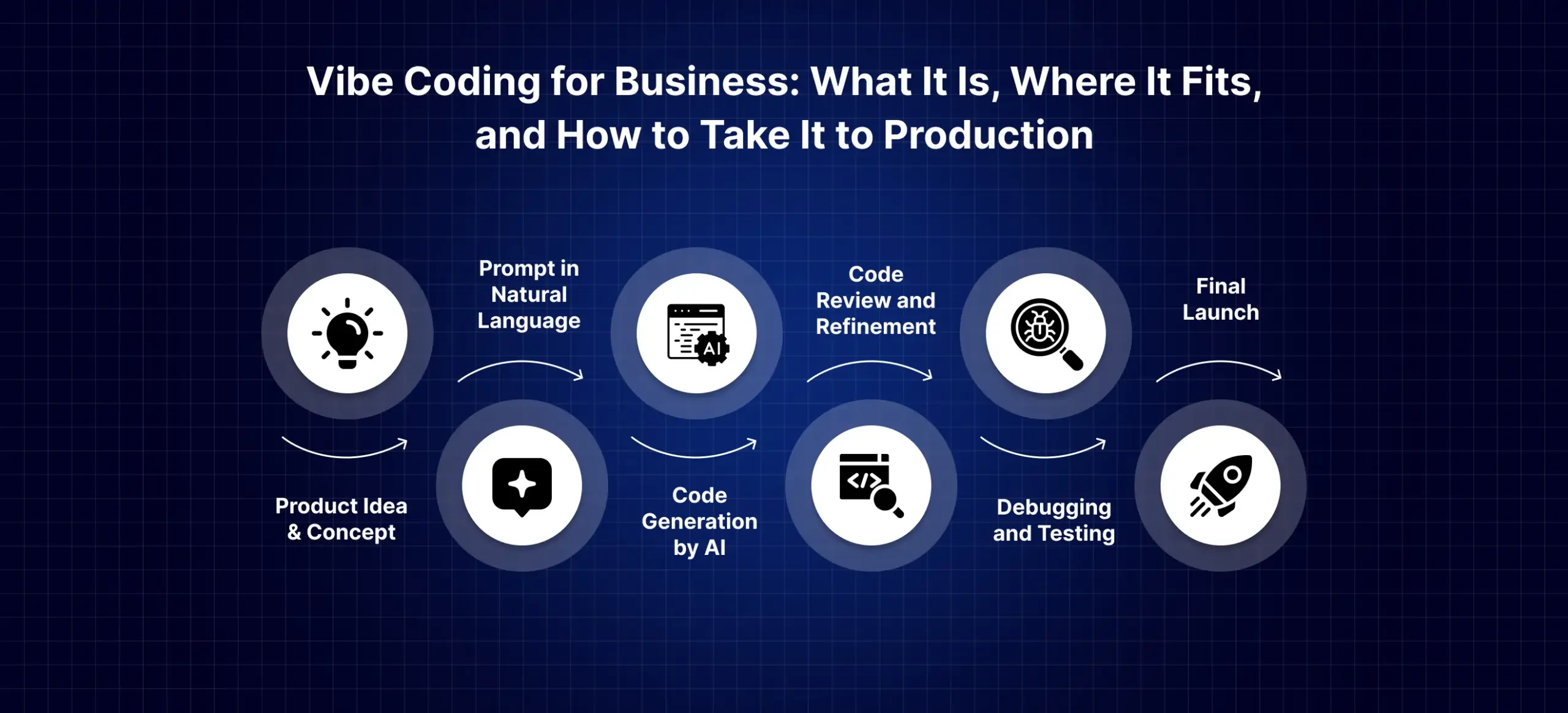
The mechanics follow a five-stage loop that experienced practitioners run repeatedly until the output matches their intent.
1. Describe the goal precisely
You open a vibe coding environment — Cursor, Lovable, Replit, Windsurf — and describe what you want to build. Specificity is the single biggest determinant of output quality. ‘Build me an app’ produces a generic scaffold. ‘Build a customer feedback collection app with email login, a five-question Likert-scale form, an admin dashboard showing aggregated responses, and CSV export’ produces something close to usable from the first output.
2. AI generates the draft
The AI model produces real, executable code — typically running live in a preview pane so you can see and interact with the output as it builds. In platforms like Lovable, you see the application running within minutes. In Cursor, you see actual code files being written in your editor.
3. Human review of the output
This is the step that separates effective vibe coding from the failure cases. You test what was built — clicking every button, submitting every form, checking every interaction. You note what works, what does not, and what was misunderstood from your original prompt.
4. Refinement through prompting
You send corrections in plain English. ‘The mobile navigation overlaps the hero section — fix the z-index,’ ‘the email validation is rejecting valid addresses with plus signs — fix it,’ ‘the export CSV is missing the timestamp column — add it.’ Each correction tightens the output toward your actual intent.
5. Deployment path decision
This is where most vibe coding guides stop and where this guide begins to diverge. The output of stages one through four is a working prototype. Whether that prototype can become production software depends entirely on what happens next: review, hardening, security audit, performance testing, SEO architecture, and ongoing maintenance planning. We return to this in detail later.
Vibe Coding vs Traditional Development, No-Code, and AI Product Engineering
These four approaches solve overlapping problems with very different tradeoffs. Understanding which one fits your specific situation is the most consequential decision you will make at the start of a project.
| Factor | Vibe Coding | Traditional Dev | No-Code | AI Product Eng.. |
|---|---|---|---|---|
| Speed | Very fast | Slow | Fast | Fast + structured |
| Control | High | Complete | Limited | Complete + governed |
| Debugging | Iterative prompting | Manual + tooling | Platform-bound | Reviewed + tested |
| Compliance | Manual review needed | Built into process | Platform- dependent | Engineered in |
| Maintenance | On you | Team- supported | Vendor- handled | Lifecycle-managed |
| Best for | Prototypes, MVPs | Custom enterprise | Simple sites | Production AI products |
The fourth column — AI product engineering — is the category that gets mentioned least often in vibe coding discourse but matters most for businesses building software they intend to operate for years. AI product engineering is what happens when a professional team integrates AI assistance into their delivery workflow while retaining the architectural discipline, code review practices, security protocols, and lifecycle management that separate prototypes from production systems. It is not vibe coding done by an agency. It is professional engineering accelerated by AI. We cover the full lifecycle in our guide to AI product engineering.
Where Does Vibe Coding Genuinely Help?
There are five categories of work where vibe coding has demonstrably and consistently produced excellent outcomes for businesses in 2026.
Rapid prototyping and concept validation
When the goal is to test whether an idea is worth pursuing, the speed advantage of vibe coding is decisive. A prototype that takes a developer two weeks to build can be vibe-coded in an afternoon. The output does not need to be production-grade — it needs to be testable. For founders pre-product-market-fit, this changes how many ideas you can realistically validate.
Investor demonstrations and pitch artefacts
A live, clickable prototype is significantly more persuasive than a slide deck. Vibe coding makes it economically rational to build a working demo for every investor meeting rather than relying on static designs.
Internal tools and operational dashboards
When the audience is your own team and the consequences of imperfection are limited to internal frustration, vibe coding is often the most efficient way to ship the tool. Bug trackers, internal admin dashboards, custom reports, ad-hoc data pipelines — all are well within the practical scope of a competent vibe coder.
Marketing tools and lead-capture experiments
ROI calculators, quiz-style lead capture, comparison widgets, and interactive landing-page elements are commonly vibe-coded by marketing teams. These tools have the additional benefit of being resilient to AI Overview traffic decline because they provide interactive value that summarised search results cannot replicate.
Personal projects and learning
If your goal is to understand how something is built, vibe coding produces working examples you can deconstruct. Many developers who entered the field through vibe coding report a meaningful learning curve from working backwards through AI-generated code.
Where Does Vibe Coding Break Down?
This is the section that gets understated in most vibe coding content, often because the writer benefits from positioning vibe coding as universally applicable. The honest analysis from the engineering side looks different. There are five categories of failure that recur with predictable regularity.
Security vulnerabilities in AI-generated code
AI tools produce code that looks correct and frequently contains security gaps that a developer reviewing the output would catch immediately. Common patterns include unsanitised user inputs, exposed API keys in client-side code, broken authentication flows, and SQL injection vulnerabilities in database queries. These do not produce visible problems on launch day. They produce problems when an attacker finds them three months later. Our AI security checklist for enterprises covers the full review framework.
Hallucinated dependencies and packages
AI models sometimes import packages that do not exist or use methods that the imported library does not actually provide. The code looks plausible. It runs in development. It breaks in production environments where the dependency mismatch surfaces. This is genuinely a category-defining failure mode for vibe coding.
Architectural drift on growing projects
As a vibe coding session extends, the AI’s context window starts dropping earlier instructions. New code begins to inconsistently reference old patterns. Dependencies multiply. Naming conventions diverge. The system becomes harder to maintain not because of a single flaw but because the architectural coherence has slowly eroded.
Production-readiness gaps
AI tools rarely volunteer the things that production systems need: comprehensive error handling, logging, monitoring integration, performance optimisation, accessibility compliance, SEO infrastructure, internationalisation, or backup and rollback strategies. Each of these is achievable through vibe coding, but only if you specifically ask for it. Most beginners do not, because they do not know to. This is also why AI software testing matters as much as the build itself.
Maintenance burden and brittleness
Six months after launch, a production system needs updates. Security patches. Dependency upgrades. New features. Bug fixes. AI-generated codebases without clean documentation, consistent patterns, or test coverage are significantly more expensive to maintain than professionally engineered systems. The total cost of ownership often exceeds what the upfront engineering would have cost.
Worried About Your Vibe-Coded Prototype’s Production Readiness?
We review AI-built prototypes for security gaps, performance issues, SEO architecture, and the production-readiness blockers that AI tools never mention. Catching them before launch costs a fraction of fixing them after.
Which Projects Should Use Vibe Coding — and Which Need Professional Engineering?
Use this guide to assess your specific project against the categories where vibe coding either succeeds or systematically fails. The recommendations are based on practical project scope and the consequences of technical failure in each category. If you are weighing the broader question of who should be on your team, our breakdown of web designer vs web developer gives useful context for that decision.
| Project Type | Vibe Coding Alone | Pro Engineering | Why |
|---|---|---|---|
| Landing page / portfolio | ✅ Good fit | Optional | Simple scope, fast iteration |
| MVP / investor prototype | ✅ Good fit | Optional | Speed over perfection |
| Internal tool / dashboard | ✅ Good fit | Recommended for scale | Low stakes, fast wins |
| Business website (5–20 pages) | ⚠️ Possible | ✅ Recommended | SEO architecture matters |
| eCommerce store | ❌ Risky | ✅ Essential | Payments + UX = revenue stakes |
| SaaS platform | ❌ Not advised | ✅ Essential | Auth, APIs, scale need architecture |
| Enterprise application | ❌ Not advised | ✅ Essential | Security, compliance, integrations |
| Regulated industry product | ❌ Not advised | ✅ Essential | Audit trails, governance required |
The pattern is consistent: where stakes are low and recovery from imperfection is easy, vibe coding is the right tool. Where stakes are high and failures are visible to customers, regulators, or the market, professional engineering — ideally AI-accelerated — produces materially better outcomes.
How Do You Take a Vibe-Coded Prototype to Production?
This is the most important section of this guide for anyone who has built something with AI tools and is now wondering whether and how to ship it. The path exists. It is well-defined. It is the bridge between what vibe coding produces and what production software actually requires.
Step 1: Code review by an experienced developer
Every line of AI-generated code that handles user input, makes API calls, processes data, or interacts with authentication needs human review. The review identifies security gaps, hallucinated dependencies, anti-patterns, and architectural inconsistencies. This typically takes 10–20% of the original build time.
Step 2: Dependency and package audit
Verify that every imported package exists, is current, and is unaltered. Check that the methods being called actually exist on the libraries being imported. This sounds basic — it is the failure mode that has caused the most public vibe coding incidents in 2025–2026.
Step 3: Comprehensive testing
Functional testing across browsers and devices on real hardware. Performance testing under realistic load. Security testing including penetration tests for anything handling user data or payments. Accessibility testing against WCAG 2.1 AA at minimum.
Step 4: SEO architecture
Add the foundational SEO infrastructure that AI tools rarely volunteer: title tags, meta descriptions, canonical URLs, structured data, semantic heading hierarchy, image alt text, robots.txt, XML sitemap, Open Graph cards, and clean URL patterns. This step alone is worth months of organic traffic that would otherwise be lost.
Step 5: Monitoring, logging, and observability
Integrate error tracking, performance monitoring, and structured logging before deployment, not after the first incident. The cost of adding observability before launch is approximately 5% of the cost of debugging a production incident without it.
Step 6: Compliance and governance review
For any system handling user data, payments, or operating in a regulated industry, complete a compliance review before deployment. This includes GDPR and equivalent privacy reviews, accessibility certifications, payment processor compliance, and any sector-specific frameworks.
Production-Readiness Checklist for Vibe-Coded Builds
Before any vibe-coded project goes live, verify each of the following:
- Security review by a developer for every form, API call, and data input
- Cross-browser and cross-device testing on real hardware, not emulators
- SEO audit: title tags, meta descriptions, canonical URLs, schema markup, alt text, heading hierarchy
- Performance testing: page speed, Core Web Vitals, server response under load
- Authentication and authorisation review for any user-account or admin functionality
- Code dependency audit — confirm all imported packages are real, current, and unaltered
- Accessibility check (WCAG 2.1 AA minimum)
- Logging, monitoring, and error-tracking integration before launch
- Privacy policy, cookie compliance, and GDPR review for any data collection
- Backup and rollback strategy in place before deployment
Ready to Move Beyond a Prototype?
Our AI Product Engineering team takes vibe-coded prototypes — and greenfield AI projects — through the full production path: architecture, security, performance, compliance, and ongoing lifecycle management. We use AI assistance ourselves, with the engineering discipline that vibe coding alone cannot provide.
What Are the Main Vibe Coding Tools in 2026?
The tooling landscape has matured significantly since the term emerged. Five tools account for the overwhelming majority of professional vibe coding work, each with distinct strengths.
- Cursor — preferred by professionals and engineering teams. Sits inside a real code editor, provides AI assistance without surrendering control of the codebase, and integrates cleanly into existing version-control workflows.
- Lovable — the most accessible starting point for non-technical users. Excellent for landing pages, MVPs, and simple web apps. Limited control over deeper architectural decisions, which becomes a constraint as projects grow.
- Replit — strong for collaborative builds, scripts, and APIs. Less suited to design-heavy front-end work, where the iteration loop is faster in design-focused tools.
- Windsurf — competitor to Cursor with similar professional-grade capabilities. Steeper learning curve for non-technical users.
- ChatGPT + Google Colab — the most flexible combination for automation, SEO tools, and data scripts. Not suitable for full production websites but excellent for the long tail of business-process automation.
For most business teams evaluating where to start, the practical advice is: Lovable for first experiments, Cursor when you outgrow it, ChatGPT and Colab for any non-website automation work. For production-grade web platforms, the platform choice matters as much as the tool — our teams work across Webflow, Framer, Next.js, and WordPress, incorporating AI-assisted workflows where they accelerate delivery without compromising quality.
Who Should Use Vibe Coding?
Vibe coding has clear primary audiences where the productivity gains are largest and the risk profile is most manageable.
- Founders pre-product-market-fit — where the goal is testing many ideas quickly and the cost of imperfection is low.
- Product managers prototyping new features — where the prototype’s purpose is to validate user appetite before engineering investment.
- Internal innovation teams in larger companies — where the audience is internal, the consequences of imperfection are limited, and the speed advantage compounds.
- Marketing teams building tools, landing pages, and campaign-specific assets — where the iteration cycle is short and the technical scope is contained.
- Solo operators and freelancers expanding their service offerings — where vibe coding bridges the gap between design skills and full-stack delivery.
- Technical teams under delivery pressure — using vibe coding as a productivity accelerator for routine code, not a replacement for engineering judgement.
If your team falls outside these categories — particularly in regulated industries or enterprise contexts — AI consulting services or AI governance consulting are typically the better starting point.
Sources & Further Reading
The factual claims in this guide draw on the following primary and authoritative sources. Each can be verified independently.
- Andrej Karpathy’s original post introducing vibe coding (February 2025) — primary source for the concept’s definition and original intent.
- Collins Dictionary Word of the Year 2025 announcement — authoritative source for the formal dictionary definition.
- IBM: “What Is Vibe Coding?” explainer — established technology publisher’s framing of the term.
- Salesforce: Guide to Vibe Coding — major platform’s educational positioning of the concept.
- Google’s October 2025 vibe coding explainer — the platform owner’s own framing for prototyping use cases.
- Search Engine Land: vibe coding and search marketing analysis — practical SEO industry analysis from a recognised authority.
Last reviewed: April 2026. We update this guide on a 90-day cycle as the vibe coding tool landscape evolves.
Frequently Asked Questions About Vibe Coding
These questions reflect what business decision-makers most often ask when evaluating vibe coding for their context.
What is vibe coding?
Vibe coding is a method of building software using AI tools and natural language prompts, without writing traditional code manually. The term was coined by Andrej Karpathy, co-founder of OpenAI, in February 2025 and was named Collins Dictionary’s Word of the Year 2025.
Is vibe coding safe for production use?
Vibe coding is appropriate for production for simple projects like landing pages, prototypes, and internal tools. Production deployment of complex systems — eCommerce, SaaS, regulated products — requires security review, performance testing, SEO architecture, and ongoing maintenance planning that vibe coding alone does not provide.
Can non-developers use vibe coding effectively?
Yes. Vibe coding is specifically designed for non-developers. Tools like Lovable, Replit, and Cursor allow anyone with clear thinking and patience for iteration to produce working software through plain-English prompts. The skill is in clear specification and disciplined review, not in syntax.
When do you need engineers instead of vibe coding?
Bring engineers in for production websites with significant SEO stakes, eCommerce platforms with payment processing, SaaS applications requiring authentication and scaling, regulated industry products, and any system where security, compliance, or data integrity failure carries serious consequences.s
Is churn prediction or demand forecasting a better first project?
That depends on the business model. Churn prediction is often better when recurring revenue is the main concern, while demand forecasting is often better when inventory, staffing, or supply planning drives cost and service quality.
What changes for vibe coding in regulated environments?
Regulated environments — finance, healthcare, government — require audit trails, data governance, compliance documentation, and code provenance records. Vibe-coded outputs must be reviewed against the relevant regulatory framework before deployment, which typically requires professional engineering oversight and documentation discipline that AI tools do not generate by default.p
How do you take a vibe-coded prototype to production?
The path includes security review by experienced developers, dependency auditing, comprehensive testing across browsers and devices, SEO architecture, performance optimisation, monitoring and logging integration, compliance review, and a defined maintenance plan. WebbyCrown offers production-readiness reviews specifically for AI-built prototypes.
Which tools are best for vibe coding in 2026?
Cursor is preferred by professionals and engineering teams. Lovable is the most accessible for non-technical users. Replit is best for collaborative builds and scripts. Windsurf is a strong professional alternative to Cursor. ChatGPT combined with Google Colab is the most flexible option for automation and SEO tooling.a
How is vibe coding different from no-code platforms?
No-code platforms like basic Wix or Webflow editors use drag-and-drop interfaces with pre-defined components and limited customisation. Vibe coding uses AI to generate actual code from natural language descriptions, providing significantly more flexibility and control. Vibe coding requires reviewing AI output; no-code handles execution entirely through its own interface.
Final Thoughts — The Right Question to Ask
The most useful question is not whether vibe coding is good or bad. It is: where does vibe coding belong in my specific project, and where does it not?
For prototypes, internal tools, marketing assets, and ideas that need to be tested before they need to be perfected, vibe coding is a genuinely transformative capability. It removes the bottleneck between thinking of something and seeing it work. That is real, and it deserves the attention it has received.
For production systems where security, performance, SEO, compliance, and long-term maintainability matter — which describes most software a serious business depends on — vibe coding is best understood as a powerful accelerant inside a professional engineering process, not a replacement for it. The category that does this well is what the industry has begun calling AI product engineering: professional teams using AI assistance with the discipline that distinguishes shipped software from broken prototypes.If you are evaluating vibe coding for a project that needs to be reliable, scalable, and supportable for the long term, our AI product engineering team handles exactly that bridge — taking AI-accelerated builds through the security, performance, and lifecycle work that production deployment requires. We are happy to start with an honest assessment of where vibe coding alone takes your project, and where it does not. Get in touch to discuss your project.