Summarize This Article With AI
LLM evaluation metrics in production matter because live large language models do not stay static after launch. Real traffic changes, prompts evolve, user behavior shifts, retrieval settings change, and connected tools get updated. That means teams need more than offline testing. They need a production evaluation system that tracks quality, safety, and drift over time. A strong llm evaluation strategy helps teams measure model performance, detect regressions early, and keep llm outputs useful, safe, and aligned with business goals.
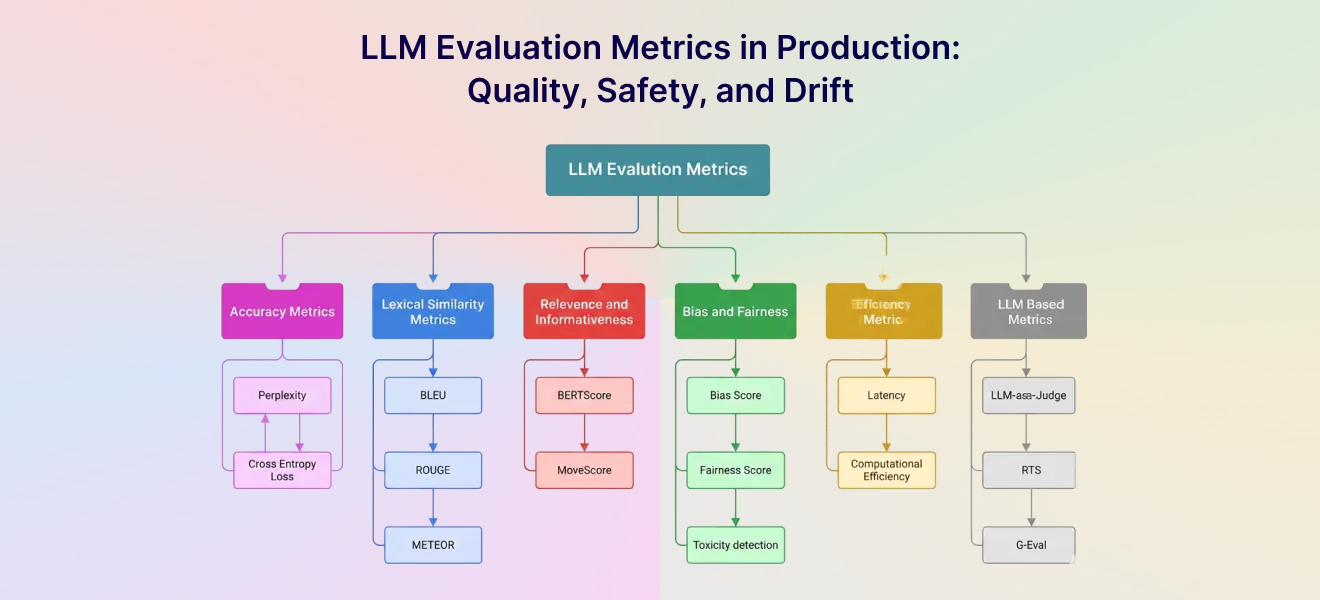
In practice, llm evaluation metrics should not be limited to one score. Production teams usually need a small but balanced set of evaluation metrics that cover output quality, safety, runtime health, and drift signals. This is especially important for llm systems built on generative ai models, RAG workflows, or agents, where the final output depends not only on the base language model but also on prompts, retrieval, tool use, and changing input data. The strongest production approach combines automated metrics, human review, and continuous monitoring instead of relying on one-time benchmarks alone.
Why Production Evals Are Different From Offline Benchmarks
Offline testing is useful, but it does not capture everything that happens after deployment. Once a system is live, the distribution of input data can change, prompts can be updated, retrieval logic can evolve, and end users can behave differently than test users. Even when the same ai models are still running, the broader system may no longer operate on the same distribution it was evaluated on before launch.
That is why evaluating llm performance in production needs a different mindset. Teams need to think about live evaluation criteria, not just research benchmarks. They need to measure whether the model still produces the expected outputs, whether the answer still matches the business requirement, and whether the system remains safe under real traffic. This is where production monitoring, regression checks, and application-specific evaluation become more valuable than generic leaderboard scores.
A useful production setup normally combines:
- offline checks before release
- online scoring after launch
- alerting for performance changes
- human review for higher-risk outputs
- periodic regression tests after prompt, workflow, or model updates
Quality Metrics to Track in Production
Quality is usually the first category teams think about, but it needs to be broken into measurable pieces. The best llm performance metrics depend on the use case, yet a few quality dimensions appear again and again across production systems.
Important quality-focused evaluation metrics include:
- correctness
- relevance
- faithfulness
- answer completeness
- instruction following
- coherence
- answer relevancy
- factual consistency
- factual accuracy
For many teams, llm evaluation metrics around answer quality begin with whether the model produces a factually correct answer that actually addresses the question. A response can be technically correct but still fail on relevance if it ignores the real user intent. This is why both correctness and relevance matter.
When a system has a known reference answer, reference text, or ground truth, teams can use reference based metrics to compare the generated text against the expected output. These include exact match, overlap-based comparisons, or alignment with a known target. Where strict ground truth is not available, reference free metrics become more useful. These may score helpfulness, structure, or rubric compliance without requiring a single perfect answer.
For nuanced applications, teams often use:
- semantic similarity between the generated answer and a reference answer
- factuality checks against trusted sources
- rubric scoring with LLM judges
- custom correctness rules for domain-specific use cases
Semantic similarity is especially useful because many good answers do not look identical to the reference text. A system may produce different wording while still conveying the same meaning. That is why embedding-based comparisons often work better than strict lexical overlap for modern llm evals.
Safety Metrics for LLM Systems
Safety should be treated as a first-class evaluation category, not an optional add-on. Production teams need to know whether llm outputs are harmful, misleading, or policy-violating, even when the system appears useful from a quality perspective.
Common safety-focused metrics include:
- hallucination rate
- toxicity
- harmful or restricted content
- bias
- unsafe disclosure
- refusal quality
- prompt injection resistance
- policy compliance
This matters because a strong answer is not enough if the output creates risk. A model can be fluent and relevant while still being unsafe. That is why llm evaluation in production should include both quality and safety evaluation criteria. For enterprise use cases, teams may also need custom metrics for privacy, compliance, and organization-specific risk policies.
Safety reviews should also account for:
- ethical considerations
- sensitive-domain rules
- escalation paths for unsafe outputs
- human review for high-risk responses
- red-team or adversarial testing for misuse scenarios
The strongest production stacks use a hybrid model: automated safety checks for scale, plus human judgment for edge cases that require nuance or policy interpretation.
Drift Metrics and Why They Matter
Drift is one of the most important topics in production because the model can degrade without an obvious failure event. Teams often notice quality slipping before they understand why. That is why drift detection deserves its own section in any production evaluation plan.
Data drift refers to changes in the distribution of input data over time. If live prompts, documents, customer requests, or upstream workflow data start looking different from what the system usually sees, performance can fall. Concept drift happens when the underlying relationship between inputs and expected outputs changes. Model drift is the broader decline in output quality or reliability over time, even when the model version itself has not changed.
In production, teams may need to watch for:
- data drift
- significant data drift
- concept drift
- model drift
- output drift
- quality drift
- prompt drift
- retrieval drift
This is especially important for RAG or tool-augmented systems, where drift can come from many layers:
- retrieval changes
- prompt changes
- user-intent shifts
- source-content changes
- workflow updates
- tool failures
A practical monitoring setup should define what counts as significant deviations from baseline and set a predefined threshold for alerts. Drift is often detected when quality scores, latency patterns, safety failures, or retrieval behavior move outside expected bounds.
How to Detect Drift in Practice
The best drift detection strategies combine statistics, semantic checks, and human review. There is rarely one perfect signal.
Teams often start with:
- a baseline dataset
- a recent production sample
- a few core key metrics
- alert thresholds for quality and safety changes
Useful drift checks may include:
- distribution comparisons on live input data
- statistical tests for shifts in data distributions
- embedding-based comparisons
- cosine similarity checks across prompt or output clusters
- answer-quality score trends
- sampled manual reviews
For example, if answer relevance, faithfulness, or hallucination rate worsens over time, that can indicate drift even before users file complaints. If retrieval quality changes, teams may also need to inspect retrieval strategies, document freshness, and even the health of the vector database or embedding models used underneath.
A practical production workflow might include, often supported by specialized machine learning development and consulting services:
- define a baseline from previous stable runs
- compare new traffic against that baseline
- use statistical or embedding-based checks to flag significant deviations
- review a sample of flagged runs manually
- retrain, re-prompt, or adjust the pipeline if the decline is confirmed
This is why drift monitoring is not only about one number. It is about catching shifts in the system before the final output becomes unreliable for users.
Reference-Based Metrics vs Reference-Free Metrics
Not every production use case has strong ground truth data. Some teams can compare outputs against a reference answer, while others operate in open-ended workflows where multiple answers may be acceptable.
Reference based metrics work well when there is a clear expected answer or a validated reference text. These are useful for QA systems, extraction tasks, classification, and structured generation.
Examples include:
- exact match
- comparison to generated and reference text
- answer correctness against ground truth
- similarity to a validated reference answer
Reference free metrics are more useful when the system is open-ended, subjective, or hard to compare against one target response. These often rely on rubric-based evaluation, LLM judges, policy checks, or task-specific scoring rules.
Examples include:
- relevance scoring
- faithfulness scoring
- rubric-based helpfulness
- hallucination detection
- safety scoring
- style or format checks
In production, many teams need both. A customer-support system may use reference-based scoring for known FAQ answers but switch to reference-free scoring for longer conversations or drafting tasks, much like WordPress AI-powered support experiences that mix scripted responses with generative replies.
Automated Metrics, Human Feedback, and Human Judgment
No single method is enough for all llm evals. That is why strong evaluation frameworks combine:
- automated scoring
- model-based scoring
- sampled human review
- runtime analytics
Automated metrics are useful because they scale. They help teams score large volumes of production logs quickly and compare versions over time. But they are not always enough for subtle quality issues. Human feedback and human judgment are still essential when outputs need nuance, domain expertise, or contextual interpretation.
This is especially true when:
- the answer must reflect policy nuance
- the response is high stakes
- the evaluation depends on context
- multiple valid outputs are possible
- the tone or explanation quality matters
A balanced setup may use:
- deterministic checks for structure or policy
- LLM-based metrics for nuanced scoring
- human review for exceptions and audits
- CSAT or user ratings as real-world feedback
If your team is moving from evaluation design into implementation, monitoring, and production hardening, explore Generative AI Development Services or broader custom AI development company offerings for end-to-end support.
Metrics for RAG, Agents, and Other LLM Systems
Different llm systems need different metric stacks. This is where many teams make mistakes by applying generic metrics to very specific architectures.
For retrieval augmented generation, useful metrics often include—regardless of whether you pair RAG with fine-tuning or advanced prompting strategies like those compared in RAG vs fine-tuning vs prompting—metrics such as:
- contextual precision
- contextual recall
- faithfulness
- answer relevancy
- citation quality
These metrics help teams understand whether the retrieved context was useful and whether the generated answer stayed grounded in the sources. If retrieval is weak, even a strong language model may fail. Teams building grounded apps often need dedicated architecture, retrieval tuning, and evaluation workflows, which is why RAG development for grounded LLM applications becomes important once retrieval quality starts influencing production outcomes.
For agent evaluation, the stack usually expands to include—especially in enterprise settings that rely on AI agent development services for complex workflows—metrics such as:
- task completion
- tool success rate
- workflow reliability
- handoff accuracy
- plan quality
- action correctness
For structured tasks, teams may also use:
- exact extraction accuracy
- schema compliance
- latency
- cost per run
The key is to align the metric set with the real use case instead of relying on generic metrics that miss system-specific failure modes.
RAG vs Non-RAG Evaluation
Not every LLM application should be evaluated the same way. A general drafting workflow may emphasize correctness, style, safety, and task completion, while a retrieval-backed system needs much stronger checks around groundedness, citation quality, contextual precision, contextual recall, and faithfulness to retrieved sources.
That difference is important because production failures in RAG systems often come from retrieval quality, stale context, weak chunking, or poor citation grounding rather than only from the base model. For a deeper comparison of these grounded-app metrics, review RAG evaluation metrics.
Legacy Metrics and Why They Are Not Enough Alone
Some older text-generation metrics still appear in SEO tools and even in some software quality assurance workflows because they are part of evaluation history. For example:
- bilingual evaluation understudy refers to BLEU
- recall oriented understudy for gisting evaluation refers to ROUGE
- gisting evaluation and understudy for gisting evaluation are related to the same family of summarization-style overlap checks
These can still be useful in narrow settings, especially when comparing generated and reference text, but they often fail to capture meaning, nuance, and factual quality in modern large language models. That is why semantic and rubric-based methods usually work better for production systems than lexical overlap alone.
Operational Metrics and Production Monitoring
A production evaluation plan should also include runtime health metrics, not only content scoring. Strong production monitoring usually tracks:
- latency
- time to first token
- throughput
- cost per query
- uptime
- request errors
- token usage
- tool failures
These are not replacements for quality or safety metrics, but they matter because a model that is accurate but too slow, too expensive, or too unstable may still fail in production.
Teams should also compare model performance before and after:
- prompt updates
- model changes
- retrieval modifications
- tool integration changes
- data pipeline updates
This is where monitoring becomes a true production discipline rather than a one-time testing step, especially for teams using AI in software testing to scale QA evaluation.
Common Mistakes Teams Make
Common mistakes include:
- tracking latency only
- using too many metrics with no prioritization
- relying on one judge or one score
- skipping safety checks
- ignoring data drift
- not defining evaluation criteria
- not creating custom metrics for the real use case
- assuming ground truth always exists
- not reviewing changes in user behavior
Another common problem is overcomplicating the pipeline. In practice, most teams do better with a focused set of no more than a few important metrics than with dozens of disconnected scores. The goal is not to measure everything. The goal is to monitor what actually predicts production quality and risk.
Conclusion
LLM evaluation metrics in production should help teams measure what matters after launch: output quality, safety, runtime reliability, and drift. The best production approach combines llm evaluation metrics, operational signals, hybrid review methods, and application-specific scoring instead of relying on a single benchmark or one generic score. When teams monitor quality, safety, and data drift continuously, they are much more likely to catch regressions early, protect user trust, and improve llm performance over time.
FAQs
What are the most important LLM evaluation metrics in production?
The most important metrics usually include correctness, relevance, faithfulness, hallucination rate, safety policy compliance, task completion, latency, and drift signals.
What is the difference between reference-based metrics and reference-free metrics?
Reference-based metrics compare the output against a known reference answer or ground truth, while reference-free metrics score the response without requiring one exact expected answer.
What is data drift in LLM systems?
Data drift refers to changes in the distribution of live input data over time. These changes can reduce model quality even if the model version itself has not changed.
What is concept drift?
Concept drift happens when the relationship between inputs and expected outputs changes, making older evaluation assumptions less reliable in production.
Why is semantic similarity important in LLM evaluation?
Semantic similarity helps measure whether a response preserves the meaning of a correct answer even when the wording differs. This is often more useful than strict text overlap for modern LLMs.
Should teams use automated metrics or human review?
Most teams should use both. Automated metrics scale well, while human judgment and human feedback are better for nuanced or high-risk evaluation.
How often should production LLM systems be evaluated?
Production systems should be monitored continuously, with deeper review after prompt changes, model updates, retrieval changes, or noticeable shifts in user behavior.