Summarize This Article With AI
The AI product engineering lifecycle is the end-to-end process of turning an AI idea into a production system that teams can trust, monitor, and improve over time. The AI lifecycle refers to the comprehensive set of stages involved in developing, deploying, and maintaining AI systems, ensuring structured processes and best practices throughout.
Unlike typical software, AI products depend on data quality, probabilistic model behavior, evaluation discipline, and ongoing monitoring. That’s why “it works in a demo” is not the same as “it works in production.” A key difference between the AI product lifecycle and traditional software development is that AI systems continuously learn and evolve after deployment, requiring ongoing adaptation and monitoring throughout their lifecycle.
Effective AI lifecycle management and a structured lifecycle are the backbone for every AI initiative, delivering clear business value by reducing wasted effort and accelerating time-to-value. The AI product lifecycle is a strategic, iterative framework that guides the development, deployment, and continuous improvement of AI products, setting it apart from traditional, linear software development. Managing the AI product engineering lifecycle requires a shift from deterministic, linear software development to an experimental, data-driven approach.
This guide walks through a practical AI product engineering lifecycle you can follow—covering strategy, data readiness, architecture choices, evaluation, deployment, and continuous improvement.
If you want help designing and shipping a production-ready AI product, contact WebbyCrown Solutions
What AI product engineering means (and how it differs from software engineering)
AI product engineering is still product engineering—but with extra constraints:
- Outputs are probabilistic. You validate behavior with evaluation, not only unit tests.
- Data is part of the product. Data quality, permissions, and freshness directly affect user outcomes.
- Quality must be measured continuously. Drift, content updates, and user behavior change results.
- Security and governance matter earlier. AI can expose sensitive information or take risky actions if unscoped.
- Iteration loops are tighter. Shipping is not “done” at launch; it’s continuous improvement.
Unlike traditional software engineering, the product development lifecycle for AI-powered products becomes a continuous, iterative journey—planning, building, launching, and improving AI solutions to ensure ongoing business value and technological robustness.
A good lifecycle makes these realities explicit, so teams can build AI products that are reliable and scalable.
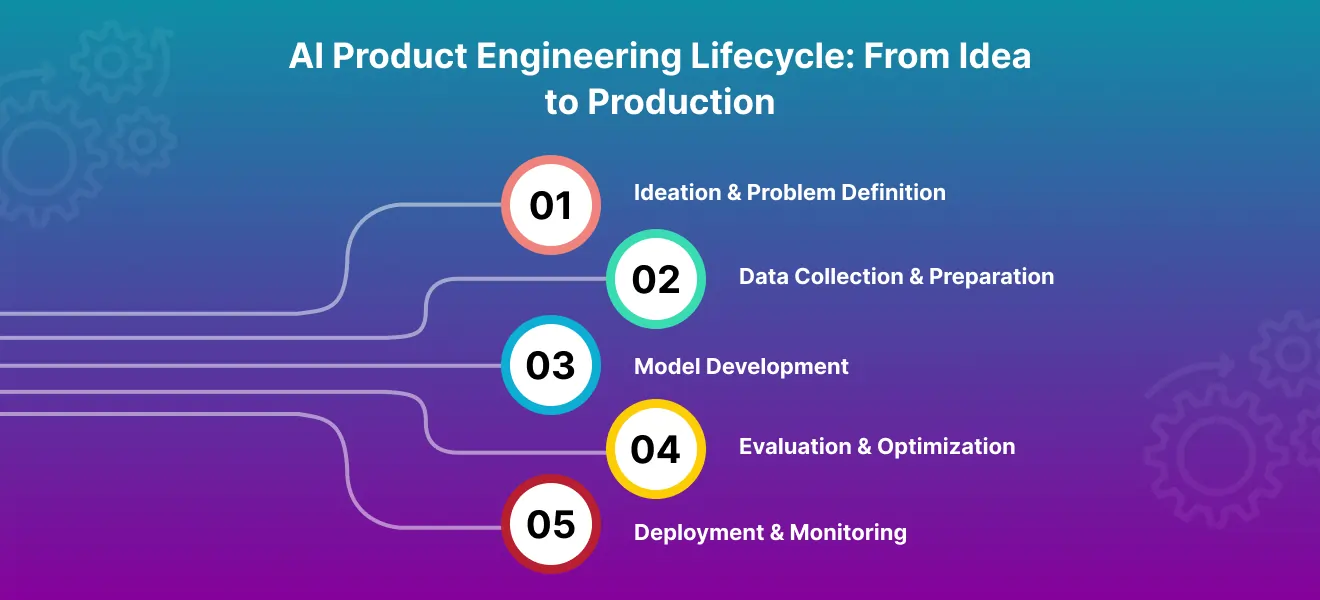
The AI product engineering lifecycle (end-to-end map)
Here’s a practical lifecycle you can apply to most AI products:
- Problem framing and ROI hypothesis
- Data readiness assessment
- Architecture choice (prompting vs RAG vs fine-tuning vs ML)
- Prototype and MVP build
- Evaluation and quality engineering
- Security, privacy, and responsible AI controls
- Deployment with LLMOps/MLOps
- Monitoring, drift, and incident response
- Iteration and scaling
The rest of this article breaks down each phase with practical guidance.
AI Systems and Solutions
AI systems and solutions harness the power of artificial intelligence and machine learning to solve real-world business challenges and drive operational efficiency.
The journey begins with a clear problem definition, ensuring that the AI initiative aligns with business objectives and delivers measurable value. Throughout the AI development lifecycle, teams focus on data collection—gathering high-quality, relevant data from sources such as internal databases, external providers, and direct user feedback. This data forms the foundation for building robust AI models.
A successful AI system is not just about sophisticated algorithms; it’s about integrating user interactions and feedback into the development process. By continuously refining models based on real-world usage and performance, organizations can ensure their AI solutions remain effective and user-centric.
Model development and model evaluation are critical stages, where teams assess model performance against business goals and iterate as needed. Ultimately, well-designed AI systems deliver scalable solutions that adapt to changing needs, providing ongoing value and supporting strategic decision-making.
Phase 1: Problem framing and product strategy
Start by clarifying what “success” means. This phase lays the foundation for successful AI initiatives by ensuring comprehensive planning and alignment with business objectives.
Define the user problem
- Who is the user?
- What task are they trying to complete?
- What does “good” look like (speed, accuracy, reduced effort, better decisions)?
Write an ROI hypothesis
- What cost are you reducing or what revenue are you enabling?
- Where is the current manual effort?
- What is the business value of improving that workflow?
Set constraints early
- latency target (interactive vs batch)
- cost per request limits
- required compliance (PII, HIPAA, GDPR, industry rules)
- audit and traceability requirements
This phase produces your AI product roadmap inputs: scope, measurable outcomes, and constraints.
Skipping or rushing through any phase of the AI lifecycle often leads to budget overruns, poor alignment with business goals, or models that fail to perform reliably in production. Taking the time to thoroughly address each stage is critical for the long-term success of your AI initiatives.
Phase 2: Data collection and readiness assessment
Data collection is the foundational step in the AI development lifecycle. Most AI projects fail because data is not ready—not because the model is weak.
Inventory data sources
- documents, knowledge bases, tickets, CRM data
- databases, logs, product catalogs
- structured vs unstructured content
- data freshness requirements (static vs frequently updated)
- Robust data architecture is a non-negotiable prerequisite in AI development, focusing on high-quality, labeled, and diverse datasets.
Validate data quality
- duplication, missing fields, inconsistent formats
- versioning and outdated content
- language consistency and taxonomy
- Data preparation is critical because raw data is rarely ready for machine learning and usually requires preprocessing.
- Data labeling is essential for supervised learning, requiring accuracy and domain expertise to ensure datasets are properly prepared for model training.
- The quality and quantity of training data is the single most important factor in the strength of AI models.
- Feature engineering is a prominent part of the data preparation process, involving the creation of effective input variables to improve model performance.
Confirm permissions and governance
- who can access the data
- what can be stored, logged, or cached
- retention rules
- sensitive data handling requirements
- Inadequate data management is often the source of ethical, reputational, and financial risks in AI projects.
If data is not clean, available, and permissioned, production reliability will suffer no matter which model you pick. Data is the lifeblood of AI, and without high-quality, relevant data, even the most advanced models will fail.
Phase 3: Choose the right approach (prompting vs RAG vs fine-tuning vs ML)
Do not default to the newest technique. Choose based on the problem.
Selecting the right machine learning algorithms is essential, as different tasks may require anything from simple regression models to complex neural networks. Generative AI, including large language models (LLMs) and other generative models, presents unique complexities in development, training, fine-tuning, and deployment, and is particularly suited for tasks like content creation, summarization, and code generation. Model learning is a critical component of the AI development process, playing a key role in continuous delivery pipelines and the ongoing lifecycle of AI models, including training, deployment, and maintenance.
After considering these approaches, remember that model selection and architecture design are crucial steps that must precede the training phase in the AI development lifecycle.
Prompting (fastest to start)
Best when:
- the task is low risk
- you need rapid prototyping
- the system does not require private or frequently changing knowledge
- outputs can be reviewed or verified easily
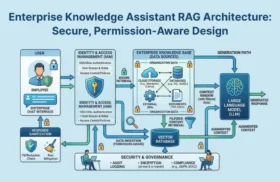
RAG (for grounded answers on enterprise knowledge)
Retrieval-Augmented Generation (RAG) is best when:
- answers must be grounded in internal documents
- knowledge changes frequently
- you need citations or traceability
- you want to reduce hallucinations using retrieved context
Fine-tuning (for consistent behavior and strict formatting)
Fine-tuning is best when:
- you have enough high-quality training examples
- you need consistent outputs (classification, structured extraction, style)
- prompting alone is too inconsistent
- you want stable behavior across many requests
Classical ML (for prediction and forecasting)
Classic ML fits when:
- you need predictive analytics
- outputs should be numerical or categorical
- you have labeled historical data and stable targets
Many strong products combine these approaches, especially prompting + RAG, or RAG + fine-tuning.
Phase 4: Prototype, model development, and MVP build
The MVP should prove value quickly, without creating risk.
Build the minimal user workflow
- one clear user path
- one core task outcome
- clear success criteria
Design for human-in-the-loop
Even if you want automation, start with review steps where needed:
- human approval for high-impact actions
- escalation when confidence is low
- “I don’t know” behavior when context is insufficient
Avoid premature complexity
Do not build every integration at once. Start with a narrow slice of your stack—for example, piloting one workflow on a Builder.io-powered digital experience or a single internal tool—before expanding. Start with:
- one data source
- one workflow
- one department or segment
This is faster and reduces rework.
AI Solutions and Models
At the heart of every AI system are the AI solutions and models that enable intelligent automation, prediction, and insight generation. The model development process starts with thorough data preparation—cleaning, transforming, and structuring raw data to create a reliable training dataset. This step is essential for ensuring that the AI model can learn effectively and deliver accurate results.
Selecting the right type of AI model depends on the specific problem at hand. Options range from supervised learning models for classification and regression tasks, to unsupervised models for clustering, and reinforcement learning for dynamic environments. Once the model architecture is chosen, model training begins, using prepared data to optimize the model’s parameters and enable enterprise-grade AI chatbot experiences where relevant.
After training, it’s crucial to evaluate the AI model on unseen data to verify its ability to generalize beyond the training set. This evaluation uses performance metrics such as accuracy, precision, recall, and others tailored to the business context. By rigorously assessing model performance, teams can ensure their AI solutions are reliable, robust, and ready for deployment in production environments.
Phase 5: Model evaluation and quality engineering
Evaluation is what makes AI products production-grade.
Build a test dataset
Use real examples:
- support tickets
- internal queries
- user questions
- expected answers or approved sources
Define evaluation metrics
Choose metrics that match your product:
- answer relevancy and completeness
- factual grounding and faithfulness
- refusal correctness (saying “I don’t know” when needed)
- latency and cost
- for RAG: retrieval accuracy and context quality
- for classification/extraction: precision/recall, error types
Set release criteria
Before production:
- stable performance on the test set
- clear regression checks
- known failure modes documented
- fallback behavior verified
Without evaluation discipline, you won’t know whether changes improved the system or broke it.
Phase 6: Security, privacy, and responsible AI controls
Security controls should be designed, not bolted on.
AI-powered applications present unique challenges for governance and privacy regulations, as they handle large volumes of data and operate within complex, interconnected systems, particularly when deploying enterprise AI agents and automation in production environments.
Core controls
- role-based access control (RBAC)
- audit logs for tool calls and data access
- data minimization (only retrieve what’s needed)
- encryption in transit and at rest
- secure secrets management for integrations
- protecting sensitive data throughout the AI development lifecycle, including compliance with privacy regulations such as GDPR and CCPA, maintaining transparency in data processing, and providing users with control over their information
AI-specific risks
- prompt injection
- data leakage via retrieval
- unsafe tool use (agents)
- biased or misleading outputs
Define what the system must not do, and enforce it with both technical rules and monitoring.
AI Life Cycle and Project Management
Managing an AI project requires a structured approach, guided by the AI life cycle—a framework that spans from initial concept to deployment and ongoing maintenance. The life cycle begins with problem definition and data collection, ensuring that the project addresses real business needs and is supported by sufficient, high-quality data. Model development and model evaluation follow, with teams iteratively refining their AI systems to meet performance metrics and business objectives.
Effective AI life cycle management involves proactive risk identification and mitigation. Challenges such as data scarcity, model drift, and regulatory compliance must be addressed early and continuously. Model drift, in particular, requires ongoing monitoring and adaptation to ensure that AI solutions remain accurate as new data and user behaviors emerge.
AI project management also means coordinating the efforts of data scientists, software engineers, and business stakeholders when deciding between AI agents, chatbots, and automation approaches. Integrating AI solutions with existing systems and workflows is essential for maximizing impact and ensuring seamless adoption, including AI-powered WordPress experiences where websites are a key delivery channel. By following a disciplined development lifecycle, organizations can deliver AI projects that are timely, cost-effective, and aligned with strategic goals.
Phase 7: Deployment with LLMOps / MLOps
Production AI needs operational discipline.
Model deployment is the final step in the AI product engineering lifecycle, playing a crucial role in operationalizing trained models. Deployment integrates the AI system into a production environment, allowing it to handle real-world data and workflows. Building scalable AI solutions during deployment is essential to ensure reliability, adaptability, and efficient performance as demands grow.
Version everything
- prompts
- retrieval configurations
- model versions
- data source connectors
- evaluation datasets
Create a safe release process
- dev/staging/prod separation
- rollback plan
- canary rollout if needed
- monitoring on release day
Once a model has been trained and successfully validated, it moves on to the deployment phase, where it is integrated into the production environment for real-world use.
Optimize cost and latency
- caching where appropriate
- batching for async tasks
- token budgeting and response constraints
- model selection by tier (fast vs premium)
LLMOps/MLOps is what turns a working prototype into an operational product.
Phase 8: Monitoring, model drift, and incident response
AI quality is not static.
Monitor:
- user satisfaction signals
- error and fallback rates
- drift in query types or data
- cost per request
- latency percentiles
- retrieval failures (if RAG)
- escalation rates (if human-in-loop)
Model monitoring and performance monitoring are crucial post-deployment phases to ensure ongoing reliability and effectiveness of AI products. Continuous monitoring of model performance helps detect issues such as data drift, which can occur when production data changes and impact model accuracy. To address data drift and maintain performance, deployed models typically require periodic retraining on fresh data.
Implementing MLOps automates the lifecycle of model training, testing, and deployment, making it easier to handle model drift and streamline updates. Anomaly detection techniques should be integrated to identify unusual activities, vulnerabilities, or security breaches in AI systems and data pipelines. Continuous monitoring and retraining are essential stages in the AI product engineering lifecycle, ensuring that models remain accurate and useful over time. Iterative refinement of AI models based on real-world results and user interactions is also crucial for optimizing performance.
Set triggers for:
- quality regression
- rising hallucination flags
- data source changes
- system integration failures
Treat the AI system like a production service with observability, incident response, and continuous improvement.
Phase 9: Iteration and scaling
Once the MVP is stable:
- expand to additional workflows
- add integrations gradually
- improve evaluation coverage
- add governance policies as autonomy increases
- measure ROI continuously and refine the roadmap
Scaling AI products is less about adding features and more about improving reliability, coverage, and operational maturity. The ai product engineering lifecycle is an iterative process, where refining and improving AI models happens through repeated cycles of training, evaluation, and tuning based on performance feedback.
Maintaining AI systems is crucial—ongoing monitoring, updates, and management are needed to ensure sustained performance and reliability. AI products do not stop evolving after deployment; they require continuous improvement to adapt to new data and user feedback.
AI product engineering lifecycle checklist (copy/paste)
Use this checklist before production:
- Problem statement and user workflow defined
- Success metrics agreed (business + quality)
- Data sources mapped with permissions verified
- Architecture chosen (prompting/RAG/fine-tuning/ML) with reasons
- MVP scope limited and testable
- Evaluation dataset created and maintained
- Release criteria defined and enforced
- Guardrails and escalation paths implemented
- Access control and audit logging enabled
- Monitoring dashboards and alert triggers configured
- Rollback plan documented and tested
- Post-launch review cadence scheduled
Work with WebbyCrown Solutions
WebbyCrown Solutions helps organizations design and ship AI products with a production-ready lifecycle—from discovery to deployment to ongoing optimization.
If you want an implementation partner for AI product delivery, explore AI Product Engineering Services.
FAQs
What is the AI product engineering lifecycle?
It is the end-to-end process of taking an AI idea into production, including strategy, data readiness, architecture choices, evaluation, deployment, monitoring, and continuous improvement.
What is the biggest reason AI products fail?
Most failures come from weak data readiness, lack of evaluation discipline, missing governance controls, or poor monitoring—not model choice alone.
When should I choose RAG instead of fine-tuning?
Choose RAG when answers depend on private or frequently updated knowledge and you need grounded responses. Choose fine-tuning when you need consistent output format or stable behavior across many requests.
What should I measure after launch?
Track quality, drift, latency, cost per request, fallback rates, escalation rates, and user satisfaction signals. Add retrieval metrics if you use RAG.
Do AI products need governance?
Yes. Even low-risk systems need access control and monitoring. As autonomy increases, approval gates and audit logs become essential.
Conclusion
In summary, building and deploying effective AI systems and solutions demands a disciplined, structured approach that spans the entire AI development lifecycle. From the initial problem definition to deployment and ongoing maintenance, each phase requires careful attention to relevant data, robust model development, and the protection of sensitive data. Continuous monitoring is essential to detect model drift and maintain high performance, especially as AI systems interact with real-world data and evolving user needs.
Unlike traditional software, AI projects must address unique challenges such as regulatory compliance, data quality, and the need for ongoing updates to trained machine learning models. By embracing best practices in AI life cycle management and project execution, organizations can unlock the full potential of artificial intelligence—driving innovation, efficiency, and business value while safeguarding sensitive information and meeting compliance requirements.