Summarize This Article With AI
Effective AI governance is essential as organizations increasingly adopt AI systems across their business operations. Using a well-structured AI governance policy template helps teams scale governance efforts by providing clear, actionable policies that can be adapted and implemented quickly. While this template provides operational guidance, it is not a substitute for legal advice tailored to your organization’s specific needs—consulting legal counsel is recommended to ensure legal compliance with relevant laws and regulations. The template should be tailored to the organization’s size and needs, and helps organizations avoid massive penalties and fines that can arise from AI-related vulnerabilities.
This AI usage policy template and usage policy template are designed to be accessible and customizable for organizations of any size. Implementing an AI usage policy is a commitment to integrating AI into the workplace in a respectful, safe, and innovative manner.
This template offers copy/paste policy sections designed for practical use, enabling teams to establish responsible AI practices, ensure compliance with data governance standards, and manage AI risk effectively. A standardized AI policy protects the organization while fostering transparency, compliance, and innovation.
Introduction to AI Governance
AI governance is rapidly becoming a cornerstone of modern business strategy, as organizations face increasing pressure to ensure the responsible and ethical use of artificial intelligence (AI) tools and systems. With the growing reliance on AI technology to drive business operations and innovation, it is essential to have a robust AI governance policy in place. Such a policy not only helps organizations mitigate risks associated with AI initiatives but also ensures compliance with evolving legal and regulatory standards.
An AI policy template provides a practical starting point for organizations to develop a governance policy tailored to their unique needs. By establishing clear guidelines for AI usage, organizations can balance the benefits of AI development—such as improved efficiency and enhanced decision-making—with the need to uphold ethical standards and manage potential risks. Effective AI governance enables companies to harness the power of AI responsibly, ensuring that their use of AI systems aligns with both organizational values and regulatory requirements. Ultimately, a well-structured governance policy supports responsible AI adoption, fosters trust, and positions organizations to thrive in an increasingly AI-driven world.
How to use this template
- Define scope: Determine whether the policy applies to internal AI tools, customer-facing AI systems, or both, clarifying the boundaries of AI usage within your organization.
- Define owners: Assign clear ownership for AI governance responsibilities across business units, engineering teams, security, and compliance departments to ensure accountability.
- Involve multiple departments in the creation of the AI governance policy to ensure comprehensive coverage of all relevant aspects.
- Define risk tiers: Categorize AI use cases into low, medium, and high-risk tiers to tailor governance controls, approval workflows, and monitoring efforts accordingly.
- Audit current AI tool usage, including “shadow AI,” to understand baseline risk before implementing the policy.
- Conduct risk assessments to identify potential negative impacts of AI projects and develop mitigation strategies.
- Establish procedures for collecting, storing, and sharing data, ensuring compliance with laws like GDPR or HIPAA.
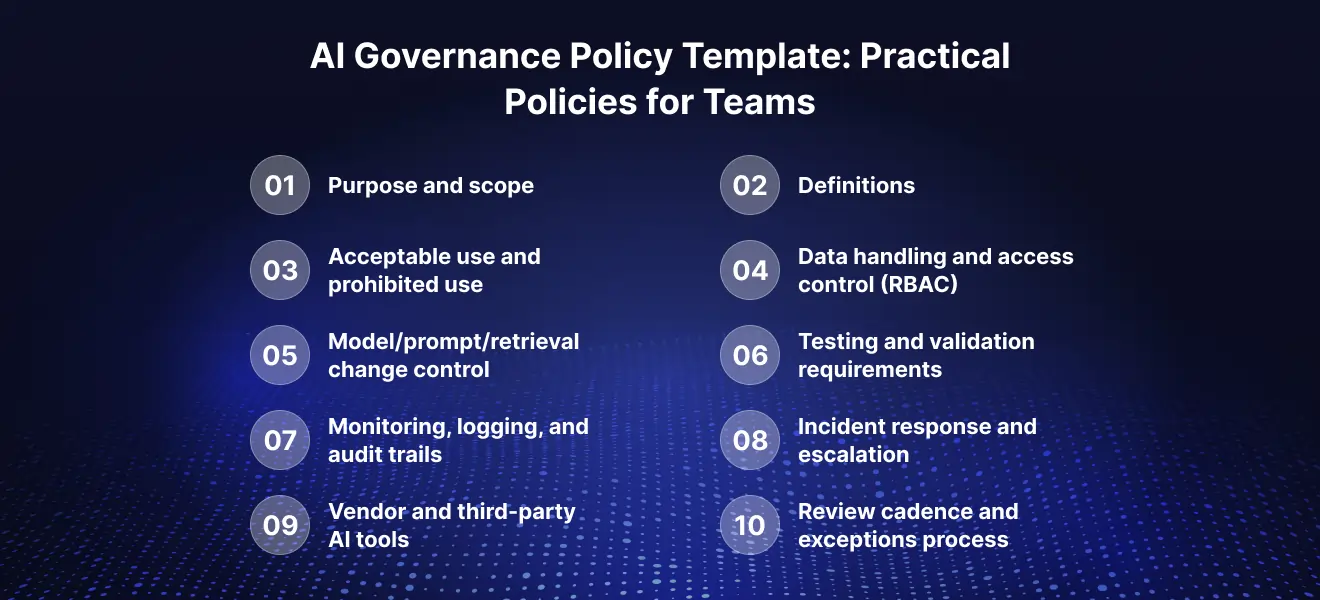
AI governance policy template
1) Purpose and scope
- Establish the policy’s intent to guide responsible AI use and governance across the company.
- Ensure the policy considers real world applications of AI within different departments to align strategies and practices accordingly.
- Clarify which AI systems and projects the policy covers.
- Align governance objectives with organizational values and regulatory standards.
- State that the policy helps mitigate unclear or fragmented decision-making authority and compliance failures due to governance blind spots.
- Owner: Governance Committee
- Evidence required: Policy document approval records
2) Definitions
- Define key terms such as AI system, model, prompt, retrieval-augmented generation (RAG), agent, generative AI (AI systems that can create new content, code, or insights), and generative AI tools (software or platforms, such as ChatGPT, that use generative AI to produce content or code).
- Add a definition for NIST AI RMF (National Institute of Standards and Technology Artificial Intelligence Risk Management Framework), highlighting its relevance as a standard for operationalizing AI governance and ensuring regulatory compliance.
- Ensure consistent understanding across teams.
- Owner: Governance Committee
- Evidence required: Glossary document
3) Acceptable use and prohibited use
- Specify permitted AI applications and prohibited behaviors, including outlining specific tasks where AI is allowed versus high-risk tasks that are banned.
- Include guidelines for ethical use based on core ethics principles and compliance with legal requirements.
- Prohibit use cases that pose significant ethical, compliance, or significant risks associated with AI use.
- Require mandatory human-in-the-loop oversight for high-stakes decisions affecting employment or financial status.
- Explicitly prohibit uploading sensitive, proprietary, or confidential information into public, non-enterprise AI tools.
- Owner: Compliance Team
- Evidence required: Usage logs and policy acknowledgment records
4) Data handling and access control (RBAC)
- Implement role-based access control to protect sensitive data.
- Define data privacy and data security requirements aligned with data protection laws such as GDPR or HIPAA.
- Establish procedures for collecting, storing, and sharing data, ensuring compliance with laws like GDPR or HIPAA.
- Ensure data governance practices are integrated with AI usage.
- Owner: Data Governance Team
- Evidence required: Access control logs and data handling protocols
5) Model/prompt/retrieval change control
- Require approval workflows for changes to AI models, prompts, or retrieval mechanisms.
- Maintain audit trails of all modifications.
- Include rollback procedures in case of adverse impacts.
- Owner: Engineering and Governance Teams
- Evidence required: Change logs and evaluation reports
6) Testing and validation requirements
- Mandate rigorous testing before deployment of AI models or updates.
- Define validation criteria based on risk tiers.
- Document test results and approvals.
- Owner: Quality Assurance Team
- Evidence required: Test reports and validation certificates
7) Monitoring, logging, and audit trails
- Establish continuous monitoring of AI system performance and compliance.
- Maintain detailed logs for auditing and incident investigation.
- Define metrics for ongoing evaluation.
- Owner: Security and Governance Teams
- Evidence required: Monitoring dashboards and audit reports
8) Incident response and escalation
- Define procedures for identifying, reporting, and responding to AI-related incidents.
- Assign escalation paths and responsible parties.
- Include communication protocols for internal and external stakeholders.
- Owner: Incident Response Team
- Evidence required: Incident logs and resolution documentation
9) Vendor and third-party AI tools
- Require due diligence and risk assessment for third-party AI vendors, including defined review processes to ensure third-party AI tools meet internal security and privacy standards.
- Specify compliance requirements and contractual obligations.
- Company policy should guide procurement and approval processes for third-party AI solutions to align with organizational standards and control shadow AI adoption.
- Define review processes for third-party AI tools to ensure they meet internal security and privacy standards.
- Monitor vendor performance and security.
- Owner: Procurement and Security Teams
- Evidence required: Vendor risk assessments and contracts
10) Review cadence and exceptions process
- Set regular intervals for policy review and updates.
- Define a process for handling exceptions and policy deviations.
- Ensure documentation and approval of exceptions.
- Owner: Governance Committee
- Evidence required: Review schedules and exception logs
Implementation
Successfully implementing an AI governance policy requires a structured and systematic approach that addresses every aspect of AI use within the organization. The first step is to assign clear roles and responsibilities, ensuring that all stakeholders—from business leaders to technical teams—understand their part in upholding the AI governance policy. Establishing well-defined procedures for AI development, deployment, and ongoing management is crucial for maintaining oversight and accountability.
Ongoing monitoring and evaluation of AI systems are essential to identify and address any emerging risks or policy violations. This includes setting up regular audits and assessments to ensure that AI usage remains aligned with organizational goals, regulatory requirements, and ethical standards. Training employees on the AI policy and responsible use of AI tools is also a key component of effective implementation, helping to build a culture of responsible AI use across the organization.
By following a comprehensive implementation plan, organizations can ensure that their AI governance policy is not only adopted but also actively enforced and continuously improved. This proactive approach helps mitigate risks, supports responsible AI usage, and ensures that the organization’s use of AI systems remains both effective and compliant.
Training and Education
A critical element of effective AI governance is providing comprehensive training and education for all employees involved in the use of AI tools and systems. Training should cover the fundamentals of the AI governance policy, including data protection requirements, intellectual property laws, and ethical guidelines for AI use. Employees need to understand the potential risks and benefits associated with AI, as well as their responsibilities in ensuring responsible AI usage.
Education programs should also address how to identify and report concerns related to AI use, such as data breaches, policy violations, or ethical dilemmas. By fostering awareness and understanding, organizations can promote a culture of responsible AI use and ensure that their governance policy is effective in practice.
To keep pace with rapid advancements in AI technology and evolving industry best practices, organizations should establish ongoing learning and development opportunities. This commitment to continuous education helps employees stay informed about the latest developments in AI governance, data protection, and ethical standards, ensuring that the organization remains compliant and resilient in the face of new challenges.
Approval matrix
| Change Type | Approval Needed | Evidence |
|---|---|---|
|
Prompt update (low risk) |
Product + Engineering |
Test set results |
|
New data source |
Security + Data Owner |
Access review |
|
Model change |
Engineering + Governance |
Evaluation + rollback |
|
Tool/action added (agent) |
Governance + Security |
Threat review |
Common mistakes
- Policies that are too abstract and lack actionable details.
- Absence of evidence discipline leading to poor compliance tracking.
- Missing change control processes causing unmanaged AI risks.
- Shadow AI tools usage without governance oversight.
- Lack of clear ownership and accountability.
- Failure to address AI-related risks by not conducting comprehensive risk assessments to identify potential negative impacts of AI.
Contact us
For expert guidance on implementing this AI governance policy template and scaling your AI governance efforts, contact our AI Governance Consulting Services. We also offer support through our AI Product Engineering Services and custom AI development services to help operationalize your AI initiatives responsibly.
FAQs
What should be in an AI governance policy?
A comprehensive AI governance policy includes clear principles, defined roles, acceptable use guidelines, data governance, risk management, monitoring, incident response, vendor management, and review processes.
How often should the AI governance policy be reviewed?
Regular reviews should occur at least annually or whenever there are significant changes in AI technology, regulatory requirements, or organizational operations.
Who approves AI system changes?
Approval depends on change type but typically involves product, engineering, governance, security, and data owners as outlined in the approval matrix.
What evidence should be kept?
Maintain records such as policy approvals, usage logs, test results, change logs, incident reports, vendor assessments, and review documentation.
Does this policy apply to chatbots and agents?
Yes, all AI systems including chatbots and autonomous agents fall under the governance policy’s scope. For more detailed guidance, explore our AI policy management playbook and AI risk assessments guide.