Summarize This Article With AI
RAG systems can look impressive in demos and still fail in production.
A knowledge assistant may generate fluent answers, but if it retrieves weak evidence, misses the right document, or adds unsupported claims, users lose trust quickly. That is why rag evaluation metrics and a repeatable rag evaluation process are not optional.
A strong RAG application has to do three things well:
- retrieve relevant documents and relevant information
- generate a useful answer from the retrieved context
- stay grounded in that evidence so the final answer quality remains high
This guide explains which rag evaluation metrics matter most, how to use the right evaluation criteria, and how to build practical evaluation workflows for production-grade retrieval augmented generation systems.
If you want help building and validating production-ready retrieval systems, explore RAG Development Services.
Why evaluation matters in RAG systems
Retrieval augmented generation combines a retriever that fetches relevant documents with a language model that generates responses from that evidence. In modern retrieval augmented generation rag applications, the quality of the output depends on how well the retriever, ranker, and generator work together.
That sounds simple, but failures can happen at multiple stages:
- the retriever surfaces the wrong document
- the right document is retrieved but the wrong chunk is passed forward
- the answer misses a key step or condition
- the model adds unsupported claims
- citations point to weak or unrelated sources
These failures are dangerous because the response can still sound polished. Users often trust fluent answers even when the evidence is incomplete or wrong.
A good rag evaluation program helps prevent:
- irrelevant or outdated retrieval
- unsupported claims
- incomplete workflow guidance
- incorrect citations
- silent quality degradation after indexing, prompt, or model changes
If you evaluate retrieval and generation separately, you can debug the real cause instead of guessing. That is the foundation of evaluating rag systems well.
The three layers of RAG evaluation
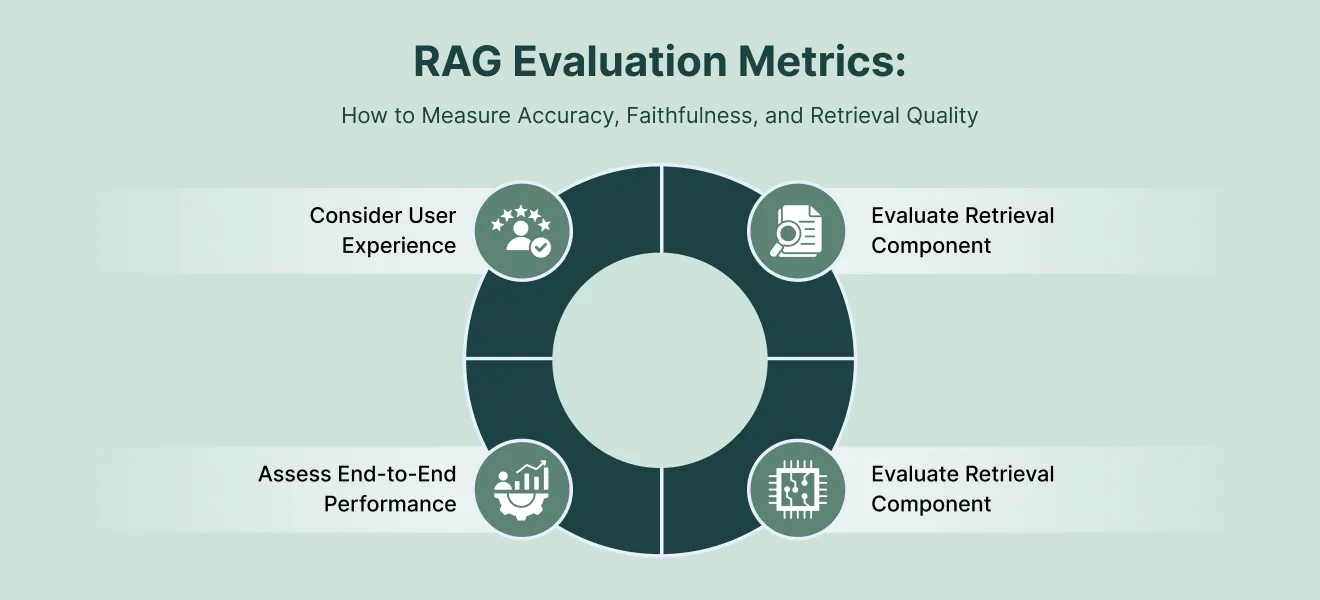
A practical rag evaluation framework should measure three layers:
1) Retrieval quality
Did the system retrieve the right relevant documents and passages?
2) Answer quality
Did the response address the user’s query clearly, correctly, and completely?
3) Grounding quality
Were the important claims in the answer actually supported by retrieved context?
These layers depend on each other.
If retrieval is weak, generation starts from poor evidence. If generation is weak, even excellent retrieval can still produce an incomplete or misleading answer. If grounding is weak, the system may hallucinate despite retrieving useful context.
For teams evaluating systems in production, these layers also map cleanly to three buckets:
- retrieval metrics
- generation metrics
- grounding or citation metrics
Retrieval evaluation metrics
Retrieval sets the upper limit on answer quality. If the system does not retrieve useful evidence, the final answer will rarely be reliable. This is why retrieval metrics matter so much in rag systems and other retrieval systems.
1) Retrieval accuracy
Retrieval accuracy measures whether the system retrieved useful evidence for the query.
In practical terms, ask:
- Did the first relevant document appear in the retrieved set?
- Was the most useful source surfaced early enough?
- Could the answer have been produced correctly from the retrieved material?
Retrieval accuracy is one of the easiest metrics to explain to non-technical stakeholders because it answers a simple question: did the system find something useful?
For many teams, retrieval accuracy is the first of the key metrics they track before they move into more advanced ranking analysis, especially when validating customer-facing website development services.
2) Top-K hit rate
Top-K hit rate measures how often at least one relevant item appears in the top K results.
Examples:
- Top-3 hit rate
- Top-5 hit rate
- Top-10 hit rate
This is a strong early indicator of retrieval quality because most rag systems only pass a limited number of chunks into the generation step. If the system fails to retrieve the first relevant document or another highly relevant item, that evidence may never influence the answer, which is critical in tightly coupled environments such as Dynamics 365 integration services.
This metric is often used alongside retrieval accuracy when evaluating rag systems for production readiness, particularly for data-heavy SaaS development projects.
This metric is often used alongside retrieval accuracy when evaluating rag systems for production readiness.
3) Context precision
Context precision measures how much of the retrieved context is actually relevant to the answer.
Low context precision usually means the system is passing too much weak or noisy material into the model. That often leads to:
- mixed answers
- extra detail that hurts answer relevance
- lower faithfulness
- weaker final answer quality
Context precision becomes especially important when chunk counts are limited and the system must choose carefully from many relevant results.
4) Context recall
Context recall measures whether the retrieved context includes enough information to answer correctly and completely.
A system may retrieve a relevant document but still fail if it misses the section containing the required steps or constraints. Low context recall often shows up when:
- chunking is weak
- exact sources are not retrieved
- the retrieval process is too narrow
- metadata filters are too aggressive
Context recall is strongly tied to completeness in the final answer and to the overall retrieval performance of the rag pipeline.
5) Precision and recall
Precision and recall are standard retrieval metrics used in many machine learning and search systems.
Precision@K asks: how many of the top K retrieved items are actually relevant?
Recall@K asks: how many of the known relevant items were captured in the top K results?
These metrics help you understand whether the system is:
- too noisy
- too narrow
- or reasonably balanced
If precision is high but recall is weak, you may be missing important supporting context. If recall is high but precision is low, the model may receive too much irrelevant content.
For evaluating rag systems, precision and recall remain some of the most useful appropriate metrics because they reveal both retrieval noise and retrieval gaps.
6) Source quality and ranking quality
Not all sources deserve equal weight.
A production-grade RAG system should prefer:
- approved documents over drafts
- current versions over outdated versions
- official SOPs over informal notes
- authoritative product docs over low-quality text fragments
This is where source quality and ranking quality matter. Questions to ask include:
- Does the system ranks relevant documents above weaker ones?
- Do current documents outrank deprecated versions?
- Are authoritative sources appearing early enough?
- Is the retrieval process surfacing the most relevant results first?
This matters a lot in compliance, support, and operational workflows where outdated information can cause real errors.
7) Advanced ranking metrics
For more mature evaluation workflows, teams may also use:
- average precision
- mean reciprocal rank mrr
- normalized discounted cumulative gain
You may also see related concepts such as:
- reciprocal rank
- discounted cumulative gain
- cumulative gain
These advanced retrieval metrics are useful when:
- multiple relevant documents exist
- ranking order matters heavily
- you want more granular measurement of retrieval effectiveness
- the number of relevant documents varies widely across queries
For example:
- average precision helps when multiple relevant results matter
- mean reciprocal rank mrr focuses on how early the first relevant document appears
- normalized discounted cumulative gain is useful when you care about ranking multiple relevant sources by graded importance
If your team is doing deeper rag evaluation, these are strong additions to your core dashboard.
Answer evaluation metrics
Strong retrieval does not guarantee strong answers. The language model still needs to:
- interpret the retrieved context correctly
- answer the user’s query directly
- include important steps and conditions
- avoid vague or padded language
These evaluation metrics help measure the quality of the generated answer.
1) Answer relevance
Answer relevance measures whether the response actually addresses the question.
A response may sound polished but still drift away from the user’s intent. If the human user asks how to reset privileged access for a contractor, the answer should focus on that workflow—not on access control theory in general.
Answer relevance is one of the most useful generation metrics because it reveals whether the system understands the question and returns correct answers that match user intent.
2) Correctness
Correctness measures whether the answer is factually accurate according to the authoritative source material.
An answer can be relevant but still incorrect. This matters especially in:
- finance
- compliance
- product support
- legal workflows
- healthcare workflows
If the assistant states the wrong process, wrong fee, or wrong policy step, trust drops quickly. This is why many teams use both human evaluation and automated scoring to validate correct answers.
3) Completeness
Completeness checks whether the answer includes all the critical steps, caveats, or conditions needed to solve the problem.
Many weak RAG answers are not fully wrong — they are incomplete.
Examples:
- skipping an approval step
- leaving out a required document
- missing a final validation step
- omitting an exception condition
Completeness is one of the most practical evaluation criteria for workflow-heavy rag systems because incomplete but fluent answers still create tickets, confusion, and risk.
4) Actionability
Actionability measures whether the user can do something useful with the answer immediately.
A technically accurate answer can still be unhelpful if it does not provide:
- next steps
- required conditions
- the correct team or system
- the right sequence
- the relevant link or form
This metric is especially useful for:
- helpdesk assistants
- support bots
- IT assistants
- internal knowledge systems
Actionability is closely connected to final answer quality because a complete answer that cannot be used is still not a good outcome.
5) Coherence and clarity
Most modern large language models already produce fluent text, so coherence is rarely the main failure point. Still, it matters.
A coherent answer should be:
- logically structured
- easy to follow
- free from contradiction
- clear enough for real users, not just technical reviewers
These generation metrics are usually secondary to correctness and faithfulness, but they still influence whether the generated response is usable.
Grounding and faithfulness metrics
Grounding metrics tell you whether the final answer stays anchored to retrieved context. This is where hallucination detection becomes practical.
1) Faithfulness
Faithfulness measures whether important claims in the answer are supported by the retrieved context.
A useful way to think about faithfulness is:
- fully supported
- partially supported
- unsupported
If an answer introduces claims that are not present in the retrieved material, faithfulness is weak.
Faithfulness is one of the most important rag metrics in production because it directly reflects hallucination risk and the quality of the generated output.
2) Citation precision
If your system provides citations, citation precision measures whether those citations actually support the claims they are attached to.
Poor citation precision creates false confidence. The answer looks trustworthy, but the evidence does not actually match.
Check whether:
- the cited source is correct
- the cited section supports the claim
- the citation is relevant, not just topically similar
3) Citation coverage
Citation coverage measures whether the important claims in the answer are backed by citations at all.
An answer may include one good citation but leave several critical claims unsupported. This is especially important in:
- customer-facing support
- policy assistants
- compliance tools
- regulated workflows
High citation precision with weak citation coverage still leaves trust gaps.
A practical RAG evaluation workflow
You do not need a huge platform to start. A practical rag evaluation workflow can begin with a representative query set, structured review, and repeatable scoring.
Step 1) Build a representative query set
Start with real or realistic user queries from:
- support tickets
- internal search logs
- documentation search patterns
- helpdesk requests
- customer conversations
Include a mix of:
- short keyword queries
- long natural-language questions
- exact lookup requests
- multi-step process questions
- edge cases
This gives you useful test data and helps ensure your test dataset reflects actual use.
For more mature teams, this may evolve into a ground truth dataset or a reference dataset with labeled expected evidence.
Step 2) Define expected evidence
For each query, document:
- the ideal source document
- key passages that should support the answer
- what a correct answer should include
- what should not appear in the answer
This becomes the foundation for retrieval review, answer review, and more consistent relevance judgments. Over time, you can build labeled data and a reusable ground truth layer for more repeatable evaluation methods.
Step 3) Evaluate retrieval separately from generation
This is one of the most important best practices.
First evaluate retrieval:
- which documents were retrieved
- whether the right source appeared early enough
- whether the system retrieved sufficient context
- whether the retrieved results contained the most relevant documents
Then evaluate answer quality:
- relevance
- correctness
- completeness
- faithfulness
- citation quality
Separating these stages makes failure analysis much easier and improves retrieval effectiveness faster.
Step 4) Track recurring failure patterns
Do not only record evaluation scores. Also label the reason for failure.
Common failure categories include:
- poor chunking
- weak exact-match retrieval
- outdated documents ranking too high
- missing metadata filters
- poor reranking
- unsupported claims
- incomplete answers despite good retrieval
This turns rag evaluation into a product improvement tool, not just a reporting exercise. It also helps teams create custom metrics for domain-specific issues that generic dashboards may miss, such as those arising in bespoke WordPress development services.
Step 5) Monitor performance after launch
Evaluation should continue after deployment.
Monitor:
- retrieval success trends
- low-confidence answers
- faithfulness sampling
- citation quality sampling
- escalation or fallback rate
- user satisfaction
- latency
- cost per query
This helps you catch regressions after:
- documentation updates
- indexing changes
- model changes
- retrieval tuning
- prompt updates
For teams deciding how retrieval should be structured in the first place, connect this article to your internal guide on hybrid search strategy for RAG.
Common RAG issues and the metrics that reveal them
Poor chunking
If chunks are too large, retrieval becomes noisy. If chunks are too small, meaning gets fragmented.
Metrics that reveal it
- context precision
- context recall
- completeness
Weak retrieval strategy
If the system relies too much on one retrieval method, it may fail on exact-match or domain-specific queries.
Metrics that reveal it
- Top-K hit rate by query type
- retrieval accuracy
- ranking quality
This is often where the embedding model, hybrid retrieval, or a better vector database setup can improve retrieval performance.
Missing metadata and source prioritization
Weak filtering can allow outdated or low-value documents to outrank the current authoritative source.
Metrics that reveal it
- source ranking quality
- citation precision
- retrieval accuracy
Good retrieval but weak generation
Sometimes the system retrieves the right evidence, but the answer is still vague, incomplete, or partially unsupported.
Metrics that reveal it
- faithfulness
- completeness
- actionability
- answer relevance
This is often where prompt refinement, answer-format rules, or stronger grounding improve the generated response.
Which RAG metrics matter most to business stakeholders?
Technical teams can track many rag metrics, but most business stakeholders need a simpler view.
A practical business-facing dashboard usually includes:
- retrieval accuracy
- Top-K hit rate
- answer faithfulness
- answer relevance
- escalation / fallback rate
- user satisfaction
- latency
- cost per query
This gives leadership a clear view of whether the system is:
- useful
- trustworthy
- efficient
- scalable
If your organization needs structured dashboards, monitoring, and rollout support, WebbyCrown Solutions can help define custom metrics and practical evaluation workflows that work for both technical teams and business stakeholders.
A practical rollout plan for RAG evaluation
Phase 1: Baseline testing
Start with a small but representative test dataset and manual review.
Phase 2: Retrieval improvement
Improve:
- chunking
- metadata filters
- hybrid retrieval
- reranking
- source prioritization
Phase 3: Response grounding
Strengthen:
- prompt rules
- answer format constraints
- citation behavior
- fallback behavior when context is weak
Phase 4: Ongoing monitoring
Build repeatable review cycles, regression testing, and dashboard reporting.
If your team is also comparing architecture approaches, connect this article to your internal guide on RAG vs fine-tuning vs prompting.
Human evaluation, synthetic data, and automated scoring
Not every team starts with a large ground truth dataset. In practice, many organizations combine:
- human evaluation
- synthetic data
- automated scoring
Human evaluation
Human evaluation remains one of the best ways to validate whether answers are actually useful. Reviewers can assess:
- correctness
- completeness
- faithfulness
- actionability
For high-risk domains, human testers are still essential.
Synthetic data and synthetic data generation
When real labeled data is limited, teams often use synthetic data or synthetic data generation to expand a reference dataset more quickly. This can support rapid iteration, especially early in development.
That said, synthetic examples should not fully replace real queries. The best results usually come from combining synthetic data with real test data and periodic human evaluation.
LLM as a judge
Many teams now use llm as a judge to score retrieval relevance, faithfulness, and answer quality at scale. While llm as a judge can accelerate rag evaluation, it works best when calibrated against ground truth and periodic human review.
Common RAG evaluation frameworks and tools
If you want to scale rag evaluation, there are several common rag evaluation frameworks teams look at. The right choice depends on your stack, your evaluation methods, and whether you need a lightweight workflow or a more automated system.
Many teams begin with:
- spreadsheets + manual review
- Python notebooks
- a simple automated evaluation framework
- internal dashboards with custom metrics
As the system matures, they expand toward more formal tooling. The important part is not the brand name of the framework — it is whether your evaluation workflows let you:
- evaluate retrieval
- compare metric scores
- review generated output
- maintain a usable ground truth dataset
- test against real user’s query patterns
Training data vs retrieved context
One important concept in retrieval augmented generation is the difference between model training data and runtime context.
A language model or other large language models may know many general facts from training data, but a RAG application should answer from the retrieved context whenever freshness, policy accuracy, or enterprise-specific knowledge matters.
That is why evaluating rag systems must focus not only on whether the answer sounds right, but also on whether the system retrieved the right evidence and used that evidence properly.
Why businesses choose WebbyCrown Solutions for RAG evaluation and implementation
WebbyCrown Solutions helps teams design, deploy, and improve retrieval augmented generation systems for real business use cases.
Our work includes:
- RAG architecture design
- retrieval pipeline engineering
- search and reranking strategy
- enterprise knowledge integration
- evaluation frameworks
- monitoring and optimization
- governance-aware implementation
If you want a RAG system that retrieves better evidence and produces more trustworthy answers, contact WebbyCrown Solutions:
FAQs
What are the most important RAG evaluation metrics?
The most important starting rag evaluation metrics usually include retrieval accuracy, Top-K hit rate, context precision, context recall, answer relevance, and faithfulness.
What is the difference between retrieval accuracy and faithfulness?
Retrieval accuracy measures whether the right evidence was retrieved. Faithfulness measures whether the answer stayed supported by that evidence.
How do you measure hallucinations in a RAG system?
A practical method is to review answer claims and label them as fully supported, partially supported, or unsupported by retrieved context.
Do small RAG systems need formal evaluation?
Yes. Even smaller rag systems benefit from representative test queries, retrieval checks, and answer-quality review before scaling.
How often should RAG evaluation run?
Baseline rag evaluation should happen before launch, followed by periodic review after deployment. Active systems often benefit from weekly or monthly cycles depending on usage and change frequency.
Can better prompts replace retrieval evaluation?
No. Better prompting can improve responses, but if the retrieval layer is weak, the system still works with poor or incomplete evidence.