Summarize This Article With AI
If you’re searching for how to hire an AI developer in 2026, you’re likely trying to avoid a common trap: hiring someone who can demo generative AI in a notebook but can’t ship AI systems into a production environment with monitoring, security, and predictable cost.
This guide is for founders, CTOs, and product leaders hiring AI developers (including remote AI developers) for AI development projects like chatbots, predictive analytics, recommendation systems, computer vision, and natural language processing (NLP) and for teams considering custom AI development services to accelerate delivery.
Inside, you’ll get:
- A practical skills matrix to assess skilled AI engineers
- A structured AI interview kit with 30+ interview questions
- 2 take-home tasks (ML + RAG) with grading rubrics
- A reusable AI developer job description section
- Cost and delivery guidance for global teams using cloud computing platforms like AWS, Google Cloud / Google Cloud Platform, and Azure
Step 0: Hire the right role
The biggest mistake in hiring AI developers is posting one job and expecting one person to do everything: data science, data engineering, software development, and production deployment. In reality, “AI developer” is a broad label that can include:
Quick decision table
| Your business goal | Role you likely need | Typical work |
|---|---|---|
| Forecast demand, churn, pricing | Machine learning engineer + data engineer | model training, feature work, pipelines |
| GenAI assistant over company docs | LLM/RAG engineer + backend software engineer | retrieval, citations, guardrails |
| Image & video use cases | Computer vision engineer | image recognition, detection, pipelines |
| Enterprise reliability & monitoring | MLOps/LLMOps engineer | deploy AI models, monitoring, rollback |
| Advanced autonomous decisioning | RL specialist | reinforcement learning, policy training |
If your primary use case is natural language processing (support bot, internal knowledge agent, language translation, summarization), prioritize candidates who understand natural language processing NLP, retrieval, evaluation, and safe output behavior.
Step 1: Define outcomes
Before you hire AI engineers or hire AI experts, write a one-page “Outcome Brief”:
- Use case + real world applications (who uses it, why)
- Inputs (training data, source docs, event streams, data points)
- KPI targets (accuracy, latency, cost, user satisfaction, model performance)
- Constraints (privacy, compliance, audit logging, ethical AI)
- Integration with existing systems (ERP/CRM, e-commerce, analytics tools)
- Deployment expectation (MVP vs production; uptime & support)
This transforms vague “AI applications” into measurable AI solutions.
Examples of outcomes (useful in proposals):
- E commerce: personalize recommendations based on customer behavior using recommendation systems
- Supply chain management: demand forecasting using predictive analytics tools and time-series ML
- Customer support: NLP assistant with citations + escalation logic, similar to enterprise-grade AI chatbot development services
- Quality inspection: computer vision models for defect detection (image recognition)
Step 2: Hiring models + remote AI developers
You can build with in-house talent, contractors, or a delivery partner. For global teams, these are the common models:
Option A — Full-time
Best when AI becomes product IP and you need continuous improvement, continuous learning, and scaling.
Option B — Contractor / fractional
Works for a clear spec with milestone-based delivery. Works well for remote AI developers.
Option C — Dedicated pod
A pod combines:
- AI/ML engineer (models and evaluation)
- Backend engineer (software architecture, APIs)
- DevOps/MLOps (CI/CD, monitoring, infra)
- QA (quality gates and regression tests)
This approach reduces risk when you need to ship intelligent systems into production, not just prototypes.
Step 3: Skills Matrix
Use the matrix below to identify top AI engineers and keep your hiring consistent. Score each line 0–3.
Score meaning:
0 = missing • 1 = basic • 2 = shipped before • 3 = advanced + can explain tradeoffs and lead
AI Skills Matrix
| Category | What to look for | Score |
|---|---|---|
| Core computer science | Clean coding, Git, debugging, testing | |
| Programming languages | Python + basics of JS/TS/Java/Go (any 2), strong SQL | |
| Machine learning fundamentals | Metrics, leakage, baselines, feature thinking | |
| Supervised and unsupervised learning | Can choose correct approach and explain why | |
| Machine learning algorithms | Trees, linear models, boosting; when to use each | |
| Deep learning + neural networks | Practical understanding of training dynamics | |
| Deep learning frameworks | PyTorch/TensorFlow experience | |
| Advanced architectures | Knows where recurrent neural networks fit (and limits) | |
| NLP | natural language processing + natural language processing NLP concepts | |
| GenAI / LLM | generative AI basics, prompt hygiene, tool use | |
| AI retrieval (RAG) | Retrieval quality, citations, handling “not found” | |
| Training data & labeling | Data quality, sampling, governance | |
| Model training execution | Can train models responsibly with logging | |
| Evaluation | Defines acceptance criteria; regression testing | |
| Deployment | Can deploy AI models as APIs/services | |
| Production readiness | Works in production environment with monitoring | |
| Cloud | Familiar with cloud computing and cloud computing platforms | |
| GCP | Basic comfort with Google Cloud / Google Cloud Platform | |
| Data pipelines | data engineering, ETL, event-driven ingestion | |
| Analytics | data analysis + data visualization for stakeholders | |
| Quality | quality control mindset, tests, observability | |
| Communication | Can explain complex AI concepts to non-technical teams | |
| Proof | proven track record, past projects with shipped outcomes | |
| Ethics | ethical AI thinking: privacy, bias, risk |
Hiring thresholds (practical):
- MVP: average ≥ 1.8
- Production: average ≥ 2.2, plus deployment + evaluation + security ≥ 2
Step 4: AI developer job description
Below is a concise AI developer job description you can publish globally.
Title
AI Developer / AI Engineer (ML + GenAI) — Remote/Hybrid (Global)
Responsibilities
- Build and iterate AI models and machine learning models for real product use cases
- Implement NLP features and natural language processing pipelines where needed
- Work with training data: quality checks, labeling strategy, governance
- Own model training, evaluation, and improvement cycles
- Integrate AI with existing systems via APIs and services
- Collaborate with data engineers, data scientists, and product teams
- Help deploy AI models to a stable production environment with monitoring
- Communicate outcomes clearly and explain complex AI concepts to stakeholders
Requirements
- Strong Python + SQL; solid computer science fundamentals
- Hands-on machine learning and practical understanding of deep learning
- Exposure to neural networks, evaluation, and performance tuning
- Comfortable with cloud computing platforms (AWS / Google Cloud / Azure)
- Bonus: computer vision, RAG, LLMOps, predictive analytics
Step 5: Hiring process for skilled AI engineers
- Portfolio screen (look for proven track record with shipped work)
- Technical deep-dive (tradeoffs, failures, lessons learned)
- System design (how AI fits into software architecture)
- Practical round (take-home task)
- Review call (candidate explains results + decisions)
- Ownership & communication (can they handle ambiguity, stakeholder management?)
- Reference check (delivery reliability, documentation habits)
Step 6: AI interview questions (30+), grouped for better signal
A) Foundations + engineering
- Explain a hard production bug you solved—root cause and prevention.
- How do you structure a repo for AI + software development together?
- What do you log for an AI API endpoint (inputs, outputs, latency, cost)?
- How do you design safe retries and rate limits for AI endpoints?
- How do you ensure your work integrates with existing systems?
- What’s your approach to quality control and regression tests?
- When do you choose a software engineer vs AI engineer for a task?
- Describe your preferred software architecture for an AI feature.
B) Machine learning fundamentals
- How do you pick evaluation metrics and interpret them?
- Explain data leakage with an example.
- What’s your baseline approach for tabular ML?
- How do you handle missing values and outliers?
- Explain supervised and unsupervised learning with real use cases.
- What’s the difference between bias and variance?
- How do you evaluate model performance beyond one metric?
- How do you validate a model works in real business conditions?
- Show how you’d interpret a confusion matrix for an imbalanced case.
C) Deep learning + neural networks
- When do you choose deep learning over classical ML?
- What are common issues during training (overfitting, vanishing gradients)?
- How do you tune neural networks without overfitting?
- What do deep learning frameworks help with, and what do they not solve?
- Where do recurrent neural networks still make sense today?
- What changes when you deploy deep models under latency constraints?
D) NLP + Generative AI
- Explain natural language processing to a non-technical manager.
- What’s the difference between NLP classification and generative tasks?
- How do you evaluate a generative AI feature in production?
- How do you reduce hallucinations and unsafe outputs?
- How do you do language translation reliably—when would you not use LLMs?
- How do you build “explainability” into text outputs for business users?
- How do you handle sensitive content and ethical AI concerns?
E) RAG + production systems
- How do you measure retrieval quality before generation?
- How do you prevent incorrect citations and enforce source grounding?
- How do you design “not found” handling when retrieval fails?
- How do you reduce cost and latency in a RAG system?
- How do you run regression tests on a RAG pipeline?
- How do you deploy with monitoring, rollback, and safe versioning?
Step 7: Two take-home tasks
Take-home Task 1: Predictive Analytics MVP (ML)
Scenario: You’re building a churn or demand forecast feature using structured data (data points).
Deliverables
- Clean pipeline for training + evaluation
- Trained machine learning models (baseline + improved)
- Metrics report + discussion
- Confusion matrix analysis (classification)
- README: assumptions, limitations, next steps
Grading rubric (0–3 each)
- Data handling + leakage prevention
- Baseline + improvement quality
- Metrics correctness + confusion matrix interpretation
- Code structure, tests, reproducibility
- Communication quality
(This aligns with real predictive analytics work for e-commerce or supply chain management.)
Take-home Task 2: NLP/RAG Assistant with Citations (GenAI)
Scenario: Build a small assistant for internal policies/FAQs using documents.
Deliverables
- Ingestion + chunking + retrieval
- Answers with citations (source chunks)
- Handling “not found” safely
- Evaluation plan with at least 10 test questions
- Notes on production concerns: security, cost, monitoring
Grading rubric (0–3 each)
- Retrieval relevance and stability
- Citation correctness (no fake sources)
- Safety + “not found” logic
- Evaluation clarity
- Production readiness thinking (deploy AI models mindset)
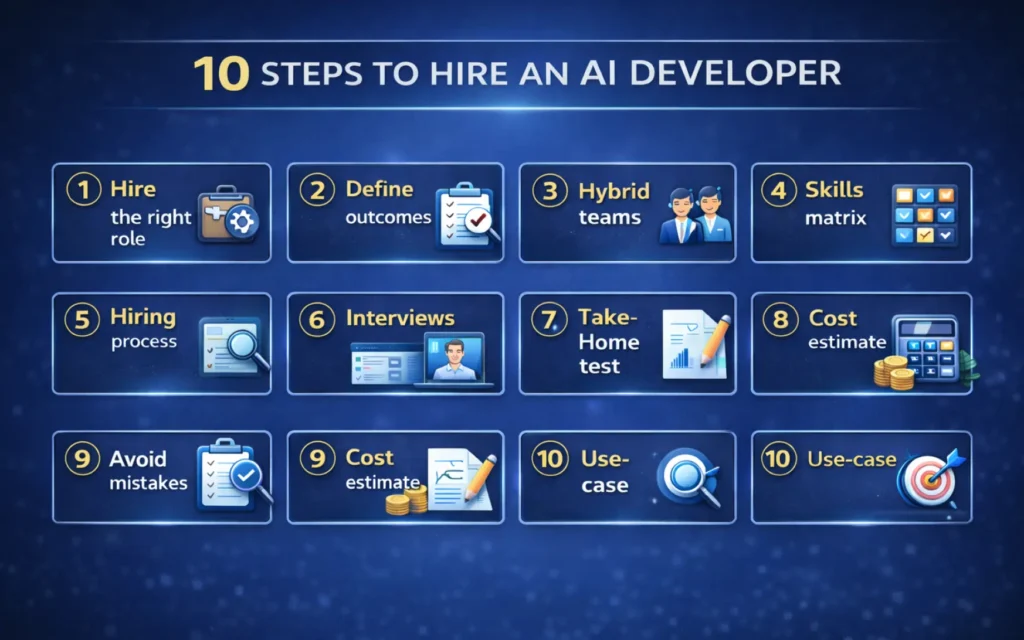
Step 8: Cost to hire AI engineers
Cost is not only rate—it’s scope + risk + operating cost:
- MVP vs production-grade AI systems
- Complexity: NLP/RAG, computer vision, predictive analytics
- Data readiness: messy training data increases effort
- Deployment requirements: monitoring, audit logs, privacy, rollback
- Cloud choice: AWS vs Google Cloud vs Azure, and infra patterns
Practical budgeting rule: Always estimate
- Build cost (one-time)
- Run cost (monthly)
- Maintenance cost (evaluation updates + drift + improvements)
Step 9: Common hiring mistakes
- Hiring someone who can’t solve complex problems outside notebooks
- No evaluation plan (endless debates)
- No clarity on market trends and realistic expectations
- Weak data governance (privacy + compliance)
- Shipping without monitoring (quality drops silently)
- Choosing “cool tech” over innovative solutions that move KPIs
Remember: human intelligence still matters—AI must support users, not confuse them.
Step 10: Use-case examples
- E commerce: recommendation systems to improve AOV and retention
- Customer behavior: churn and segmentation for targeted offers
- Supply chain management: predictive analytics for demand planning
- Computer vision: image recognition for quality inspection
- NLP: ticket routing, summarization, knowledge search, as well as AI agents, chatbots, and automation use cases
- Automation solutions: automate tasks across support and ops workflows with enterprise AI agents and governance controls
If you want a faster, safer route than trial-and-error hiring, WebbyCrown Solutions can help you define requirements, evaluate candidates using the scorecard, or deliver a dedicated team for AI development from MVP to production.