Summarize This Article With AI
The CRM market is growing fast as businesses put more emphasis on customer engagement, experience and operational efficiency. In 2024 the global CRM market was $80 billion, up 10.5% year on year. This is driven by the increasing adoption of CRM software that includes sales force automation, marketing automation, customer service management and emerging AI powered capabilities.
Global CRM Market Size and Forecast
The global CRM software market will grow significantly over the forecast period with estimates of $106.1 billion by 2029. That’s a 5.8% compound annual growth rate (CAGR) which shows CRM is an essential tool for businesses of all sizes to streamline operations, improve customer relationships and drive revenue growth.
CRM Market Size by Region
North America is the largest market for CRM solutions with over 40% of the global spend. Asia Pacific and EMEA are close behind with growing investments driven by digital transformation and customer centric strategies in these regions.
| Region | CRM Market Spend (USD Billion) | Percentage of Global Spend |
|---|---|---|
| North America (AMER) | 22.5 | 42.4% |
| Asia Pacific (APAC) | 17.8 | 33.5% |
| Europe, Middle East, Africa (EMEA) | 12.8 | 24.1% |
Leading CRM Software Vendors in 2026
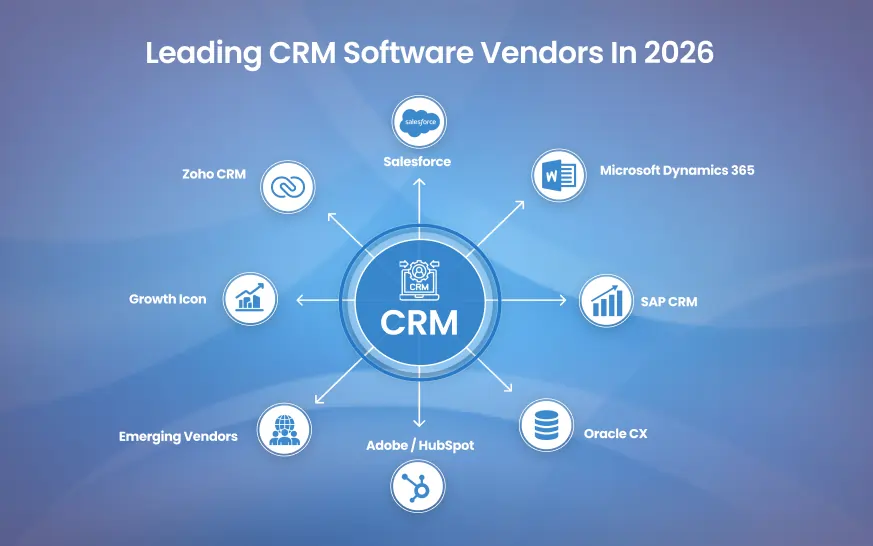
The CRM market is crowded with many vendors holding significant share. The top 10 vendors control over 50% of the market. Here’s an overview of the leading CRM vendors and their focus areas:
Top CRM Vendors by Market Share (Number of Customers)
| Vendor | Number of Customers | Market Position |
|---|---|---|
| Salesforce | 327,297 | Market leader |
| Zoho | 185,822 | Strong competitor |
| HubSpot | 179,843 | Growing mid-market player |
| Microsoft | Multiple products | Rising contender |
| Oracle | – | Established enterprise |
| SAP | – | Enterprise-focused |
| Zendesk | – | Customer service focus |
| Cox Automotive | – | Automotive CRM specialist |
| Genesys | – | Customer experience |
| ServiceNow | – | AI-powered workflows |
Salesforce
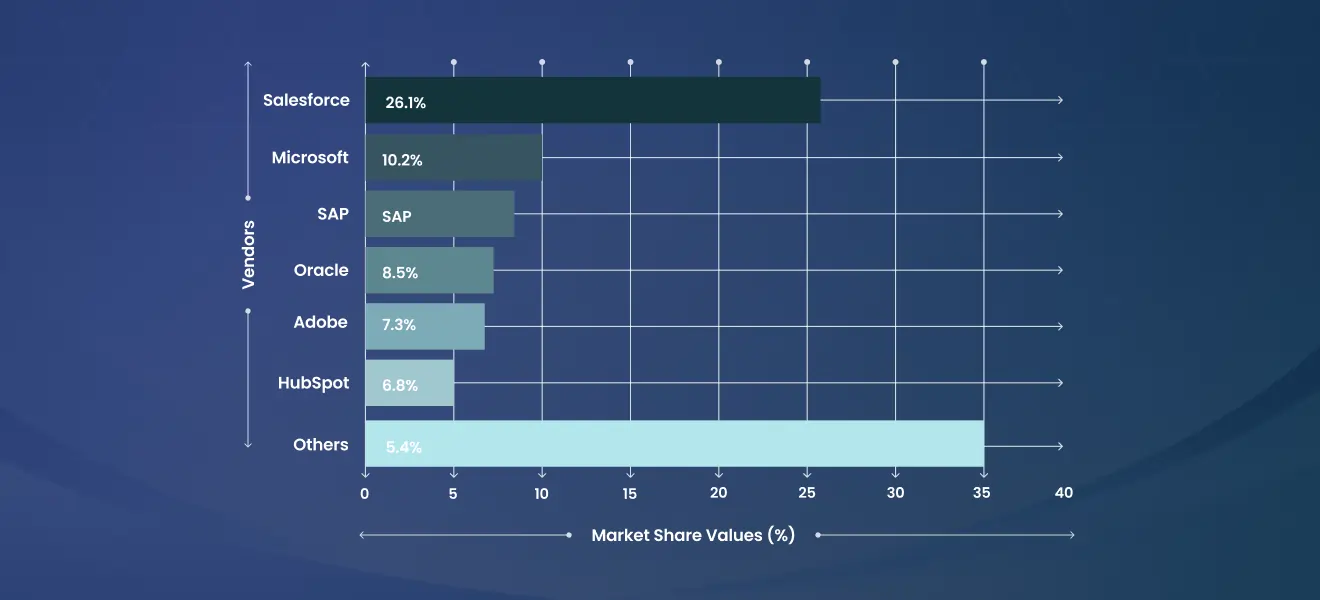
Salesforce still rules the CRM landscape with over 26% market share. Its suite of CRM apps – Sales Cloud, Service Cloud, Marketing Cloud, and Commerce Cloud – uses the Data Cloud to unify customer data across touchpoints. Salesforce’s Agentforce architecture introduces autonomous AI agents that automate sales and service processes, making it an AI-native CRM.
Adobe
Adobe brings agentic AI to its marketing and customer engagement platforms for real-time personalization and campaign orchestration. Built on Firefly generative models, Adobe’s low-code tools let marketing teams create intelligent workflows that optimize customer journeys and experiences.
HubSpot
HubSpot is scaling its Breeze AI architecture to have AI-powered agents for lead routing, ticket resolution and campaign coordination. Its no-code platform lets you deploy intelligent workflows fast, making HubSpot the CRM of choice for mid-market and growing businesses.
Microsoft Dynamics 365
Microsoft’s Dynamics 365 CRM integrates with Microsoft 365 and Power Platform, with AI-driven Copilot across sales, service and marketing. This makes Microsoft a strong contender in enterprise CRM.
Oracle
Oracle’s CRM portfolio has AI Agent Studio that lets you create context-aware digital agents that manage sales, marketing and service interactions. Oracle emphasizes cloud-native infrastructure and continuous learning to improve CRM execution and customer engagement.
SAP
SAP’s Customer Experience suite combines operational and experience data to deliver intelligent sales pipeline management, customer service automation and journey orchestration. Its no-code SAP Build platform lets business users design AI-driven agents that integrate CRM with ERP and commerce systems.
Zendesk
Zendesk is all about transforming customer service with generative AI and agentic automation. Its AI agents autonomously resolve inquiries and assist human agents, with low-code orchestration tools to streamline conversational workflows.
Cox Automotive
Cox Automotive specializes in automotive CRM and uses real-time data to enrich leads, monitor inventory and automate customer engagement. Its platform has intelligent agents to deliver data-driven marketing campaigns for the automotive industry.
Genesys
Genesys adds AI agents to its customer experience platform to personalize interactions across digital and voice channels. Its autonomous agents manage routing, resolution and summarization to deliver scalable, personalized service with minimal human intervention.
ServiceNow
ServiceNow’s CRM uses AI to automate issue triage, assignment and resolution across front and back-office systems. Its AI Agent Fabric brings together third-party and internal agents to create smarter, more seamless workflows for sales, service and field ops.
Artificial Intelligence and Machine Learning:
AI powered CRM apps and intelligent agents are becoming the norm, predictive analytics, personalization and workflow automation.
- Cloud: Cloud based CRM platforms offer scalability, flexibility and integration that modern businesses need.
- Mobile CRM: CRM solutions are providing mobile access, for remote workforces and on the go customer engagement.
- Industry Specific Solutions: Vendors are building verticalized CRM platforms for specific industries.
- Customer Experience Management: CRM systems are evolving to deliver seamless omnichannel customer experiences that drive loyalty and retention.
Buyer Landscape and Market Insights
According to recent stats, the global CRM market is expected to hit $53 billion in the next 12 months, 1% of total external IT spend and 3.7% of all software spend. 37% of customer relationship management software spend is from buyers in the US, China, Japan and the UK are the other big markets.
| Country | Spend (USD) | Number of Companies |
|---|---|---|
| United States | $19.6 billion | 4,663,758 |
| China | $7.5 billion | 196,311 |
| Japan | $3.1 billion | 164,175 |
| United Kingdom | $3.0 billion | 676,479 |
| Germany | $1.8 billion | 413,318 |
Companies with over 1,000 employees account for almost 74% of total CRM spend, so big companies matter. But small businesses are a big chunk of CRM users too, so CRM is adopted across all company sizes.
| Employee Range | Custom Dynamics 365 CRM Integrations for industry-specific workflows can help optimize your CRM spend (USD) by boosting efficiency and ROI. | Number of Companies |
|---|---|---|
| 10,000+ | $22.8 billion | 14,336 |
| 5,000-9,999 | $4.7 billion | 14,998 |
| 1,000-4,999 | $11.6 billion | 103,415 |
| 500-999 | $3.7 billion | 93,991 |
| 200-499 | $3.8 billion | 335,444 |
| 50-199 | $3.5 billion | 964,929 |
| 1-49 | $2.2 billion | 6,201,903 |
The industries spending the most on CRM software are Finance & Insurance; Public Administration; and Professional, Scientific, and Technical Services which together account for over 60% of the market spend. These industries have high average CRM spend per customer because CRM is critical to managing complex customer interactions and customer retention.
| Industry | CRM Spend (USD) | Number of Companies |
|---|---|---|
| Finance & Insurance | $18.3 billion | 348,629 |
| Public Administration | $7.9 billion | 193,482 |
| Professional, Scientific, and Technical Services | $7.0 billion | 1,373,604 |
| Manufacturing | $4.6 billion | 704,328 |
| Information | $3.5 billion | 449,938 |
Key Takeaways
- The CRM market is booming, $53 billion will be spent on CRM solutions globally next year.
- Salesforce, Zoho and HubSpot lead the market in terms of installations and customer base, have significant CRM market share.
- Big companies with over 1,000 employees dominate CRM spend, almost three-quarters of total spend.
- CRM is all the processes and strategies used to manage a company’s interactions and relationships with current and prospective customers, enabled by software that has machine learning and artificial intelligence.
- The CRM market is growing along with the market trends like AI powered sales intelligence, workflow automation and omnichannel customer experience management.
Additional Insights on CRM Market Dynamics
Besides the growth and technology, the CRM market is also influenced by evolving customer behavior and increasing importance of customer loyalty. Companies are using CRM platforms not only to manage contact management and sales pipelines but also to get deeper into customer conversations and preferences. This enables more personalized marketing and stronger customer retention.
Forecasting growth in CRM market involves analyzing the projected revenue from various industry verticals and company sizes. Data from grand view research shows that industries like Finance & Insurance and Professional Services are growing fast, contributing significantly to the overall CRM market growth. The dollar spent on CRM solutions by these industries reflects their commitment to customer experience management and operational efficiency through enterprise software
User adoption is key to CRM success, vendors are focusing on delivering user friendly interfaces and mobile CRM to support global teams. As companies become more distributed, the ability to coordinate customer interactions across multiple channels and geographies is crucial. Salesforce is setting the bar for AI and data cloud integration, moving the market forward.
In summary, the CRM landscape is changing, with new technologies and business priorities shaping the future of CRM software and platforms.
Conclusion
The CRM market is going to grow as companies want to leverage advanced CRM platforms to improve customer relationships, streamline operations and get competitive advantage. Leading CRM vendors are innovating fast, embedding AI and automation to meet evolving customer expectations and business needs. For software buyers and CRM users, understanding the landscape and vendor capabilities is key to choosing the right CRM solutions that align with strategic goals and deliver measurable value.