
Summarize This Article With AI
Online shopping is beginning to move from people clicking through every step to software agents helping complete the journey. An AI shopping agent can interpret a customer’s goal, compare suitable products, apply constraints, and-when the customer has granted permission-help execute parts of the purchase.
Quick Answer
Agentic commerce is a model of digital commerce in which AI agents can perform multi-step shopping or selling tasks on behalf of customers and merchants. Unlike a chatbot that only answers questions, a commerce agent may discover products, compare options, check availability, coordinate payment authorization, place an order, or support post-purchase actions within defined permissions. The merchant still needs accurate product data, secure integrations, clear policies, identity and payment controls, and human escalation paths.
Key Takeaways
- Agentic commerce is controlled delegation, not unrestricted autonomous buying.
- The customer journey may shift from page-by-page browsing to intent-based conversations and agent-to-system interactions.
- Machine-readable product data, real-time price and inventory, and explicit policies become discovery infrastructure.
- Payment authorization, identity, permissions, fraud controls, logs, and dispute handling are core requirements—not finishing touches.
- Most merchants should improve readiness and test bounded use cases before enabling high-risk autonomous actions.
What Is Agentic Commerce?
Agentic commerce is commerce conducted or assisted by goal-oriented AI agents that can plan and take approved actions across a transaction. A shopper may express an outcome—such as finding a carry-on suitcase under a budget that arrives before a trip—instead of manually opening product pages and filtering a catalog. The agent translates that intent into constraints, evaluates available choices, and proposes or completes the next permitted step.
On the merchant side, agents may help maintain catalog quality, answer product questions, assemble bundles, route orders, or resolve routine service requests. The defining feature is not the conversational interface. It is the ability to move through a workflow, use tools or APIs, and act within policy and authorization boundaries.
That distinction matters. A product search box returns matching items. A recommendation engine ranks likely choices. A chatbot explains information. An agent can combine these capabilities, decide what step is needed next, and invoke an allowed action. For a fuller distinction, see AI agent vs chatbot vs automation.
What Agentic Commerce Does Not Mean
- Every AI-generated recommendation is not agentic commerce. The system must be able to pursue a goal across multiple steps or actions.
- Autonomy does not remove customer consent. Spending limits, approval checkpoints, merchant policies, and legal obligations still apply.
- Websites and apps do not disappear overnight. They remain important for brand experience, product evaluation, customer service, account management, and fallback journeys.
- An agent should not invent product facts, availability, prices, delivery dates, or return terms. Those must come from merchant-controlled sources.
- A protocol does not by itself solve trust, attribution, fraud, privacy, or operational ownership.
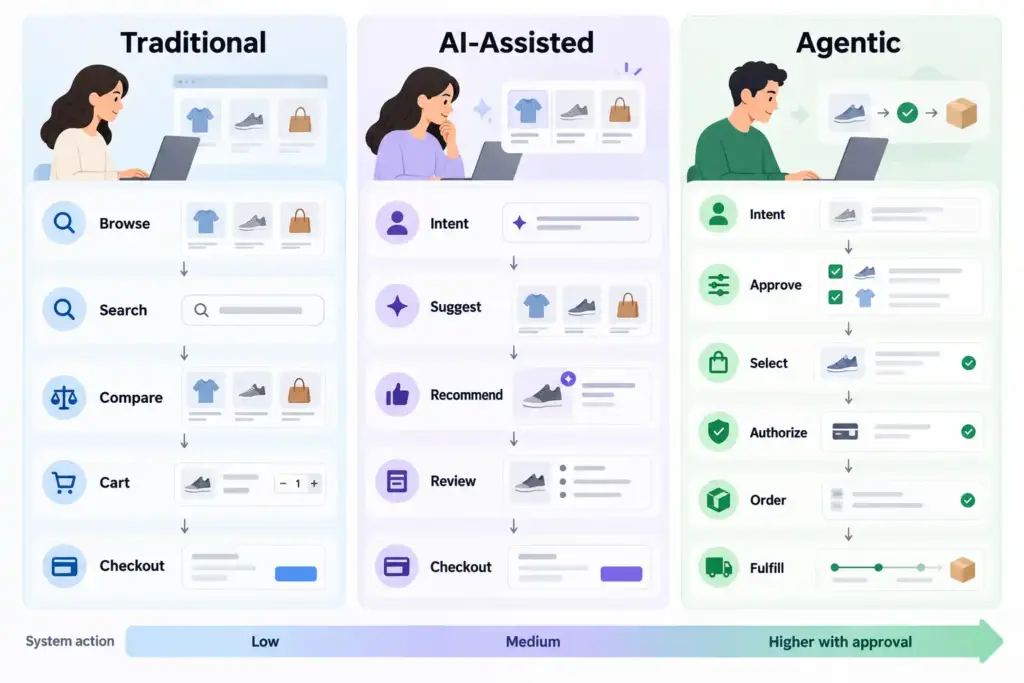
Traditional Ecommerce vs AI-Assisted Shopping vs Agentic Commerce
| Dimension | Traditional ecommerce | AI-assisted shopping | Agentic commerce |
|---|---|---|---|
| Primary interaction | Customer navigates pages, filters, cart, and checkout | AI answers, summarizes, or recommends | Agent pursues a goal and takes approved actions |
| Customer input | Keywords, clicks, filters | Questions and preferences | Outcome, constraints, permissions, and approval rules |
| System role | Present information and process direct commands | Support a human-led journey | Coordinate steps across discovery, selection, transaction, and service |
| Action level | User initiates each meaningful action | AI suggests; user continues the flow | Agent may execute bounded actions with confirmation or delegated authority |
| Merchant requirement | Usable storefront and checkout | Quality content and connected support data | Structured data, action APIs, identity, authorization, observability, and exception handling |
| Main risk | Usability or checkout friction | Incorrect or biased advice | Incorrect action, unauthorized purchase, fraud, privacy leakage, or unclear liability |
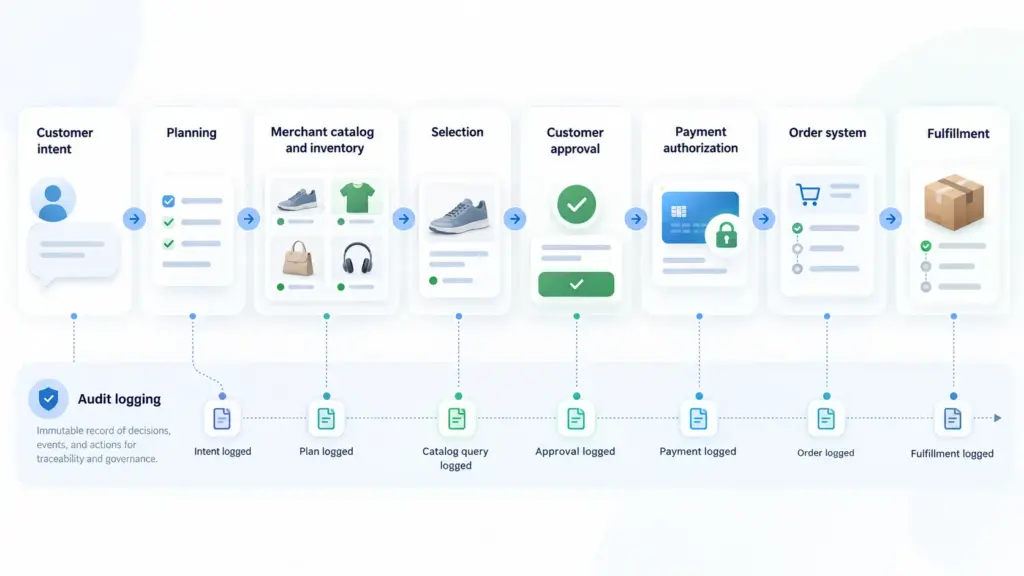
How an Agentic Commerce Transaction Works
- Intent capture. The customer states a goal and constraints: budget, size, compatibility, delivery deadline, preferred brands, sustainability requirements, or items to avoid.
- Planning. The agent breaks the request into tasks such as finding products, verifying specifications, comparing total cost, and checking delivery feasibility.
- Discovery. The agent queries catalogs, marketplaces, merchant feeds, or approved services. Product data must be structured enough for the system to interpret consistently.
- Evaluation. Options are ranked against the customer’s constraints. A trustworthy flow should distinguish merchant facts from inferred preferences or sponsored placement.
- Selection and approval. The agent recommends an item or bundle and explains material trade-offs. The customer confirms when the action exceeds a previously granted permission.
- Transaction. The agent coordinates identity, shipping details, taxes, inventory reservation, payment authorization, and order creation through secure interfaces.
- Fulfillment. The merchant’s existing systems handle picking, shipping, delivery, or digital access while status is returned to the agent and customer.
- Post-purchase service. Within policy, an agent may track an order, request a return, reschedule delivery, or escalate an exception to a person.
Not every implementation needs all eight stages. A low-risk pilot may stop after comparison and require the customer to finish checkout. Greater autonomy should be earned through reliable data, evaluation, permissions, and incident controls.
The Agents and Systems Behind the Experience
Shopper agent
The shopper agent represents the customer’s stated goal and permissions. It remembers relevant constraints, compares options, asks when information is missing, and avoids acting beyond the approved scope. A useful agent should also show why a choice fits instead of presenting an unexplained answer.
Merchant agent
A merchant-side agent exposes accurate offers and completes authorized commerce tasks. It may answer product questions, generate a valid cart, check stock, apply eligible promotions, create an order, or route a service request. It must follow the merchant’s source data and business rules.
Identity, payment, and fulfillment services
Specialized systems verify who is acting, what they are allowed to do, how payment is authorized, and how an order is fulfilled. These systems should provide auditable events and idempotent operations so a retry does not create duplicate charges or orders.
The broader pattern is consistent with other AI agents in business: useful autonomy depends on clear tools, boundaries, ownership, and measurement.
Protocols and Interoperability
Agentic commerce needs a reliable way for an agent to understand what a merchant sells and which actions are available. Emerging commerce protocols and platform integrations aim to standardize parts of this exchange: catalog representation, product discovery, cart creation, checkout steps, payment handoff, order status, and policy information.
OpenAI’s Agentic Commerce Protocol documentation, for example, describes structured catalog data and commerce integrations for connecting merchants with AI-driven shopping experiences. Google has also described an agentic-commerce ecosystem built around interoperable agents and commerce services. These initiatives are meaningful signals, but merchants should not assume one protocol is universally adopted or that all platforms expose identical capabilities.
A practical architecture therefore keeps the merchant’s catalog, pricing, inventory, policies, and order systems authoritative. Protocol adapters should translate to those systems rather than becoming an uncontrolled second source of truth. Design for versioning, authentication, rate limits, retries, and fallbacks because the ecosystem will continue to change.
Merchants should also define a channel contract for agent traffic. It should specify which product fields are required, how recently price and inventory must have been checked, which actions are available to anonymous and authenticated users, when customer confirmation is required, and what error the agent receives when a request cannot be completed safely. The contract should also identify the owner of each data source and the response-time target for corrections. This turns an experimental integration into an operational capability that can be tested, monitored, and supported across more than one agent platform.
How AI Shopping Agents Change Ecommerce Discovery
Traditional ecommerce optimization focuses heavily on pages: category structure, product titles, copy, internal links, structured data, images, speed, and conversion. Those assets still matter, but agents create an additional audience—machines that need precise, current, attributable facts.
For merchants, discoverability increasingly depends on whether a system can reliably answer questions such as: Is this item compatible? Which variant is available? What is the total delivered price? Can it arrive before a deadline? What are the return restrictions? A beautifully written page cannot compensate for stale inventory or contradictory policy data.
- Use stable product identifiers and consistent variant relationships.
- Keep price, availability, delivery estimates, and promotion eligibility current.
- Separate factual attributes from marketing language.
- Make warranty, shipping, returns, cancellation, and subscription terms explicit.
- Provide source URLs or records so claims can be traced and corrected.
- Preserve high-quality product media and accessible descriptions for human review.
This is not a reason to produce hundreds of near-duplicate pages for agentic-commerce queries. A smaller set of useful, original resources supported by accurate commerce data is more durable than scaled content created only to capture variations of a keyword.
What It Means for Shopify, WooCommerce, Headless, and Custom Stores
The platform matters less than the quality of the interfaces around it. An agent needs reliable access to the same facts and actions that power the storefront. Merchants should identify the authoritative system for catalog, price, inventory, customer identity, promotions, tax, shipping, payment, orders, returns, and support.
Shopify and other hosted platforms
Hosted platforms may provide faster access to catalog, checkout, and order capabilities through supported APIs and ecosystem integrations. The merchant still needs to review app permissions, data sharing, policy enforcement, attribution, and what happens when an external agent sends an incomplete or conflicting request.
WooCommerce and composable stacks
Open and composable systems provide flexibility, but plugin conflicts, custom fields, caching, and inconsistent business logic can make the agent-facing layer fragile. Normalize the commerce model before exposing actions, and test against real variants, discounts, taxes, shipping rules, and refunds.
Headless and custom commerce
A headless architecture can make agent integration cleaner because commerce capabilities already exist behind APIs. It also increases the importance of contract design, observability, and consistent behavior across channels. The same product and policy should not produce different answers on the website and through an agent. Merchants reviewing this path can also see how Next.js and Shopify support composable storefront architecture.
B2B commerce
B2B agentic commerce may involve negotiated pricing, approval chains, purchase-order rules, account-specific catalogs, credit limits, and repeat replenishment. The opportunity is substantial, but permissions are more complex than consumer checkout. Platform capabilities should be evaluated against these workflows; a comparison of B2B ecommerce platforms can help frame the underlying requirements.
Payments, Permission, and Trust
The most important boundary in agentic commerce is the point where advice becomes commitment. Before an agent spends money or changes an order, the system needs an unambiguous answer to four questions: Who is the customer? Which agent is acting? What exactly is it allowed to do? What evidence will prove that authorization later?
- Use explicit confirmation for new merchants, unusual amounts, restricted goods, subscriptions, or policy exceptions.
- Support scoped authority such as a maximum spend, approved category, time window, delivery address, or named merchant.
- Tokenize payment credentials and minimize the data available to agents and integrations.
- Log the intent, displayed offer, approval, action, response, and any retry or override.
- Require step-up authentication when risk changes during the journey.
- Provide a clear receipt, cancellation path, dispute process, and human support route.
Trust also depends on transparency. Customers should know when results are sponsored, when a recommendation is limited to participating merchants, what information was used, and whether an agent can receive an incentive. Without those disclosures, convenience can undermine confidence.
Risks Merchants Need to Control
| Risk | How it appears | Practical control |
|---|---|---|
| Stale or conflicting data | Wrong price, inventory, compatibility, or delivery promise | Authoritative sources, freshness timestamps, validation, and transaction-time rechecks |
| Unauthorized action | Purchase, cancellation, or return exceeds customer intent | Scoped permissions, confirmation thresholds, strong identity, and tamper-evident logs |
| Prompt or tool manipulation | Malicious content attempts to redirect the agent or expose data | Treat external content as untrusted, isolate tools, allowlist actions, and test adversarial cases |
| Fraud and account takeover | An attacker uses an agent to scale abuse | Risk scoring, velocity limits, step-up authentication, and payment controls |
| Privacy leakage | Personal or order data is shared with unnecessary parties | Data minimization, purpose limits, consent, retention rules, and vendor review |
| Biased or opaque ranking | Customers cannot tell why products are shown | Explain material criteria and disclose sponsorship or commercial relationships |
| Duplicate or partial transactions | Retries create two orders or payment succeeds without an order | Idempotency keys, atomic workflows, reconciliation, and recovery procedures |
| Unclear responsibility | Customer, agent provider, merchant, and payment provider dispute the failure | Contracts, evidence, customer remedies, escalation ownership, and incident playbooks |
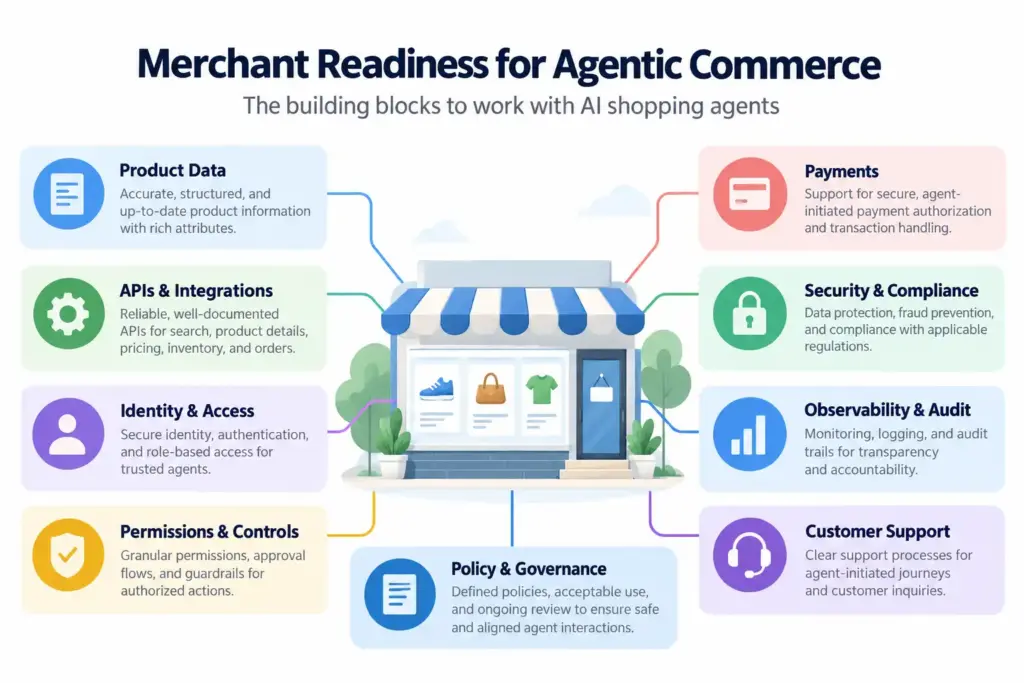
Agentic Commerce Readiness Checklist
- Product data has stable IDs, complete attributes, accurate variants, and documented ownership.
- Price, promotions, inventory, tax, shipping, and delivery estimates can be checked at transaction time.
- Policies are explicit enough for software to apply without guessing.
- APIs expose only necessary actions and enforce authentication, authorization, rate limits, and idempotency.
- The checkout flow can separate recommendation, customer approval, payment authorization, and order creation.
- Logs connect an agent request to customer consent, system actions, and the final order.
- High-risk actions have human review or step-up confirmation.
- Teams can detect failures, reconcile orders and payments, and disable an integration quickly.
- Customers can see material terms, correct mistakes, cancel when permitted, and reach a person.
- Analytics can distinguish agent-originated discovery, assisted conversion, completed orders, returns, disputes, and margin.
If the checklist reveals gaps across several systems, scope the data model, interfaces, and control requirements before choosing a vendor. A technical assessment tied to ecommerce development services should begin with these operational requirements, not with a promise to add an AI shopping widget.
Ready Now, Prepare Next, or Wait?
| Position | Merchant profile | Recommended next step |
|---|---|---|
| Ready now | Accurate real-time commerce data, mature APIs, clear permissions, strong fraud controls, high transaction volume, and an owned test workflow | Pilot a narrow, reversible journey such as product comparison, cart creation, or authenticated reorder with approval gates |
| Prepare next | Reliable storefront but fragmented data, manual policy interpretation, limited observability, or inconsistent integrations | Fix catalog and policy data, instrument APIs, define permission rules, and create an evaluation set before external agent actions |
| Wait | Frequent stock or price errors, unclear system ownership, weak identity controls, high-risk products, or no incident-response capability | Stabilize core commerce operations first; use non-transactional assistance only where facts can be verified |
How to Pilot and Measure Agentic Commerce
- Task completion: Did the agent achieve the stated goal without hidden manual repair?
- Grounded accuracy: Were product, price, policy, and delivery claims supported by current merchant data?
- Conversion quality: Did assisted journeys produce completed, profitable orders rather than only clicks or carts?
- Unit economics: What was the contribution margin after returns, discounts, agent costs, support, and payment fees?
- Customer control: How often did users correct, override, abandon, or dispute an action?
- Operational reliability: What were the failure, retry, duplicate, escalation, and reconciliation rates?
- Incrementality: Did the agent create value beyond customers who would have purchased anyway?
Do not evaluate success only by agent-originated revenue. An aggressive agent can lift short-term orders while increasing returns, complaints, discount leakage, or support cost. Use a holdout, phased rollout, or matched comparison where practical, and review results by product category and risk level.
The Near-Term Outlook
Agentic commerce is likely to develop unevenly. Product research, comparison, and cart creation are easier to deploy than broad authority to spend, subscribe, negotiate, or return. Merchants with clean data and well-governed APIs will be able to test new channels faster; merchants with fragmented systems may discover that the AI layer exposes problems that already existed.
The durable strategy is not to predict which interface will dominate. It is to make commerce capabilities accurate, permissioned, observable, and portable. That work supports websites, apps, marketplaces, human service teams, and future agent channels at the same time.
Frequently Asked Questions
What is agentic commerce in simple terms?
Agentic commerce is shopping or selling supported by AI agents that can pursue a goal across multiple steps and take approved actions. The customer may state the desired outcome while the agent handles discovery, comparison, and selected transaction tasks within clear limits.
How is agentic commerce different from conversational commerce?
Conversational commerce uses chat or messaging as the interface. It may only answer questions. Agentic commerce adds planning and action: an agent can use tools, coordinate systems, and complete permitted workflow steps. A conversational interface can be part of agentic commerce, but it is not sufficient by itself.
Are AI shopping agents the same as recommendation engines?
No. A recommendation engine ranks products based on signals. An AI shopping agent can interpret a goal, gather missing information, compare options, explain trade-offs, and potentially perform actions such as creating a cart or placing an authorized order.
Can an AI agent buy products without human approval?
Technically, an agent may act under previously delegated authority, but the implementation should use scoped permissions and confirmation thresholds. New merchants, unusual amounts, subscriptions, restricted products, or policy exceptions should normally require explicit approval or stronger authentication.
What product data do commerce agents need?
They need stable product and variant IDs, factual attributes, compatibility information, price, inventory, delivery estimates, promotions, media, and clear shipping, return, warranty, and cancellation terms. Data should be current, structured, and traceable to an authoritative merchant source.
What is an agentic commerce protocol?
It is a technical specification or integration pattern that helps agents and commerce systems exchange catalog information and execute supported actions. Protocols can reduce custom work, but merchants still need identity, authorization, security, policy enforcement, monitoring, and fallback handling.
Will agentic commerce replace ecommerce websites?
Not in the foreseeable future. Websites remain important for brand experience, visual evaluation, content, account management, support, and fallback. Agent channels may change how some products are discovered and purchased, so merchants should support both human-friendly experiences and reliable machine-readable commerce data.
What are the biggest risks of agentic commerce?
Major risks include incorrect product claims, unauthorized actions, fraud, account takeover, privacy leakage, manipulated agent behavior, biased ranking, duplicate transactions, and unclear responsibility for failures. Controls should be designed before transaction authority is granted.
How should a merchant start with agentic commerce?
Start by cleaning product and policy data, mapping authoritative systems, defining agent permissions, and selecting a bounded use case. Pilot discovery, comparison, cart creation, or authenticated reorder before high-risk autonomous purchasing, and measure quality, incrementality, operational failures, and customer overrides.
How can merchants measure agentic commerce performance?
Track successful task completion, factual accuracy, profitable incremental conversion, cost per completed journey, customer corrections, approval and abandonment rates, returns, disputes, fraud, retries, duplicate transactions, and escalation. Revenue alone does not show whether the channel creates durable value.
Conclusion
Agentic commerce changes ecommerce from a sequence of customer clicks into a delegated workflow. Its value is convenience: an agent can turn intent into comparison, selection, and action. Its difficulty is trust: every step must rely on current data, defined permission, secure integration, and evidence that the resulting transaction reflects the customer’s intent.
For most merchants, the right next move is neither to ignore the shift nor to grant broad autonomy immediately. Build the foundations, test one bounded journey, measure the complete economics and failure modes, and expand only when the system has earned more responsibility.